

Assessment of Radiation Background Levels Induced by Dust Storms in Iraq Using the FS-600 Radiation Detector
تقييم مستويات الخلفية الإشعاعية الناجمة عن العواصف الغبارية في العراق باستخدام كاشف الإشعاع FS-600
Zainab Abdulraheem1 , Majied G.Al-Gharabi 2, Haneen W Khadum Al- Khalidi3
1 Applied Biotechnology Department,College of Biotechnology, AL-Qasim Green University, Babylon, Iraq
2 Department of physics,College of Education,University of Al-Qadisiyah,Diwaniyah,Iraq
3 Department of Mathematic, College of Education, AL-Qasim Green University, Babylon, Iraq
E: haneen.waheed@edu.uoqasim.edu.iq
DOI: https://doi.org/10.53796/hnsj77/9
Arabic Scientific Research Identifier: https://arsri.org/10000/77/9
Volume (7) Issue (7). Pages: 143 - 150
Received at: 2026-04-01 | Accepted at: 2026-05-01 | Published at: 2026-07-01
Abstract: Dust storms are common environmental phenomena in Iraq and may affect variations in environmental radiation levels by dispersing naturally present radioactive materials. This study aimed to determine the radiation background levels associated with dust storm samples collected from various locations in Iraq using the FS-600 Radiation Detector. Twenty dust storm samples were analyzed, and the absorbed dose rate (D), annual effective dose (AED), and excess lifetime cancer risk (ELCR) were calculated to evaluate the potential radiological impacts. The results demonstrated that the absorbed dose rate ranged from 0.0110 to 0.0358 μSv/h, with an average of 0.0260 μSv/h. The annual effective dosage varied from 0.0963 to 0.3142 mSv/y, with a mean of 0.2277 mSv/y, whereas the ELCR values ranged from 0.371 × 10⁻³ to 1.210 × 10⁻³, averaging 0.877 × 10⁻³. Statistical study, including descriptive statistics and graphical methods, demonstrated a highly consistent distribution of radiation levels among the analyzed samples. All evaluated radiation metrics were much below the internationally defined limits imposed by UNSCEAR and NCRP.. The results demonstrate that dust storm samples in the research area do not present any substantial radiological risk to the environment or public health.
Keywords: Dust storms, background radiation, FS-600 radiation detector, annual effective dose (AED), excess lifetime cancer risk (ELCR), Iraq.
المستخلص: تُعدّ العواصف الغبارية من الظواهر البيئية الشائعة في العراق، وقد تؤثر في تباين مستويات الإشعاع البيئي من خلال تشتيت المواد المشعة الموجودة طبيعيًا. هدفت هذه الدراسة إلى تحديد مستويات الخلفية الإشعاعية المرتبطة بعينات العواصف الغبارية التي جُمعت من مواقع مختلفة في العراق باستخدام كاشف الإشعاع FS-600. تم تحليل عشرين عينة من غبار العواصف، وحُسب كلٌّ من معدل الجرعة الممتصة (D)، والجرعة الفعالة السنوية (AED)، وخطر الإصابة بالسرطان الزائد مدى الحياة (ELCR)، وذلك لتقييم التأثيرات الإشعاعية المحتملة. أظهرت النتائج أن معدل الجرعة الممتصة تراوح بين 0.0110 و0.0358 ميكروسيفرت/ساعة، بمتوسط بلغ 0.0260 ميكروسيفرت/ساعة. كما تراوحت الجرعة الفعالة السنوية بين 0.0963 و0.3142 ملي سيفرت/سنة، بمتوسط بلغ 0.2277 ملي سيفرت/سنة، في حين تراوحت قيم خطر الإصابة بالسرطان الزائد مدى الحياة بين 0.371 × 10⁻³ و1.210 × 10⁻³، بمتوسط بلغ 0.877 × 10⁻³. وأوضحت الدراسة الإحصائية، التي شملت الإحصاءات الوصفية والطرائق البيانية، وجود توزيع متسق بدرجة عالية لمستويات الإشعاع بين العينات المحللة. وكانت جميع المقاييس الإشعاعية التي تم تقييمها أقل بكثير من الحدود الدولية المحددة من قبل لجنة الأمم المتحدة العلمية المعنية بآثار الإشعاع الذري (UNSCEAR) والمجلس الوطني للحماية من الإشعاع والقياسات (NCRP). وتُبيّن النتائج أن عينات العواصف الغبارية في منطقة الدراسة لا تمثل أي خطر إشعاعي جوهري على البيئة أو الصحة العامة.
الكلمات المفتاحية: العواصف الغبارية، الخلفية الإشعاعية، كاشف الإشعاع FS-600، الجرعة الفعالة السنوية (AED)، خطر الإصابة بالسرطان الزائد مدى الحياة (ELCR)، العراق.
1: Introduction
Dust storms are one of the most important environmental phenomena in arid and semi-arid regions of the world, especially in the Middle East . Iraq is often affected by severe dust storms because of its climatic conditions, land degradation, desertification and reduced vegetation cover [1]. Such storms can transport large amounts of suspended particulate matter over large distances and carry naturally occurring radioactive materials (NORMs) from soil, rocks and other geological formations [2].Cosmic rays, terrestrial radionuclides and internal radioactive elements in living organisms are sources of the natural background radiation which is always present in the environment [3]. The local radiation background levels can be influenced by dust storms and other changes in environmental conditions due to the change in the concentration of dust particles in the air with attached radionuclides [4]. Thus, it is important to measure the radiation level during dust storm events to understand the possible radiological impacts on human health and the environment.In recent decades, the frequency of dust storms has increased in Iraq, raising concerns about their environmental and public health consequences [5]. Several studies have shown that the dust particles can contain measurable concentrations of radionuclides such as uranium-238, thorium-232, and potassium-40, which can cause external and internal radiation exposure via inhalation or ground deposition [6]. Therefore, the radiation background levels associated to the dust storms have to be monitored to evaluate any possible increase of the radiological risk.Radiation detection instruments are an essential part of environmental monitoring programs. Among these instruments, the FS-600 Radiation Detector is often used to measure ambient gamma radiation because of its portability, sensitivity and its ability to provide real-time radiation measurements under different environmental conditions [7]. Such detectors enable researchers to study temporal variations of background radiation levels and their correlation with atmospheric dust concentrations.The current study has been conducted to determine the radiation background levels related to dust storms in Iraq by using FS-600 Radiation Detector. This work tried to evaluate the impact of airborne dust on the environmental radiation levels by comparing the recorded radiation during the dust storm events with those under normal atmospheric conditions, and to provide scientific data that may help the assessment of environmental radiation and protect public health strategies in Iraq [8].
2: Practical Work and Radiation Measurements
The experimental work of this study was performed to investigate the effect of dust storms on the environmental radiation background levels in Iraq using FS-600 Radiation Detector. Dust and soil samples were collected from different sites effected by dust storm activity (twenty samples). The sites were selected as a representative of the areas of different environmental and geographical characteristics to collect representative data of radiation levels related to airborne dust particles [8].After collection, the samples were transported to the laboratory, air-dried, homogenized and sieved to remove coarse impurities and organic residues. Each sample was then put into a transparent acrylic measurement chamber designed to isolate the sample from any other environmental influences and to maintain stable measurement conditions. This procedure ensured the reliability and reproducibility of the registered radiation data [9].Radiation measurements were performed using the FS-600 Radiation Detector, a portable digital instrument that contains a Geiger–Müller (GM) detector tube for real-time measurement of ambient gamma radiation. The device shows dose rate values directly in microsieverts per hour (μSv/h). It is often used for environmental radiation surveys because of its high sensitivity, portability and fast response. The instrument was checked and calibrated as recommended by the manufacturer before data collection and background radiation levels were measured and recorded for reference comparison [10].To eliminate geometrical variations that may affect the accuracy of the measurements, the detector was kept at a constant fixed distance from each sample container. Readings were taken over a uniform counting period and several readings were taken on each sample. The arithmetic mean of these readings was calculated to increase the precision of the obtained results and decrease the statistical uncertainty. All the measurements were systematically recorded and compiled in tabular form for further analysis.The statistical analysis of the obtained data made it possible to determine the minimum, the maximum and the average values of the radiation background and the standard deviation of the radiation background. The measured radiation levels of dust storm samples were compared with normal environmental background values to find out the role of suspended dust particles in variations of ambient radiation levels. The data is important for the radiological characteristics of dust storms in Iraq and it contributes to the environmental monitoring programs that are designed to assess the potential radiation exposure risks and protect public health [11].
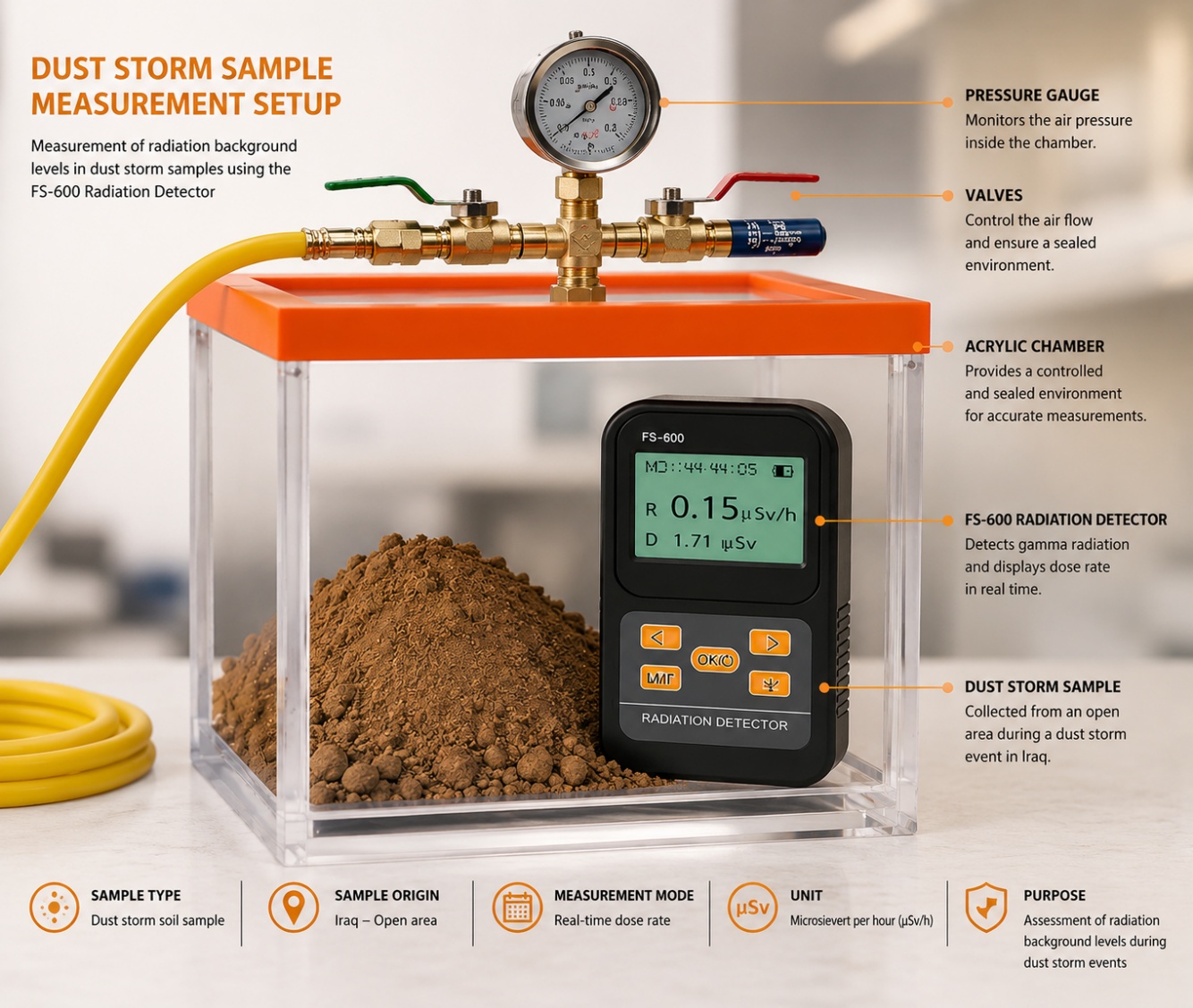
Figure 1. Experimental Arrangement Used for the Determination of Radiation Background Levels Resulting from Dust Storms in Iraq Using the FS-600 Radiation Detector
3: Calculation of AED and ELCR
The radiation dose rate (D) was measured directly for each sample with the FS-600 Radiation Detector and displayed on the LCD screen in microsieverts per hour (μSv/h). The data recorded reflect the radiation exposure rate at the time of the evaluation. The measured dose rate was converted to the Annual Effective Dose (AED) in order to estimate an annual radiation dose to an individual. The measured dose rate was multiplied by a conversion factor of 8.766 for continuous exposure over the year to obtain millisieverts per year (mSv/y) [10]. For a measured radiation dose rate of 0.12 μSv/h, the effective dosage of a year was estimated to be approximately 1.05 mSv/year. Following determination of the AED for each sample, the Excess Lifetime Cancer Risk (ELCR) was calculated to evaluate the potential probability of developing cancer from long-term radiation exposure.. The computation was predicated on the annual effective dosage, an average human lifespan of 70 years, and a cancer risk conversion factor of 0.05 Sv⁻¹. Consequently, the annual effective dose was multiplied by these two parameters to calculate the lifetime cancer risk linked to the measured radiation levels [13-12].
4: Results and Discussion
In Table 1, the obtained absorbed dose rate (D), annual effective dose (AED) and excess lifetime cancer risk (ELCR) for the twenty dust storm samples collected from different locations in Iraq are presented. The measured values of dose rate were ranged from 0.0110 to 0.0358 μSv/h with an average value of 0.0260 μSv/h. These values are also much lower than the internationally recommended reference level of 0.247 μSv/h reported by the international radiation protection organizations, which indicates that the investigated dust storm samples do not contribute significantly to the external gamma radiation exposure [13,14].
Table 1. Absorbed dose rate (D), annual effective dose (AED), and excess lifetime cancer risk (ELCR) for dust storm samples collected from the study area in Iraq.
| sample Code | D (μSv/h) | AED (mSv/y) | ELCR ×10⁻³ |
| 1 | 0.0229 | 0.2009 | 0.773 |
| 2 | 0.0239 | 0.2098 | 0.808 |
| 3 | 0.0204 | 0.1788 | 0.688 |
| 4 | 0.0239 | 0.2091 | 0.805 |
| 5 | 0.0283 | 0.2476 | 0.953 |
| 6 | 0.0284 | 0.2486 | 0.957 |
| 7 | 0.0266 | 0.2334 | 0.899 |
| 8 | 0.0326 | 0.2857 | 1.100 |
| 9 | 0.0295 | 0.2585 | 0.995 |
| 10 | 0.0289 | 0.2534 | 0.976 |
| 11 | 0.0298 | 0.2616 | 1.007 |
| 12 | 0.0221 | 0.1939 | 0.747 |
| 13 | 0.0242 | 0.2124 | 0.818 |
| 14 | 0.0332 | 0.2910 | 1.120 |
| 15 | 0.0210 | 0.1843 | 0.710 |
| 16 | 0.0110 | 0.0963 | 0.371 |
| 17 | 0.0358 | 0.3142 | 1.210 |
| 18 | 0.0206 | 0.1807 | 0.696 |
| 19 | 0.0260 | 0.2275 | 0.876 |
| 20 | 0.0304 | 0.2665 | 1.026 |
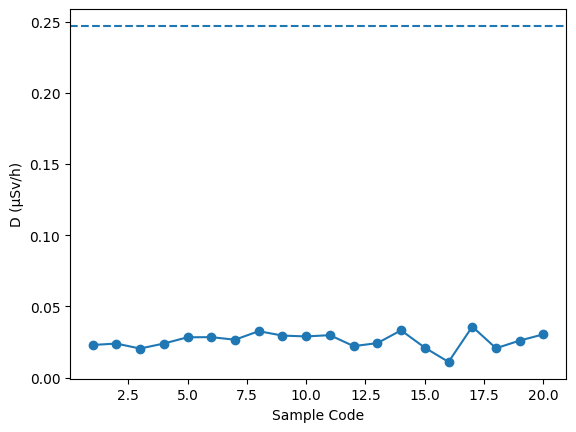
Figure 2. Comparison of the absorbed dose rate (D) of dust storm samples with the internationally recommended limit.
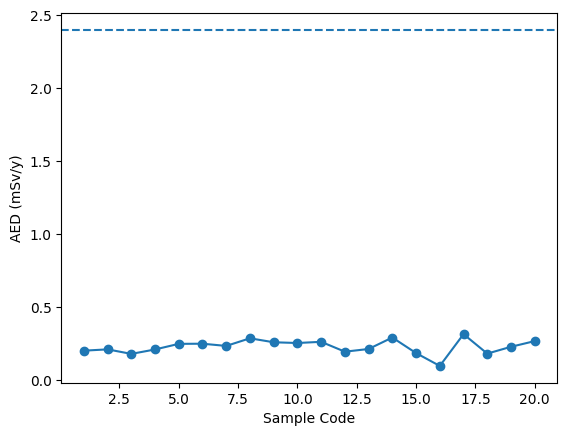 Figure 2 indicates that all measured dose rate values were much lower than the recommended safety limit. Sample 17 was found to have the maximal dose rate (0.0358 μSv/h), followed by Samples 14 and 8, while Sample 16 had the minimal dose rate (0.0110 μSv/h). These variations can be attributed to differences in the mineralogical composition of dust particles and the concentrations of naturally occurring radioactive materials such as uranium-238, thorium-232 and potassium-40 transported during dust storm events [15]. But all values are within the range of natural background radiation and do not indicate any significant radiological concern.The AED values showed a similar trend since the AED is directly proportional to the absorbed dose rate. The calculated values of AED varied between 0.0963 and 0.3142 mSv/y with an average value of 0.2277 mSv/y. These values are much lower than the average global annual effective dose of 2.4 mSv/y suggested by UNSCEAR and NCRP [14].
Figure 3. Annual effective dose (AED) of dust storm samples compared to the global reference level.
As shown in Figure 3, all AED values were significantly below the international reference level. This confirms that the calculated annual dose due to the analysed dust storm samples is relatively low and does not pose an additional health risk to the population living in the study area [16].The calculated Excess Lifetime Cancer Risk (ELCR) values ranged from 0.371 × 10⁻³ to 1.210 × 10⁻³ with an average value of about 0.877 × 10⁻³. Values were generally low and comparable to those reported in similar studies on environmental radioactivity worldwide [17] with slight differences among the samples.
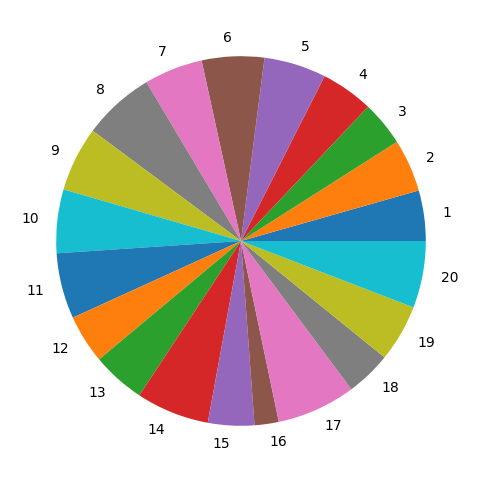
Figure 4. Contribution of the excess lifetime cancer risk (ELCR) values in dust storm samples in terms of relative percentage.
Figure 4 shows the percentage contribution of each sample to the total ELCR. Most samples show almost identical percentages, reflecting the quite homogeneous radiological characteristics of the dust storm deposits studied. Samples 17, 14 and 8 had a slightly higher contribution due to their relatively higher radiation levels. Sample 16 had the lowest contribution due to its lowest absorbed dose rate and annual effective dose.To further evaluate the statistical properties of the measured radiation levels, a box and whisker plot was generated from the absorbed dose rate data.
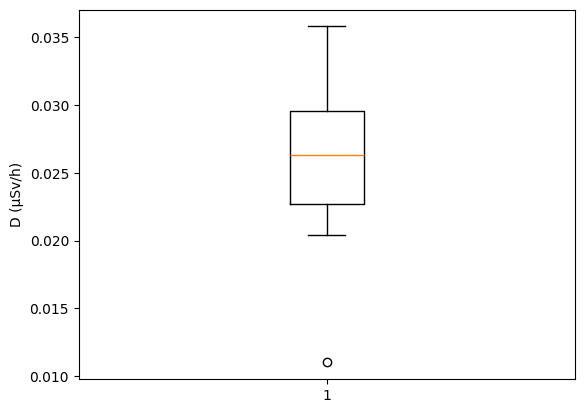
Figure 5. Box plot distribution of absorbed dose rate (D) for dust storm samples.
Figure 5 shows the box plot indicating that the majority of the dose rate values are clustered within a relatively narrow range around the median value. The low variability and good homogeneity of the samples studied is shown by the small interquartile range. This distribution shows that natural radionuclides are evenly distributed in dust storm samples obtained from the study area [18].A histogram of the absorbed dose rate values was constructed to study the frequency distribution of the radiation levels.
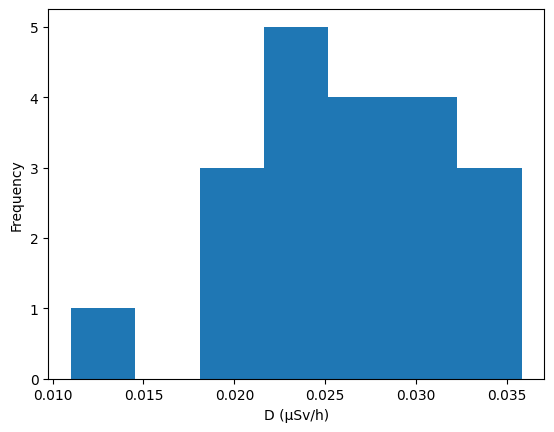
Figure 6. Frequency distribution histogram of dust storm samples absorbed dose rate (D) values.
As can be seen from the histogram of Figure 6, most of the values of the dose rate are aggregated around the mean value of 0.0260 μSv/h leading to a nearly unimodal distribution with a slight skew towards lower values. The lack of a number of peaks indicates the lack of distinct radiological zones in the area under investigation and that the observed variations are largely related to natural environmental and geological factors . The histogram further asserts the stability and consistency of the measured radiation levels and supports the conclusion that the dust storm samples of the study area are similar to normal background radiation characteristics.The overall obtained results revealed that the absorbed dose rate, annual effective dose and excess lifetime cancer risk of dust storm samples are considerably lower than the international accepted safety limits. Thus, the investigated dust storm deposits are not a significant radiological hazard to the environment or public health[13–18].
5: Conclusion
The results of this work demonstrate that the absorbed dose rate (D), annual effective dose (AED) and excess lifetime cancer risk (ELCR) of dust storm samples collected from different locations in Iraq are within the internationally accepted limits. The obtained values showed small differences between samples, indicating rather homogeneous distribution of naturally occurring radioactive materials in the studied dustdeposits. The statistical and graphical analysis showed stable measured radiation levels and no abnormal radiological contamination was demonstrated. Moreover, the calculated radiological parameters were found to be significantly lower than the global reference values suggested by international agencies. Thus, the dust storm samples studied do not represent a significant radiological risk for the environment and the general public, and may be considered radiologically safe. Results of this study also provide useful baseline data for future environmental radiation monitoring programs in Iraq.
6:References
[1] Ramasamy V, Suresh G, Meenakshisundaram V, Gajendran V. Evaluation of natural radionuclide content in river sediments and excess lifetime cancer risk due to gamma radioactivity. Research Journal of Environmental and Earth Sciences. 2009;1(1):6–10.
[2] Tzortzis M, Svoukis E, Tsertos H. A comprehensive study of natural gamma radioactivity levels and associated dose rates from surface soils in Cyprus. Radiation Protection Dosimetry. 2003;109(3):217–224. doi:10.1093/rpd/nch291
[3] Karahan G, Bayülken A. Assessment of gamma dose rates around Istanbul (Turkey). Journal of Environmental Radioactivity. 2000;47(2):213–221.
[4] Jibiri NN, Farai IP, Alausa SK. Estimation of annual effective dose due to natural radioactive elements in ingestion of foodstuffs in Nigeria. Journal of Environmental Radioactivity. 2007;94(3):125–132.
[5] United Nations Scientific Committee on the Effects of Atomic Radiation (UNSCEAR). Sources and Effects of Ionizing Radiation. UNSCEAR 2008 Report to the General Assembly with Scientific Annexes. New York: United Nations; 2010.
[6] Schauer DA, Linton OW. NCRP Report No. 160: Ionizing Radiation Exposure of the Population of the United States. Health Physics. 2009;97(1):1–5.
[7] BOSEAN Electronic Technology Co., Ltd. FS-600 Geiger Counter Nuclear Radiation Detector: User Manual. China; 2024.
[8] Alasadi LA, Abojassim AA. Mapping of background radiation for soil samples in Kufa districts, Iraq. International Journal of Nuclear Energy Science and Technology. 2021;15(1):79–91.
[9] Salam MB, Hussein HH, Abojassim AA. Assessment of transfer factor of radionuclides from agricultural soil to rice samples in Al-Abbasiyah City, Al-Najaf Governorate. European Physical Journal Plus. 2025;140:315.
[10] Knoll GF. Radiation Detection and Measurement. 4th ed. New York: John Wiley & Sons; 2010.
[11] International Atomic Energy Agency (IAEA). Radiation Protection and Safety of Radiation Sources: International Basic Safety Standards. Vienna: IAEA; 2014.
[12] Bushong SC. Radiologic Science for Technologists: Physics, Biology, and Protection. 12th ed. St. Louis: Elsevier; 2021.
[13] Campos MP, Pecequilo BRS. Estimation of annual effective dose from natural background radiation exposure. Journal of Environmental Radioactivity.
[14] United Nations Scientific Committee on the Effects of Atomic Radiation (UNSCEAR). Sources of Ionizing Radiation. New York: United Nations; 2008.
[15] International Atomic Energy Agency (IAEA). Naturally Occurring Radioactive Material (NORM) in the Environment. Vienna: IAEA.
[16] Abojassim AA, Hassan AB. Nuclear Radiation Applications in Medicine. Deep Science Publishing; 2026.
[17] Saha GB. Physics and Radiobiology of Nuclear Medicine. Springer Nature; 2026.
[18] Borrás C. Radiotheranostics: A Primer for Medical Physicists. CRC Press; 2025.
 English
  Arabic