
From Burnout to Innovation: The Role of Workaholic Behaviours as a Driving Force in Building Value Innovation Capabilities - An Applied Study of a Sample of Nursing Staff in the Al-Diwaniyah Educational Hospital
من الاحتراق الوظيفي إلى الابتكار: دور سلوكيات إدمان العمل بوصفها قوة دافعة في بناء قدرات ابتكار القيمة - دراسة تطبيقية على عينة من الكوادر التمريضية في مستشفى الديوانية التعليمي
Sanaa Saad Kadhim1
1 AL-Furat AL-Awsat Technical University (ATU), Al-Qadisiyah Polytechnic College, Iraq, Email: sanakadhim@atu.edu.iq
DOI: https://doi.org/10.53796/hnsj71/53
Arabic Scientific Research Identifier: https://arsri.org/10000/71/53
Volume (7) Issue (1). Pages: 883 - 898
Received at: 2025-12-10 | Accepted at: 2025-12-17 | Published at: 2026-01-01
Abstract: The purpose of the research is to identify the role of Workaholic behaviours as a driving force, which is represented by (Work immersion, work motivation, Work enjoyment), in building value innovation capabilities represented by (exploration, investment, adaptation) among a sample of nursing staff at Al-Diwaniyah Educational Hospital. The main objective of the research is to transition from the burnout experienced by nurses to innovation, which represents the main research problem framed in the question: "What is the role of Workaholic behaviours as a driving force in building value innovation capabilities among a sample of nursing staff at Al-Diwaniyah Educational Hospital?" To achieve the research objective, the study employed a questionnaire tool to collect the necessary data for analysis and interpretation, and to measure the level of the variables under investigation. A total of 150 questionnaires were distributed, of which 143 were returned, with 14 invalid questionnaires, resulting in 129 valid questionnaires for analysis, representing a response rate of 0.86. The same programme (SPSS&AMOS.V.30) was also used to interpret and analyze results and tests in the applied part. The results showed that Workaholic behaviors had a correlation and impact on the value innovation capabilities, which indicates that nursing staff have priorities and skills to serve as a driving force for the building of value innovation capabilities to improve behaviors which are important for improving the quality of care provided. The research also recommends that nursing staff should invest in Workaholic behaviours to provide innovative solutions to the challenges they face as a driving force for building value innovation capabilities, which requires the development of new strategies to improve the quality of health services and contribute to achieving acceptable outcomes for patients through understanding the dynamics of professional performance and improving the work environment.
Keywords: Workaholism (WAH), Value Innovation Capabilities (VIC), Diwaniyah Teaching Hospital.
المستخلص: يهدف البحث إلى تحديد دور سلوكيات إدمان العمل بوصفها قوة دافعة، والمتمثلة في (الانغماس في العمل، الدافعية نحو العمل، الاستمتاع بالعمل)، في بناء قدرات ابتكار القيمة والمتمثلة في (الاستكشاف، الاستثمار، التكيّف)، لدى عينة من الكوادر التمريضية في مستشفى الديوانية التعليمي. ويتمثل الهدف الرئيس للبحث في الانتقال من حالة الاحتراق الوظيفي التي يعاني منها الممرضون إلى الابتكار، وهو ما يشكّل جوهر مشكلة البحث التي صيغت في التساؤل الآتي: «ما دور سلوكيات إدمان العمل بوصفها قوة دافعة في بناء قدرات ابتكار القيمة لدى عينة من الكوادر التمريضية في مستشفى الديوانية التعليمي؟». ولتحقيق هدف البحث، استخدمت الدراسة أداة الاستبانة لجمع البيانات اللازمة للتحليل والتفسير وقياس مستوى متغيرات البحث، حيث تم توزيع (150) استبانة، أُعيد منها (143)، استُبعدت منها (14) استبانة غير صالحة، ليصبح عدد الاستبانات الصالحة للتحليل (129) استبانة، وبمعدل استجابة بلغ (0.86). كما تم استخدام البرنامج الإحصائي (SPSS & AMOS V.30) في تحليل البيانات وتفسير النتائج واختبار الفرضيات في الجانب التطبيقي. وأظهرت النتائج وجود علاقة ارتباط وتأثير لسلوكيات إدمان العمل في قدرات ابتكار القيمة، بما يدل على امتلاك الكوادر التمريضية أولويات ومهارات تؤهلها لتكون قوة دافعة في بناء قدرات ابتكار القيمة، بما يسهم في تحسين السلوكيات المهنية المهمة لتحسين جودة الرعاية الصحية المقدمة. كما أوصى البحث بضرورة استثمار الكوادر التمريضية لسلوكيات إدمان العمل في تقديم حلول مبتكرة للتحديات التي تواجهها، بوصفها قوة دافعة لبناء قدرات ابتكار القيمة، الأمر الذي يتطلب تطوير استراتيجيات جديدة لتحسين جودة الخدمات الصحية، والمساهمة في تحقيق نتائج مقبولة للمرضى، من خلال فهم ديناميكيات الأداء المهني وتحسين بيئة العمل.
الكلمات المفتاحية: إدمان العمل، قدرات ابتكار القيمة، مستشفى الديوانية التعليمي.
Introduction
Work has always been one of the individual’s top priorities, not only for earning a living but also for proving success, achieving self-fulfilment, and satisfying psychological needs for achievement (Stoliarchuk et al., 2024: 314). Given the significance of work in an individual’s life, it occupies a considerable space in their thoughts, time, and effort, while considering that a healthy state means that work should not overshadow the fulfilment of other roles within their family, friendships, and surrounding environment (Serenko, 2024: 28). It is essential for an individual to strive to achieve balance and harmony between the demands of work and their personal and family life (Bella, 2023: 2).
The current era, with its rapidly changing nature and the methods and techniques introduced by technology, has compelled the individual to strive to keep up and make efforts to catch up with the swift and successive developments in all aspects of life, attempting to achieve psychological harmony with all its requirements (Zhang & Chen, 2024:1483). This has rendered the individual a victim of pressures from multiple sources, foremost among them work. An individual and an organisation may adopt an unrealistic view of their own worth and achievements, exaggerating the importance of the organisation and its various activities and resources under the weight of work pressures and tasks. In other words, the accelerated technological changes that have forced institutions to continuously update and innovate require human resources with skills and abilities capable of evolving and renewing continuously and persistently (Frémeaux et al., 2025:29).
Workaholics show both high conscientiousness (extremely high competence) and high achievement striving (extreme effort, long hours, and work to the point of extreme effort), which can result in unnecessary personal competition and a tense work environment (Balducci et al.,2021:7), as well as negative emotions in their lives such as stress, depression, self-competition, anxiety and fatigue. However, workaholics tend to have high creative potential, driving them to perform well in their jobs with an intrinsic work energy that compels them to put in their best effort in order to produce superior results (Abdullah et al.,2022:88).
PART ONE: RESEARCH METHODOLOGY
First: Research Problem
Workaholic behaviors are a major phenomenon because it is a representation of the fatigue and burnout among employees, especially in the healthcare industry such as nursing. Employees who have work immersion, work motivation, and work enjoyment in their tasks often have superior abilities to generate and apply innovative capabilities to solve problems encountered at work. Their exploration, investment, and adaptation capabilities to enhance value are the key basis for achieving added value in constructing healthcare quality.
Practitioners may be fatigued, but they can generate innovative solutions and ideas to improve efficiency at work and to increase patient satisfaction with the quality of service. Hence, it is essential to comprehend the workplace dynamics to develop new solutions that could improve their work capabilities and gain patient satisfaction regarding the quality of service provided. In addition, identifying the key pillars of Workaholic Behaviours allows to know how nurses build a driving force for value innovation capabilities, by nature, which is needed to generate innovative solutions to develop the work environment, which is based on a balance of Workaholic Behaviours and directing these behaviours to create value innovation capabilities. From here, a question can be raised to formulate the research problem, which is: What is the role of Workaholic Behaviours behaviours as a driving force in building value innovation capabilities among a sample of nursing staff at Al-Diwaniyah Teaching Hospital? To address this question, it is necessary to provide a convincing answer to the following inquiries:
1. What is the level of workaholism among nursing staff at Al-Diwaniyah Teaching Hospital?
2. What capabilities do nursing staff at Al-Diwaniyah Teaching Hospital employ to achieve value innovation capabilities?
3. What are the driving forces that can be adopted to build value innovation capabilities among nursing staff at Al-Diwaniyah Teaching Hospital?
4. What is the nature and type of relationship between workaholism behaviors and value innovation capabilities?
Second: The Importance of Research
The research gains its importance from studying the relationship between Workaholic Behaviours and value innovation capabilities in the context of the healthcare sector, as nursing staff suffer from high levels of fatigue and exhaustion due to recurring pressures throughout the days. Despite these health and psychological risks, this exhaustion and fatigue often lead to enhanced value innovations through Work enjoyment, commitment to work, and Work immersion. Furthermore, the research is significant through the following points:
1. Most previous studies have focused on the negative aspects of workaholism, while the current study focuses on the positive aspects it offers.
2. Providing a clear and new vision for leveraging the positive behaviors of workaholism as a driving force for building value-added innovation, which positively impacts the improvement and development of nursing staff.
3. Building and understanding work dynamics by developing effective strategies to make decisions that contribute to improving the overall performance of healthcare institutions.
4. Enhancing the quality of services provided to patients by improving innovative methods in healthcare delivery and increasing patient satisfaction in the hospital.
5. Focusing on promoting positive interactions between nursing staff and patients by improving the work environment and exploring, investing, and adapting to trends and challenges in the workplace.
Third: The Objectives of Research
The overall objective of the research is to identify the role of Workaholic Behaviours as driving forces, manifested in (Work immersion, Work motivation, Work enjoyment), in building value innovation capabilities represented by (exploration, investment, adaptation) among a sample of nursing staff at Al-Diwaniyah Educational Hospital. The research also aims to:
1. Determine the level of workaholism among nursing staff at Al-Diwaniyah Teaching Hospital.
2. Identify the capabilities employed by nursing staff at Al-Diwaniyah Teaching Hospital to achieve value Innovation capabilities.
3. Identify the driving forces that can be adopted to build value Innovation capabilities among nursing staff at Al-Diwaniyah Teaching Hospital.
4. Measure the nature and type of relationship between workaholism behaviors and value Innovation capabilities.
Fourth: Hypothetical Outline and Hypothesis Development
Constructing a hypothetical research plan contributes to building the cognitive and applied foundations through which alternative mechanisms can be developed to address the research problem, thus achieving the established objectives. Therefore, Figure (1) illustrates the theoretical, conceptual, and applied relationship between the research variables, represented by:
The independent variable: represented by Workaholic Behaviours, measured through three dimensions: work immersion, work motivation, and work enjoyment.
The dependent variable: included value Innovation capabilities, measured through three dimensions: exploration, investment, adaptation.
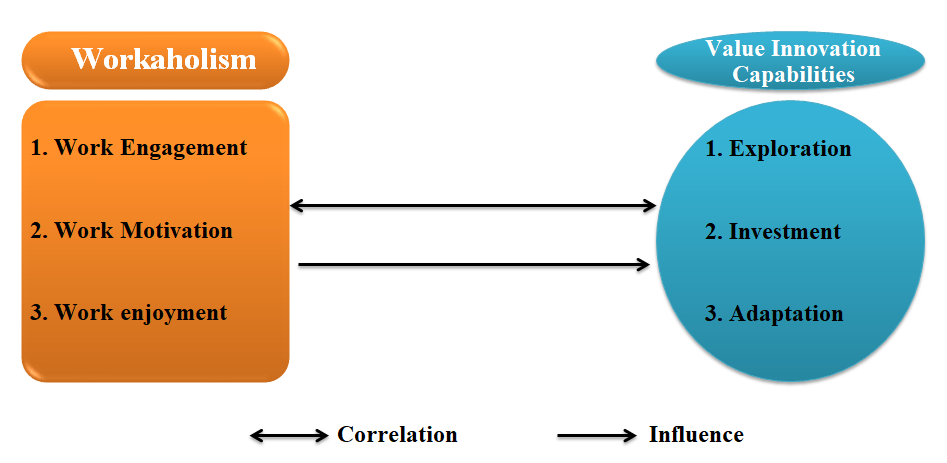
Figure (1) Hypothetical Outline of the Research
Source: Prepared by the researcher
Based on the hypothetical outline of the research, two hypotheses can be developed:
H1: There is a significant correlation between workaholism behaviors and value Innovation capabilities, and the following are derived:
1. There is a significant correlation between work engagement and value Innovation capabilities in its dimensions (exploration, investment, adaptation).
2. There is a significant correlation between work motivation and value Innovation capabilities in its dimensions (exploration, investment, adaptation).
3. There is a significant correlation between work enjoyment and value Innovation capabilities in its dimensions (exploration, investment, adaptation).
H2: There is a significant effect of workaholism behaviors on value Innovation capabilities, and the following are derived:
1. There is a significant effect of work engagement on value Innovation capabilities in its dimensions (exploration, investment, adaptation).
2. There is a significant effect of work motivation on value Innovation capabilities in its dimensions (exploration, investment, adaptation).
3. There is a significant impact of work enjoyment on value Innovation capabilities in its dimensions (exploration, investment, adaptation).
Fifth: Research Sample
The research community was formed at Al-Diwaniya Educational Hospital, and the research sample included nursing staff at Al-Diwaniya Educational Hospital, with a total of 129 nurses. A total of 150 questionnaires were distributed, out of which 143 were returned, with 14 questionnaires deemed invalid, resulting in 129 valid questionnaires for analysis, which corresponds to a response rate of 0.86.
PART TWO: THE THEORETICAL ASPECT
First: Workaholic Behaviours
1. The Concept of Workaholic Behaviours
A workaholic immerses themselves completely in their work and cannot physically separate themselves from it, despite all the negative consequences and implications, and the impact this has on their social relationships, physical health, and personal happiness. This is due to an internal drive (Saleh, 2024:574). Addiction is part of a complex process involving biological, psychological, and social aspects. Evidence is increasing that excessive behaviours related to different types of addiction share many characteristics (Volkow & Blanco, 2023:205). Furthermore, Griffiths noted that all types of addiction consist of a set of common components, such as mood changes, tolerance, withdrawal, conflict, and relapse; these shared characteristics may affect not only the treatment of these behaviours but also how individuals perceive them (Yaacob et al., 2021:566).
Researchers and specialists have predominantly focused on substance use disorders, with a dynamic increase in this interest in recent years within the scientific community and among professionals who have dedicated their research to the problem of non-substance or drug-related dependence (Sweileh, 2024:33). Views (Abdel-Shakoor,2021:188) Workaholic Behaviours as a positive phenomenon, while others regard it as having negative effects on the physical health of individuals and their families. The most commonly associated negative effects of Workaholic Behaviours are increased levels of stress and conflict between work and family life (Borges et al., 2021:5946), while the most commonly associated positive effects include improved employee wellbeing, job engagement, and job satisfaction. Workaholic Behaviours focuses on individuals whose work overwhelmingly dominates their feelings, thoughts, and behaviours (Torp et al., 2018:1072).
Workaholic Behaviours is defined as a set of behavioural tendencies that drive individuals to invest significant time and energy in technically unwanted activities, alongside influencing and controlling the work of others (Lučić et al., 2021: 255). Workaholics exert effort beyond what their job tasks require and devote much greater energy to their roles than their colleagues or those they work for expect, resulting in the neglect of aspects of their lives outside of work (Xu et al., 2023: 505).
clarified that (Atroszko, 2022: 215) workaholism is a psychological disorder manifested in the inability to stop working. In this regard, (Mónico & Margaça, 2021: 853) noted that workaholics are individuals who are passionate and obsessed with their work, as they dedicate long hours and personal time to thinking about it. In the same context, Defined (Duke-Dawson, 2023: 94) workaholics as individuals whose desire to work for extended and arduous periods surpasses their professional habits and the expectations of their colleagues or those for whom they work.
On the other hand, described (Taheri et al.,2021:373) Workaholic Behaviours as excessive engagement in work, leading to neglect of other aspects of life, and dependent on internal motivations to sustain this behaviour rather than job or organisational demands. Similarly, Viewed (Gillet et al.,2021:2843) Workaholic Behaviours as a set of behaviours adopted by individuals who spend excessive time on work-related activities at the expense of family and external commitments, and who think about work continuously even when not in the work environment, exceeding reasonable expectations of their jobs. In the same context, defined (Kun et al.,2021:949) Workaholic Behaviours as an obsessive-compulsive disorder manifested by self-imposed demands, inability to regulate work habits, and overworking, leading to the exclusion of most other life activities. Additionally, defined (Akinwale et al.,2024:2070) Workaholic Behaviours as the activities and behaviours adopted by individuals who enjoy work, are obsessed with it, and dedicate long hours and personal time to it. It is clarified that (Lo & DeLong, 2024: 2) it is a subtype of investment in hard work, where individuals expend considerable time and effort at work, which does not stem from external expectations or passion, but from immersion in the work itself. From the above, it can be said that Workaholic Behaviours represents a combination of activities and behaviours aimed at constructing and developing solutions that contribute to enhancing the internal capabilities and expectations of workers to invest their time and effort in the appropriate place and time.
2. Characteristics of Workaholic Behaviours
Workaholic Behaviours is characterized by three important characteristics:
- Excessive work: This refers to the actual behavior that a workaholic typically engages in, in terms of spending a long time on work-related activities when given the opportunity. In effect, they work more than is reasonably required to meet organizational expectations (Tabassum & Rahman, 2013: 82).
- Compulsive work: This refers to an internal compulsion to work as a characteristic of workaholism. It can be considered a personal reluctance to withdraw from work. A workaholic is obsessed with work activities; they constantly think about them, even when not working (Mónico & Margaça, 2021: 853).
- Habitual work: Workaholism should be interpreted as a habit with serious consequences. Workaholism is a unique type of addiction because it “involves a physical component (adrenaline addiction) and a procedural component (addiction to the work process itself)” (Duke-Dawson, 2023:94). This habit is based on three factors: individual predisposition, social and cultural experiences, and behavioral reinforcements in the work environment. A person becomes a workaholic because they possess certain personality traits (Kun et al., 2021:946). In addition, the workaholic’s social or cultural experiences may facilitate their addiction. Furthermore, this person’s behaviors are constantly reinforced in the work environment, leading to their addiction (Atroszko et al., 2025:247).
3. Dimensions of Workaholic Behaviours
The research relied on three important dimensions to measure the Workaholic Behaviours variable (Spence & Robbins, 1992; Mohamed et al., 2024):
- Work Engagement: Work engagement represents the extent to which employees are able to invest their time in work through their participation in the available work activities (Al-Salanti&Al-Adl,2022:1619). According to (Cabile Jr,2024:926), work immersion represents a set of activities focused on passion for job tasks by concentrating on building high productivity and taking on the risks associated with mental and physical exhaustion. Meanwhile, (Abou Hashish et al.,2024:235) argue that workaholic engagement indicates that individuals often neglect their social and family demands; therefore, it is important to achieve a balance between work immersion and rest to avoid the side effects of work addiction.
- Work Motivation: Work motivation refers to a strong internal desire within an individual that makes them feel a strong commitment to work, to the extent of experiencing guilt and anxiety when ceasing to work (Bailey et al.,2017:32). Rivaldo (2021:26) indicated that work motivation represents a set of internal and external factors that guide individuals to achieve their job goals by focusing on the desire to succeed and develop skills. Meanwhile, Demircioglu (2021:157) believes that individuals with strong motivation usually tend to innovate in achieving positive and highly satisfying outcomes.
- Work enjoyment: Enjoying work is when individuals experience happiness and satisfaction in carrying out their duties and work requirements (Judge et al., 2023:162) (which makes them more productive and innovative), which reflects positively on their commitment and motivation, and which results in less stress and more efficiency and effectiveness in their internal work by using their positive work experiences (Modise, 2023:26).
Second: Value Innovation Capabilities
1. The Concept of Value Innovation Capabilities
Innovation capabilities usually concentrate on the analysis and enhancement of new ideas and concepts, while the investment part of innovation is often ignored (Endres et al., 2022:137). Innovation capability models can therefore be understood as depicting the elements and relationships that enable the generation of novel solutions, systems, or processe (Ghobakhloo et al., 2023:1475). These models are mechanisms designed to enable effective and efficient collaboration within and between organisations. Digital innovation tools provide a platform that allows stakeholders inside and outside the organisation to leverage, discuss, vote on, and evaluate new ideas (Al-Radady & Al-Sarihi, 2025:3).
The capabilities for value innovation represent a recognized tool for the organisation, particularly with respect to small companies and many others, aimed at production and sustaining competitive offerings. Subsequently, the implementation of strategies related to enhancing the organisation’s internal and external capabilities can be executed (Yousaf, 2021:54865). Additionally, capabilities for value innovation can be regarded as an important metric for achieving integration in business strategies (Vrontis et al., 2022:7955), as they represent a process for innovating and executing the organisation’s plan to maximise income and sales through the development of the internal value curve and the essence of internal operations. The capabilities for value innovation are characterised by a set of features and skills that achieve excellence in the business world (Irvan & Karmagatri, 2021:985).
Value innovation capabilities are considered one of the important pillars that play a key role in increasing the value of inputs and raw materials to achieve better outputs. These inputs are often related to social capital and market orientation, while outputs are related to business performance (Klein et al., 2022: 2240). assert that (Eid&Abdullah,2023: 589) value innovation is the collaborative creativity between the customer and the company; value is created based on the exchange of knowledge and skills between customers and the company to build successful experiences between them. Customers engage in all procedures aimed at interaction, participation, and suggesting ideas to companies, with the goal of enhancing the company’s products and services. These customer feedback can be related to a good or service provided by the company, employee service, pricing policy, marketing strategy, and service quality. Indicated that (Cambra-Fierro et al.,2018: 338) value innovation is a simultaneous, collaborative, and interactive process aimed at improving project outputs by mobilising both fixed and dynamic resources (Fuentes, 2019: 101).
From the above, it can be stated that the capabilities for value innovation represent a culmination of capacities and innovative abilities aimed at enhancing and developing strategies and new ideas, as well as establishing values, vision, and enlightened decisions to lead the organisation’s performance to a safe zone.
2. The Importance of Value Innovation Capabilities
The importance of value Innovation capabilities is highlighted by business organizations’ focus on developing their internal and external capabilities to capture the largest possible market share and compete fiercely to maintain it. Value Innovation capabilities also work to:
- Improve employee ideas by creating new, innovative factors that create new customer needs.
- Ensure the organization’s growth and continuity in light of the need to respond to a highly complex and highly competitive environment.
- Create added value for the organization by institutionalizing innovation into its products and services (Shawky, 2021: 247).
- Achieve a differentiation strategy and a low-cost strategy by creating positive innovative value.
- Create a leap in value for both the buyer and the organization.
- Regulate the organization’s ability to create an appropriate balance between price, benefit, and cost (Hamza & Qassabi, 2021: 122).
3. Dimensions of Value Innovation Capabilities
The research relied on three important dimensions to measure the value Innovation capabilities variable (Zacharias et al., 2016):
- Exploration: Exploration represents an analysis and investment process of the opportunities available to the organisation with the aim of improving products and developing services through reliance on innovation (Andersen et al., 2022:21). This, in turn, requires an understanding of customer requirements and market trends, as well as the exploration of fluctuations, new methods, and activities to guide them in order to create added value that meets the expectations, needs, and desires of customers and subsequently achieve a competitive advantage (Fernando et al., 2023:985).
- Investment: Investment refers to the allocation and direction of resources and efforts to support innovation and achieve added value in product development and process improvement (Komandrovska et al., 2021:112), in addition to enhancing the organisation’s competitive capability to gain customer satisfaction and loyalty by providing appropriate training and support to employees, thereby facilitating a positive response to market changes and ensuring sustainable growth (Lepistö et al., 2024:76).
- Adaption: Adaptation characterizes the ability to develop organisational plans that meet the changing wants of the market. By creating new answers that align with customers’ drives and tastes, it helps the organisation to survive and grow while remaining modest (Douglas et al., 2025:68). In addition, adaptation improves the organisation’s flexibility and enables it to respond quickly to tests, seize opportunities, and consequently deliver better value to clienteles and gain their gratification (Nosike et al., 2024:219).
PART THIRD: PRACTICAL ASPECT
First: Research Description and Coding
In this section, the variables of the research and their sub-dimensions are coded and described in their foreign language to make it easier to employ the analysis methods and to process the data extracted from the questionnaire and to read and interpret the data. Table (1) shows the main variables of the study and their sub-dimensions, along with their codes in foreign language and the number of items related to each dimension.
Table (1) Research Description and Coding
|
Variables |
No. |
code |
Source |
||
|
Main |
Subvariables |
||||
|
Workaholism |
Work immersion |
8 |
WAEW |
WAH |
Spence& Robbins,1992 ; Mohamed et al.,2024 |
|
Work motivation |
7 |
WAOV |
|||
|
Work enjoyment |
10 |
WAMO |
|||
|
Value Innovation Capabilities |
Exploration |
3 |
VICE |
VIC |
Zacharias et al.,2016 |
|
Investment |
3 |
VICI |
|||
|
Adaption |
3 |
VICA |
|||
Second: Moderation and Reliability of the Measurement Tool
The results in Table (2) explain that the data for the research items concerning the variable of workaholic behaviours and value innovation capabilities follow a normal distribution due to their compliance with the rule at a significance level greater than (0.05). This suggests that the findings presented by the data on workaholic behaviours and value innovation capabilities can be generalised to the population being studied.
The results shown in Table (2) indicate a relative reliability of the items measuring Workaholic Behaviours, represented by (Work immersion, Work motivation, Work enjoyment), with a total of (25) items and a Cronbach’s alpha value of (0.879), indicating the reliability of the measurement tool items regarding this variable. Meanwhile, the variable of value innovation capabilities, represented by (exploration, investment, adaptation), comprised (9) items, achieving a Cronbach’s alpha value of (0.806).
Table (2) Test of Moderation and Reliability of the Measurement Tool
|
Variables |
Value Kol-Smia |
Decision |
Cronbach’s alpha |
Decision |
|||
|
Main |
Subvariables |
||||||
|
Workaholism |
Work immersion |
0.237 |
0.320 |
Good moderation |
0.902 |
0.879 |
Good stability |
|
Work motivation |
0.311 |
0.904 |
|||||
|
Work enjoyment |
0.227 |
0.880 |
|||||
|
Value Innovation Capabilities |
Exploration |
0.290 |
0.300 |
Good moderation |
0.802 |
0.806 |
Good stability |
|
Investment |
0.220 |
0.813 |
|||||
|
Adaption |
0.199 |
0.831 |
|||||
Third: Statistical Description
As can be seen in Table (3), the work addiction behaviours of nursing staff at Al-Diwaniyah Teaching Hospital achieved a mean score of 3.38 and a standard deviation of 0.66, with a relative importance of 67.64%, ranking as a priority in this variable due to the adoption of the work motivation dimension (WAOV), which achieved a mean of 3.44, a standard deviation of 0.67, and relative importance of 68.72%, followed by work engagement dimension (WAEW) which ranked last with a mean score of 3.33, a standard deviation of 0.84, and relative importance of 66.55%. This implies that the nursing staff place more emphasis on work motivation as a main component of work addiction behaviours, and there is a need to enhance work engagement, which suggests the need to develop strategies to enhance work engagement to improve performance and efficiency.
As can be seen in Table (3), the nursing staff at Al-Diwaniya Teaching Hospital demonstrated the highest level of knowledge about Value Innovation Capabilities (VIC), with a mean of 3.34 and a standard deviation of 0.77 and a relative importance of 66.71%. In particular, they prioritized the investment dimension (VICI) the most, with a mean of 3.40, a standard deviation of 0.69, and a relative importance of 67.92%, while the adaptation dimension (VICA) ranked last, with a mean of 3.28, a standard deviation of 0.77, and a relative importance of 65.51%, which shows that the nursing staff place more emphasis on the investment dimension of Value Innovation Capabilities, but adaptation in the work environment can be enhanced by strategies that improve adaptation.
Table (3) Statistical Description of the Research Variables
|
No. |
mean |
S.D |
% |
No. |
mean |
S.D |
% |
No. |
mean |
S.D |
% |
|
WAEW1 |
3.52 |
0.86 |
70.34 |
WAOV6 |
3.46 |
0.86 |
69.26 |
WAH |
3.38 |
0.66 |
67.64 |
|
WAEW2 |
3.47 |
0.95 |
69.40 |
WAOV7 |
3.41 |
0.94 |
68.19 |
VICE1 |
3.24 |
0.93 |
64.83 |
|
WAEW3 |
3.36 |
0.94 |
67.25 |
WAOV |
3.44 |
0.67 |
68.72 |
VICE2 |
3.58 |
0.95 |
71.54 |
|
WAEW4 |
3.15 |
1.14 |
63.09 |
WAMO1 |
3.27 |
0.76 |
65.37 |
VICE3 |
3.18 |
0.94 |
63.62 |
|
WAEW5 |
3.17 |
1.06 |
63.49 |
WAMO2 |
3.30 |
0.93 |
66.04 |
VICE |
3.33 |
0.80 |
66.67 |
|
WAEW6 |
3.21 |
1.09 |
64.16 |
WAMO3 |
3.55 |
0.80 |
71.01 |
VICI1 |
3.19 |
0.95 |
63.76 |
|
WAEW7 |
3.28 |
1.10 |
65.64 |
WAMO4 |
3.34 |
0.79 |
66.71 |
VICI2 |
3.38 |
0.82 |
67.65 |
|
WAEW8 |
3.44 |
0.97 |
68.72 |
WAMO5 |
3.47 |
0.79 |
69.40 |
VICI3 |
3.62 |
0.82 |
72.35 |
|
WAEW |
3.33 |
0.84 |
66.55 |
WAMO6 |
3.57 |
0.72 |
71.41 |
VICI |
3.40 |
0.69 |
67.92 |
|
WAOV1 |
3.44 |
0.92 |
68.72 |
WAMO7 |
3.30 |
0.84 |
66.04 |
VICA1 |
3.48 |
0.98 |
69.66 |
|
WAOV2 |
3.50 |
0.79 |
69.93 |
WAMO8 |
3.39 |
0.82 |
67.79 |
VICA2 |
2.96 |
1.11 |
59.19 |
|
WAOV3 |
3.52 |
0.80 |
70.47 |
WAMO9 |
3.31 |
1.09 |
66.17 |
VICA3 |
3.38 |
0.88 |
67.65 |
|
WAOV4 |
3.30 |
0.84 |
66.04 |
WAMO10 |
3.34 |
0.84 |
66.71 |
VICA |
3.28 |
0.77 |
65.51 |
|
WAOV5 |
3.43 |
1.00 |
68.59 |
WAMO |
3.38 |
0.57 |
67.66 |
VIC |
3.34 |
0.67 |
66.71 |
Fourth: Hypothesis Testing
H1: There is a significant correlation between WAH and value VIC.
As can be seen from the outcomes in Table (4), the work addiction behaviors and value innovation capabilities have a high correlation of 0.904, which is caused by the nursing staff to make the work motivation dimension (WAOV) and adaptation dimension (VICA) have the highest correlation (0.798), and the work enjoyment dimension (WAMO) and exploration dimension (VICE) have the lowest correlation (0.731), so the nursing staff should focus on improving the relationship between work enjoyment and exploration to improve value innovation capabilities to enhance performance and innovation.
Table (4) Correlation Matrix
|
WAEW |
WAOV |
WAMO |
WAH |
VICE |
VICI |
VICA |
VIC |
|
|
WAEW |
1 |
|||||||
|
WAOV |
.901** |
1 |
||||||
|
WAMO |
.805** |
.881** |
1 |
|||||
|
WAH |
.959** |
.972** |
.925** |
1 |
||||
|
VICE |
.751** |
.788** |
.731** |
.794** |
1 |
|||
|
VICI |
.778** |
.770** |
.735** |
.801** |
.607** |
1 |
||
|
VICA |
.742** |
.798** |
.752** |
.799** |
.674** |
.723** |
1 |
|
|
VIC |
.857** |
.890** |
.837** |
.904** |
.871** |
.868** |
.907** |
1 |
H2: There is a significant effect of workaholism behaviors on value Innovation capabilities.
The results of Table (5) and Figure (2) indicate that Workaholic Behaviours behaviours contributed to enhancing value innovation capabilities. This shows that a focus by nursing staff on improving Workaholic Behaviours behaviours by a single unit leads to achieving exploratory and investment innovations and adapting to them by (0.907), and reduces the standard error to (0.035). The strength of this relationship is supported by a critical ratio estimated at (25.914). It is also evident that Workaholic Behaviours behaviours contributed to explaining (0.817) of the variance in value innovation capabilities, thereby enhancing the internal and external capabilities of the nursing staff.
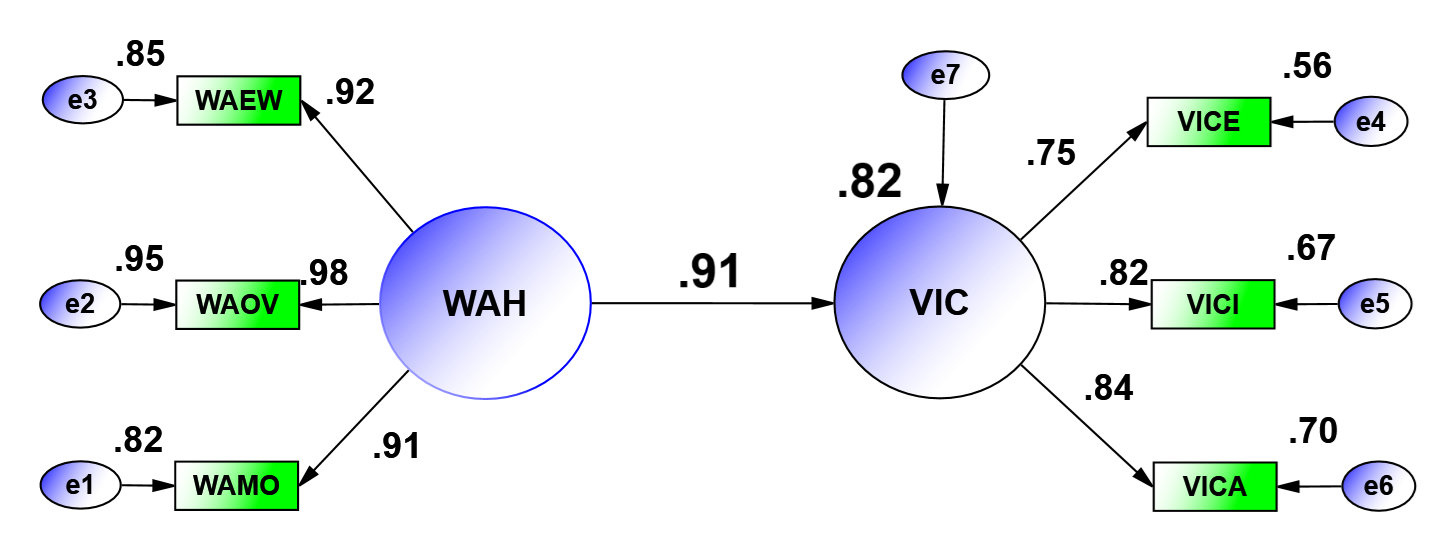
Figure (2) Standard Model of the Effect of Workaholism Behaviors on Value Innovation Capabilities
Table (5) Results of the Analysis of the Effect of Workaholism Behaviors on Value Innovation Capabilities
|
The Path |
Standard weights |
standard error |
critical value |
R2 |
P |
||
|
Workaholic Behaviours |
—> |
Value Innovation Capabilities |
0.907 |
0.035 |
25.914 |
0.817 |
*** |
PART FOUR: CONCLUSIONS AND RECOMMENDATIONS
First: Conclusions
- There is a correlation and impact between Workaholic Behaviours behaviours and value innovation capabilities, indicating that nursing staff possess the necessary priorities and skills as a driving force for building value innovation capabilities, which in turn contributes to the improvement of behaviours that play an important role in enhancing the quality of healthcare provided.
- Nursing staff are concerned with enhancing Work motivation by setting professional and personal goals, and this motivation plays a vital role in effecting a positive transformation from burnout to innovation, thereby enhancing the ability to deliver outstanding healthcare.
- Nursing staff concentrate on the work environment, because the work environment is an important condition for reducing fatigue and enhancing productivity, thus creating a collaborative and supportive environment to develop the capability for value innovation.
- Nursing staff are interested in enhancing cooperation between different medical teams to create an integrated work environment, and this cooperation promotes innovation through the exchange of ideas and expertise to improve healthcare strategies.
- Nursing staff manage time because time management is an important condition for reducing fatigue and contributes to enhancing the capability for learning to manage time to reduce daily pressures so they can concentrate on innovation for better results.
- Nursing staff are eager to explore and apply the information technology to improve nursing performance, such as electronic systems and healthcare applications.
Second: Recommendations
- Work addiction behaviors should be harnessed by nursing staff to create value innovation capabilities, which are driven by the need to find innovative solutions to the challenges that they face by developing new strategies to improve the quality of health services and contribute to achieving acceptable patient outcomes through the dynamics of professional performance and by enhancing the work environment.
- Nursing staff need to continue training and workshops in innovation skills to be able to provide new solutions to health problems, and therefore improve the level of care provided.
- Nursing staff need to strengthen their independence in making clinical decisions, and this autonomy contributes to improving job satisfaction and stimulating innovation in providing effective healthcare.
- Performance measurement tools are used to assess the effectiveness of innovation initiatives, which can help evaluate results and make adjustments to future strategies for healthcare provision.
- A culture of continuous learning is another important driver of innovation, and nursing staff need to attend conferences and training courses to share knowledge and learn skills that enhance healthcare quality.
- Mental health is also a critical area that requires attention; offering psychological support and resources can alleviate fatigue and increase the ability of nursing staff to innovate in the workplace.
References
- Abdel-Shakoor, H. (2021). Workaholic Behaviours as a moderating variable of the relationship between psychological climate and employee satisfaction outcomes in mobile phone companies in Egypt. Alexandria University Journal of Administrative Sciences, 58(1), 185-219.
- Abdullah, M., Abbas, A., Khan, I. A., & Akram, M. W. (2022). Impact of work-holism and Destructive leadership on Creativity, Emotional Exhaustion, and Intrinsic Motivation in the Banking Sector of Pakistan. NICE Research Journal, 87-111.
- Abou Hashish, E. A., Alsayed, S. A., & Alnajjar, H. A. (2024). Exploring workaholism determinants and life balance: a mixed-method study among academic nurse educators. Journal of Professional Nursing, 54, 234-244.
- Akinwale, O. E., Kuye, O. L., & Akinwale, O. E. (2024). Predictors of workaholism and quality of work-life among information technology (IT) professionals in Nigeria: a dynamite promoting brain-drain albatross. International Journal of Organizational Analysis, 32(9), 2067-2092.
- Al-Radady, N& Al-Sarihi, M, (2025). A proposed model for value innovation in organizations in light of the knowledge economy. Journal of Information Studies and Technology, 2025(1), 2.
- Al-Salanti. L &Al-Adl. A, (2022). The mediating role of Workaholic Behaviours in the relationship between personality traits and job burnout, applied to faculty members and their assistants at Damietta University. The Scientific Journal of Financial and Commercial Studies and Research, Faculty of Commerce, Damietta University, 3(2)
- Andersen, T. C. K., Aagaard, A., & Magnusson, M. (2022). Exploring business model innovation in SMEs in a digital context: Organizing search behaviours, experimentation and decision‐making. Creativity and Innovation Management, 31(1), 19-34.
- Atroszko, P. A. (2022). Workaholic Behaviours. In Behavioral Addictions: Conceptual, Clinical, Assessment, and Treatment Approaches (pp. 213-240). Cham: Springer International Publishing.
- Atroszko, P. A., Kun, B., Buźniak, A., Czerwiński, S. K., Schneider, Z., Woropay-Hordziejewicz, N., … & Charzyńska, E. (2025). Perceived coworkers’ Workaholic Behaviours: Scale development and associations with one’s own workaholism, job stress, and job satisfaction in 85 cultures. Journal of Behavioral Addictions, 14(1), 246-262.
- Bailey, C., Madden, A., Alfes, K., & Fletcher, L. (2017). The meaning, antecedents and outcomes of employee engagement: A narrative synthesis. International journal of management reviews, 19(1), 31-53.
- Balducci, C., Alessandri, G., Zaniboni, S., Avanzi, L., Borgogni, L., & Fraccaroli, F. (2021). The impact of workaholism on day-level workload and emotional exhaustion, and on longer-term job performance. Work & Stress, 35(1), 6-26.
- BELLA, K. M. J. (2023). A Study on Achieving Harmony: Balancing Work and Personal Life. International Journal of Multidisciplinary Research in Arts, Science and Technology, 1(1), 1-7.
- Borges, E. M. D. N., Sequeira, C. A. D. C., Queirós, C. M. L., & Mosteiro-Díaz, M. P. (2021). Workaholism and family interaction among nurses. Ciencia & Saude Coletiva, 26, 5945-5953.
- Cabile Jr, D. C. (2024). Implementation of Work Immersion in the New Normal: Basis for Students’ Quality Performance and Satisfaction. International Journal of Multidisciplinary: Applied Business and Education Research, 5(3), 925-938.
- Cambra-Fierro, J., Melero-Polo, I., & Sese, F. J. (2018). Customer value co-Innovation over the relationship life cycle. Journal of Service Theory and Practice, 28(3), 336-355.
- Demircioglu, M. A. (2021). Sources of innovation, autonomy, and employee job satisfaction in public organizations. Public Performance & Management Review, 44(1), 155-186.
- Douglas, B., Burrell, D. N., & Zoric, V. D. (2025). Marketing, Strategic Planning, Culture, and Organizational Adaptability in Retail Markets. In Retail Innovations in Business Models (pp. 67-94). IGI Global Scientific Publishing.
- Duke-Dawson, V. (2023). Workaholic Syndrome: Law and Psychology Explore the Far Reach of the Egg Shell Doctrine. Law & Psychol. Rev., 48, 93.
- Duke-Dawson, V. (2023). Workaholic Syndrome: Law and Psychology Explore the Far Reach of the Egg Shell Doctrine. Law & Psychol. Rev., 48, 93.
- Eid, A &Abdullah, A. (2023). The Role of Superior Strategic Efficiency in Improving the Value Innovation Process (An Applied Study on the Industrial Sector in Sadat City). Journal of Financial and Commercial Studies, 33(2), 584-626.
- Endres, H., Huesig, S., & Pesch, R. (2022). Digital innovation management for entrepreneurial ecosystems: services and functionalities as drivers of innovation management software adoption. Review of Managerial Science, 16(1), 135-156.
- Fernando, E., Sutomo, R., Prabowo, Y. D., Gatc, J., & Winanti, W. (2023). Exploring customer relationship management: Trends, challenges, and innovations. Journal of Information Systems and Informatics, 5(3), 984-1001.
- Frémeaux, S., Mercier, G., & Grevin, A. (2025). The free-riding issue in contemporary organizations: lessons from the common good perspective. Business Ethics Quarterly, 35(1), 28-53.
- Fuentes, M. E. (2019). Co-Innovation and co-destruction of experiential value: a service perspective in projects. Built environment project and asset management, 9(1), 100-117.
- Ghobakhloo, M., Iranmanesh, M., Morales, M. E., Nilashi, M., & Amran, A. (2023). Actions and approaches for enabling Industry 5.0‐driven sustainable industrial transformation: A strategy roadmap. Corporate social responsibility and environmental management, 30(3), 1473-1494.
- Gillet, N., Austin, S., Fernet, C., Sandrin, E., Lorho, F., Brault, S., … & Aubouin Bonnaventure, J. (2021). Workaholism, presenteeism, work–family conflicts and personal and work outcomes: Testing a moderated mediation model. Journal of clinical nursing, 30(19-20), 2842-2853.
- Hamza, Y &Qassabi, E. (2021). Blue Ocean Strategy as a Revolutionary Approach to Transitioning from the Logic of Competition to Value Innovation – Shedding Light on Some Pioneering Experiences. Al-Manhal Economic Journal, 4(3), 115-132.
- Irvan, J. M., & Karmagatri, M. (2021). The Value Innovation Capabilities to Create Powerful Business Strategy: A Case Study on The High Business Performance of An Investment Business in Covid 19 Pandemic. In Proceedings of the International Conference on Industrial Engineering and Operations Management (pp. 982-993).
- Judge, T. A., Klinger, R., & Li, M. (2023). Promote job satisfaction through mental challenge. Principles of Organizational Behavior: The Handbook of Evidence‐Based Management 3rd Edition, 161-178.
- Klein, O., Nier, S., & Tamásy, C. (2022). Circular agri-food economies: business models and practices in the potato industry. Sustainability Science, 17(6), 2237-2252.
- Komandrovska, V., Kolesnyk, M., Barkova, K., Vasylyk, S., & Dorofieiev, D. (2021). Conceptual bases of the Investment Mechanism of the Innovative Activity of Enterprises in the Context of Achieving the Tasks of Strategic Development. International Journal of Computer Science & Network Security, 21(11), 111-118.
- Kun, B., Takacs, Z. K., Richman, M. J., Griffiths, M. D., & Demetrovics, Z. (2021). Workaholic Behaviours and personality: A meta-analytic study. Journal of behavioral addictions, 9(4), 945-966.
- Kun, B., Takacs, Z. K., Richman, M. J., Griffiths, M. D., & Demetrovics, Z. (2021). Workaholic Behaviours and personality: A meta-analytic study. Journal of behavioral addictions, 9(4), 945-966.
- Lepistö, K., Saunila, M., & Ukko, J. (2024). Enhancing customer satisfaction, personnel satisfaction and company reputation with total quality management: combining traditional and new views. Benchmarking: An International Journal, 31(1), 75-97.
- Lo, K., & DeLong, M. (2024). Perspectives of Fashion Designers in the United States on Motivation to Create and Copyright Protection. Fashion Practice, 1-36.
- Lučić, A., Uzelac, M., & Previšić, A. (2021). The power of materialism among young adults: exploring the effects of values on impulsiveness and responsible financial behavior. Young Consumers, 22(2), 254-271.
- Modise, J. M. (2023). The impacts of employee workplace empowerment, effective commitment and performance: An organizational systematic review. International Journal of Innovative Science and Research Technology, 8(7), 25-30.
- Mohamed. M, El-Sherbiny. S & El-Derini, S(2024). The Relationship between Workaholic Behaviours and Anti-Performance Behaviors as Applied to Physicians and Nursing Staff at Zagazig University Hospitals, Scientific Journal of Financial and Commercial Studies and Research, Faculty of Commerce, Damietta University, 5(1), 3, 599-628.
- Mónico, L. S., & Margaça, C. (2021). The workaholism phenomenon in Portugal: Dimensions and relations with workplace spirituality. Religions, 12(10), 852.
- Mónico, L. S., & Margaça, C. (2021). The workaholism phenomenon in Portugal: Dimensions and relations with workplace spirituality. Religions, 12(10), 852.
- Nosike, C. J., Ojobor, O. S. N., & Nosike, C. U. (2024). Enhancing business resilience: Innovation and adaptation during and after the global pandemic. International Journal of Financial, Accounting, and Management, 6(2), 217-229.
- Rivaldo, Y. (2021). Leadership and motivation to performance through job satisfaction of hotel employees at D’Merlion Batam. Journal The Winners, 22(1), 25-30.
- Saleh, S. (2024). The relative contribution of organizational narcissism in predicting Workaholic Behaviours among a sample of employees in some petroleum companies in Suez Governorate. Educational Journal of the Faculty of Education, Sohag, 126(126), 558-625.
- Serenko, A. (2024). The human capital management perspective on quiet quitting: recommendations for employees, managers, and national policymakers. Journal of Knowledge Management, 28(1), 27-43.
- Shawky, C. (2021). Applying the Blue Ocean Strategy at Venus Cosmetics Company and its Role in Value Innovation. Journal of Strategy and Development, 11(4), 243-260.
- Spence, J. T., & Robbins, A. S. (1992). Workaholism: Definition, measurement, and preliminary results. Journal of personality assessment, 58(1), 160-178.
- Stoliarchuk, O., Yang, Q., Diedkov, M., Serhieienkova, O., Ishchuk, A., Kokhanova, O., & Patlaichuk, O. (2024). Self-realization as a Driver of Sustainable Social Development: Balancing Individual Goals and Collective Values. European Journal of Sustainable Development, 13(4), 313-313.
- Sweileh, W. M. (2024). Research landscape analysis on dual diagnosis of substance use and mental health disorders: key contributors, research hotspots, and emerging research topics. Annals of General Psychiatry, 23(1), 32.
- Tabassum, A., & Rahman, T. (2013). Gaining the insight of workaholism, its nature and its outcome: A literature review. International Journal of Research Studies in Psychology, 2(2), 81-92.
- Taheri, F., Asarian, M., & Shahhosseini, P. (2021). Workaholism and workplace incivility: the role of work–family enrichment. Management Decision, 59(2), 372-389.
- Torp, S., Lysfjord, L., & Midje, H. H. (2018). Workaholism and work–family conflict among university academics. Higher Education, 76, 1071-1090.
- Vol. 3, pp. 1613-1666.
- Volkow, N. D., & Blanco, C. (2023). Substance use disorders: a comprehensive update of classification, epidemiology, neurobiology, clinical aspects, treatment and prevention. World Psychiatry, 22(2), 203-229.
- Vrontis, D., Chaudhuri, R., & Chatterjee, S. (2022). Adoption of digital technologies by SMEs for sustainability and value Innovation: Moderating role of entrepreneurial orientation. Sustainability, 14(13), 7949.
- Xu, X., Peng, Y., Ma, J., & Jalil, D. (2023). Does working hard really pay off? Testing the temporal ordering between workaholism and job performance. Journal of Occupational and Organizational Psychology, 96(3), 503-523.
- Yaacob, W. M. Y. W., Zakaria, N. H., & Aji, Z. M. (2021). Identification of factors contributing to online game addiction among adolescents. Journal of Information and Communication Technology, 20(4), 565-597.
- Yousaf, Z. (2021). Go for green: green innovation through green dynamic capabilities: accessing the mediating role of green practices and green value co-Innovation. Environmental science and pollution research, 28(39), 54863-54875.
- Zacharias, N. A., Nijssen, E. J., & Stock, R. M. (2016). Effective configurations of value Innovation and capture capabilities: Extending Treacy and Wiersema’s value disciplines. Journal of Business Research, 69(10), 4121-4131.
- Zhang, J., & Chen, Z. (2024). Exploring human resource management digital transformation in the digital age. Journal of the Knowledge Economy, 15(1), 1482-1498.
 English
  Arabic