

Modeling and Analysis of Risk Factors Affecting Construction Materials Management in Port Sudan
نمذجة وتحليل عوامل الخطر المؤثرة في إدارة مواد البناء في بورتسودان
SafaOsman Mohamed Suliman ¹, Abdal La Eissa Abdelkarim ², Khaled Abdelrazik Ahmed³
¹ M.Sc. Candidate, Faculty of Engineering, Red Sea University, Sudan
² Assistant Professor, Department of Civil Engineering, Faculty of Engineering, Red Sea University, Sudan
³ Assistant Professor, Department of Civil Engineering, Faculty of Engineering,Red Sea University, Sudan
DOI: https://doi.org/10.53796/hnsj76/11
Arabic Scientific Research Identifier: https://arsri.org/10000/76/11
Volume (7) Issue (6). Pages: 163 - 178
Received at: 2026-05-10 | Accepted at: 2026-05-15 | Published at: 2026-06-01
Abstract: Construction materials management is a critical factor influencing the success of construction projects, particularly in fragile and resource-constrained contexts. This study investigates the main risk factors affecting construction materials management in Port Sudan, a city facing intensified construction demand, supply chain disruption, price instability, and institutional pressure as a result of Sudan’s ongoing conflict and administrative relocation. Using a mixed-methods approach, data were collected through a structured questionnaire administered to 80 construction professionals, supported by semi-structured interviews with senior stakeholders and a case study of the Telecommunications Regulatory Building project. Quantitative data were analyzed using the Relative Importance Index (RII), mean scores, standard deviation, and correlation analysis, while qualitative data were examined thematically to interpret the contextual causes of the identified risks. The findings show that the most significant risk factors are port and customs clearance delays, price fluctuations of construction materials, dependence on imported materials, transportation and logistics problems, and lack of reliable suppliers. These risks were found to have substantial effects on project performance, contributing to cost overruns, schedule delays, material waste, and quality-related problems. The study also reveals that current materials management practices remain limited, with less than half of the surveyed firms using formal management systems and only a minority adopting software-based tracking tools. Qualitative findings further indicate that market instability, weak logistics infrastructure, inadequate storage conditions, shortages of skilled labor, and reliance on informal networks intensify materials management risks in Port Sudan. The study proposes a practical mitigation framework based on supplier diversification, adaptive procurement planning, climate-appropriate storage systems, simple digital inventory tracking, and workforce training. The research contributes empirical evidence on construction risk management in a conflict-affected African port city and offers practical recommendations for contractors, consultants, policymakers, and researchers seeking to improve construction project resilience in fragile environments.
Keywords: Construction materials management; risk factors; Port Sudan; supply chain disruption; Relative Importance Index; construction project performance; conflict-affected environments; procurement planning.
المستخلص: تُعد إدارة مواد البناء عاملاً حاسماً في نجاح مشروعات التشييد، ولا سيما في البيئات الهشة والمحدودة الموارد. تهدف هذه الدراسة إلى تحليل أهم عوامل الخطر المؤثرة في إدارة مواد البناء في مدينة بورتسودان، التي تشهد تزايداً في الطلب على مشروعات البناء، واضطراباً في سلاسل الإمداد، وتقلباً في الأسعار، وضغطاً مؤسسياً نتيجة النزاع الدائر في السودان وانتقال بعض الوظائف الإدارية إليها. اعتمدت الدراسة منهجاً مختلطاً، حيث جُمعت البيانات من خلال استبانة منظمة وُزعت على 80 من المهنيين العاملين في قطاع التشييد، إضافة إلى مقابلات شبه منظمة مع عدد من أصحاب الخبرة، ودراسة حالة لمشروع مبنى جهاز تنظيم الاتصالات. حُللت البيانات الكمية باستخدام مؤشر الأهمية النسبية، والمتوسطات الحسابية، والانحراف المعياري، وتحليل الارتباط، بينما حُللت البيانات النوعية موضوعياً لتفسير الأسباب السياقية لعوامل الخطر المحددة. أظهرت النتائج أن أكثر عوامل الخطر تأثيراً تتمثل في تأخر إجراءات الميناء والتخليص الجمركي، وتقلب أسعار مواد البناء، والاعتماد على المواد المستوردة، ومشكلات النقل والخدمات اللوجستية، ونقص الموردين الموثوقين. وقد تبين أن هذه المخاطر تؤثر بصورة كبيرة في أداء المشروعات، إذ تسهم في زيادة التكاليف، وتأخر الجداول الزمنية، وارتفاع الهدر في المواد، وظهور مشكلات مرتبطة بالجودة. كما كشفت الدراسة أن ممارسات إدارة المواد الحالية لا تزال محدودة، حيث إن أقل من نصف الشركات التي شملها المسح تستخدم أنظمة رسمية لإدارة المواد، في حين تعتمد نسبة محدودة فقط على أدوات تتبع رقمية. وأوضحت النتائج النوعية أن عدم استقرار السوق، وضعف البنية اللوجستية، وسوء ظروف التخزين، ونقص العمالة الماهرة، والاعتماد على الشبكات غير الرسمية، كلها عوامل تزيد من حدة مخاطر إدارة مواد البناء في بورتسودان. وتقترح الدراسة إطاراً عملياً للتخفيف من هذه المخاطر يقوم على تنويع الموردين، وتحسين التخطيط التكيفي للمشتريات، وتوفير أنظمة تخزين ملائمة للظروف المناخية، واعتماد أدوات رقمية بسيطة لتتبع المخزون، وتنفيذ برامج تدريبية للعاملين. وتسهم هذه الدراسة في تقديم أدلة ميدانية حول إدارة مخاطر التشييد في مدينة مينائية أفريقية متأثرة بالنزاع، كما تقدم توصيات عملية للمقاولين والاستشاريين وصناع القرار والباحثين من أجل تعزيز مرونة مشروعات التشييد في البيئات الهشة.
الكلمات المفتاحية: إدارة مواد البناء؛ عوامل الخطر؛ بورتسودان؛ اضطراب سلاسل الإمداد؛ مؤشر الأهمية النسبية؛ أداء مشروعات التشييد؛ البيئات المتأثرة بالنزاع؛ تخطيط المشتريات.
1. Introduction
1.1 Background and Context
The construction industry serves as a fundamental driver of economic development, infrastructure provision, and employment generation in developing nations (Ofori, 2015). Effective management of construction materials—encompassing procurement, transportation, storage, handling, and inventory control—directly influences project performance across the triple constraints of cost, time, and quality (Assaf & Al-Hejji, 2006; Sambasivan & Soon, 2007). In stable environments, materials management challenges are typically addressed through established supply chain protocols, reliable logistics networks, and institutional support mechanisms. However, in conflict-affected, resource-constrained, or rapidly transforming urban contexts, these foundational systems are often disrupted or absent, amplifying materials-related risks and compromising project outcomes.
Port Sudan, Sudan’s principal seaport and Red Sea State capital, exemplifies such a challenging environment. Historically serving as the nation’s primary gateway for international trade—handling approximately 90% of Sudan’s imports—the city has experienced profound transformation since April 2023, when armed conflict between the Sudanese Armed Forces (SAF) and Rapid Support Forces (RSF) rendered Khartoum, the national capital, largely inoperable (ICG, 2023; World Bank, 2024). Port Sudan was subsequently designated the nation’s de facto administrative capital, triggering an unprecedented influx of government institutions, diplomatic missions, humanitarian organizations, and an estimated 1.2 million internally displaced persons (IDPs) (UNHCR, 2024; OCHA Sudan, 2025). This demographic and functional surge—representing a population increase of over 150%—has placed extraordinary pressure on the city’s infrastructure, housing stock, and construction sector.
Against this backdrop, construction activities in Port Sudan have intensified dramatically, driven by urgent needs for administrative facilities, housing, healthcare infrastructure, and utility upgrades. However, the sector operates under severe constraints: port congestion and customs delays disrupt material imports; currency depreciation and supply chain fragmentation drive extreme price volatility; skilled labor shortages compromise workmanship; and inadequate storage facilities exacerbate material degradation in the city’s hot, humid, saline coastal climate (FAO, 2024; WHO, 2025). These conditions create a high-risk environment for construction materials management, where conventional planning assumptions frequently fail and project outcomes suffer.
1.2 Problem Statement
Despite the critical importance of construction materials management to project success, a significant knowledge gap exists regarding the specific risk factors affecting this function in conflict-affected African port cities such as Port Sudan. Existing literature on construction risk management predominantly focuses on stable developing economies (e.g., Nigeria, Kenya, Ghana) or post‑conflict reconstruction contexts (e.g., Iraq, Syria), with limited attention to cities experiencing ongoing conflict combined with rapid demographic transformation (Elhag & Mohamed, 2025; Marshall, 2020). Furthermore, while general supply chain risk frameworks exist (Ho et al., 2015), few studies provide empirical, context‑specific analysis of materials management risks in Sudan’s unique operational environment.
This knowledge deficit has practical consequences: contractors, consultants, and clients operating in Port Sudan lack evidence‑based guidance for prioritizing risk mitigation efforts, allocating contingency resources, or adapting management practices to local constraints. Consequently, projects experience avoidable cost overruns, schedule delays, and quality deficiencies—outcomes that are particularly detrimental in a humanitarian and administrative crisis context where efficient infrastructure delivery is essential.
1.3 Research Objectives
This study addresses the identified knowledge gap through the following objectives:
General Objective:
To identify, analyze, and propose mitigation strategies for key risk factors affecting construction materials management in Port Sudan.
Specific Objectives:
- To identify major risk factors affecting materials management across procurement, storage, transportation, and handling processes.
- To evaluate the impact of these risks on project cost, time, and quality performance.
- To rank risk factors based on severity (impact × likelihood) and frequency using quantitative metrics.
- To assess current materials management practices employed by contractors and consultants in Port Sudan.
- To propose practical, context‑appropriate mitigation strategies suitable for local conditions.
1.4 Significance of the Study
This research makes several contributions to theory and practice:
- Empirical Contribution: Provides original, primary data on construction materials management risks in an understudied conflict‑affected context, enriching the global evidence base on infrastructure delivery in fragile states.
- Methodological Contribution: Demonstrates the application of the Relative Importance Index (RII) combined with qualitative thematic analysis for risk prioritization in resource‑constrained research settings.
- Practical Contribution: Offers actionable recommendations for contractors, consultants, and policymakers seeking to improve materials management outcomes in Port Sudan and similar environments.
- Policy Contribution: Informs the development of targeted interventions—such as supplier certification programs, storage infrastructure guidelines, and digital tracking adoption incentives—to enhance sectoral resilience.
1.5 Scope and Limitations
The study focuses on building construction projects (residential, commercial, institutional) within Port Sudan city limits, excluding heavy civil infrastructure (roads, bridges, ports) that involve distinct supply chain dynamics. Data collection occurred between January and April 2026, capturing conditions during the third year of Port Sudan’s transformation as de facto capital. Limitations include: (1) potential response bias in self‑reported survey data; (2) security constraints limiting field access and interview depth; (3) the rapidly evolving conflict context, which may alter risk profiles post‑study; and (4) sample representativeness, though efforts were made to include diverse organizational types and project categories.
1.6 Paper Structure
The remainder of this paper is organized as follows: Section 2 reviews relevant literature on construction materials management, risk identification, and conflict‑zone infrastructure delivery. Section 3 details the research methodology. Section 4 presents quantitative and qualitative findings. Section 5 discusses implications and proposes a mitigation framework. Section 6 concludes with recommendations for practice and future research.
2. Literature Review
2.1 Construction Materials Management: Concepts and Challenges
Construction materials management encompasses the systematic planning, sourcing, transportation, storage, handling, and control of materials required for project execution (Thomas & Sakarcan, 1994). Effective management ensures materials are available at the right time, place, quantity, and quality, minimizing waste, delays, and cost overruns (Polat & Ballard, 2004). Key processes include:
- Procurement Planning: Forecasting material requirements, selecting suppliers, negotiating contracts, and scheduling deliveries.
- Sourcing and Purchasing: Identifying reliable suppliers, managing orders, and ensuring quality compliance.
- Transportation and Logistics: Coordinating movement from suppliers to site, managing customs clearance, and handling port operations.
- Storage and Inventory Control: Providing appropriate warehousing, implementing stock tracking, and preventing deterioration or loss.
- Site Handling and Distribution: Managing on‑site movement, just‑in‑time delivery to workfaces, and waste reduction.
Challenges in materials management are amplified in developing countries due to unreliable supplier networks, inadequate transportation infrastructure, limited storage facilities, currency volatility, bureaucratic delays, and skills shortages (Ogunlana et al., 2002; Muya et al., 2019). In conflict‑affected settings, these challenges are compounded by security risks, supply chain fragmentation, institutional collapse, and humanitarian priorities that distort market mechanisms (Goodhand, 2013; Schneider, 2018).
2.2 Risk Management in Construction Projects
Risk management in construction involves systematic identification, assessment, mitigation, and monitoring of uncertainties that may affect project objectives (Chapman & Ward, 2003). Materials‑related risks are particularly salient because materials typically constitute 50–70% of total project costs in building construction (Akintoye, 2000). Common risk categories include:
- Supply Chain Risks: Supplier insolvency, quality non‑compliance, delivery delays, contractual disputes.
- Logistics Risks: Transportation disruptions, port congestion, customs delays, fuel shortages.
- Market Risks: Price volatility, currency fluctuations, demand‑supply imbalances.
- Operational Risks: Poor storage conditions, material damage, theft, inventory inaccuracies.
- External Risks: Political instability, regulatory changes, weather events, security threats.
Risk assessment methodologies range from qualitative expert judgment to quantitative probabilistic modeling (Zeng et al., 2007). In resource‑constrained research contexts, the Relative Importance Index (RII) has proven effective for ranking risks based on practitioner perceptions (Ameyaw et al., 2012; Gunduz et al., 2013).
2.3 Construction in Conflict‑Affected and Fragile Contexts
Literature on construction in conflict zones highlights distinctive challenges: disrupted supply chains, skilled labor flight, damaged infrastructure, regulatory ambiguity, and heightened security costs (Coward, 2014; Meagher, 2019). Studies from Iraq (Schneider, 2018), Afghanistan (Goodhand, 2013), and Syria (Marshall, 2020) document how conflict transforms construction markets, often privileging informal networks, short‑term improvisation, and risk‑averse contracting strategies.
Port Sudan’s situation presents a distinctive variant: rather than direct warfare damage, the city faces indirect conflict impacts through demographic surge, administrative relocation, and economic distortion. This “conflict‑induced capital substitution” creates infrastructure demand that outpaces supply capacity, while traditional risk mitigation mechanisms (e.g., long‑term supplier contracts, buffer stocks, insurance) become less viable due to uncertainty and resource constraints (Elhag & Mohamed, 2025).
2.4 Materials Management in African Port Cities
Research on construction logistics in African port cities identifies recurring challenges: port inefficiencies, customs bureaucracy, inadequate hinterland connectivity, and limited warehousing capacity (Teravaninthorn & Raballand, 2009). Studies from Lagos (Ogunlana et al., 2002), Mombasa (Muya et al., 2019), and Djibouti (World Bank, 2022) emphasize the critical role of port performance in national construction sectors. However, these studies typically examine stable political contexts; few address how conflict, displacement, or rapid urban transformation interact with port‑dependent supply chains.
2.5 Research Gap
While existing literature provides valuable insights into construction risk management, materials logistics, and conflict‑zone infrastructure, significant gaps remain:
- Contextual Specificity: Limited empirical research on materials management risks in Sudan generally, and Port Sudan specifically.
- Methodological Integration: Few studies combine quantitative risk ranking (e.g., RII) with qualitative contextualization in African construction research.
- Practical Translation: A disconnect between academic risk frameworks and actionable, context‑appropriate mitigation strategies for practitioners in fragile settings.
This study addresses these gaps through primary data collection, mixed‑methods analysis, and practitioner‑focused recommendations tailored to Port Sudan’s unique operational environment.
3. Research Methodology
3.1 Research Design and Approach
This study employs a sequential explanatory mixed‑methods design (Creswell & Plano Clark, 2018), wherein quantitative data collection and analysis precede qualitative exploration to explain and contextualize statistical findings. This approach was selected to: (1) enable systematic risk ranking across a representative sample; (2) provide depth and nuance through stakeholder perspectives; and (3) enhance validity through methodological triangulation.
3.2 Study Area and Population
The research was conducted in Port Sudan city, Red Sea State, Sudan. The target population comprised construction professionals involved in materials management decisions, including contractors (site engineers, project managers, procurement officers), consultants (project supervisors, quantity surveyors, materials engineers), clients/owners (public sector representatives, private developers), and suppliers/logistics providers.
3.3 Data Collection Methods
3.3.1 Questionnaire Survey (Primary Quantitative Method)
A structured questionnaire was developed based on literature review and preliminary stakeholder consultations. The instrument comprised four sections:
- Section A (Demographic Information): Job position, years of experience, organization type, project type.
- Section B (Risk Factor Assessment): Eighteen risk factors across four categories (procurement, logistics, storage/handling, external). Each factor rated two 5‑point Likert scales: likelihood (1 = Very Unlikely to 5 = Very Likely) and impact (1 = Negligible to 5 = Catastrophic). Severity score = Likelihood × Impact (range: 1–25).
- Section C (Project Performance Outcomes): Perceived impact of materials risks on cost overrun schedule delay, quality reduction, and material waste (5‑point scales).
- Section D (Current Practices and Mitigation): Use of formal management systems, tracking methods, perceived effectiveness; open‑ended question on top mitigation strategies employed.
The questionnaire was pilot‑tested with 10 professionals for clarity and relevance, then refined accordingly. Distribution occurred via professional networks, industry associations, and direct site visits between January and March 2026. Of 120 questionnaires distributed, 80 completed responses were received (67% response rate), exceeding the minimum sample size of 30–50 recommended for RII‑based studies (Ameyaw et al., 2012).
3.3.2 Semi‑Structured Interviews (Qualitative Component)
Purposive sampling identified 15 senior stakeholders for in‑depth interviews: 5 senior project managers (contractors), 4 principal consultants, 3 client representatives, and 3 major suppliers/logistics providers. Interviews (45–60 minutes each) explored root causes of top‑ranked risks, local contextual factors (port operations, customs, climate, security), effectiveness of current mitigation approaches, and suggestions for improvement. Interviews were conducted in Arabic, recorded with consent, transcribed verbatim, and translated for analysis.
3.3.3 Case Study Analysis
The Telecommunications Regulatory Authority Building project (Contract No. 2411‑015, value: 14.28 billion SDG) served as an illustrative case study. Monthly progress reports (December 2025–April 2026) provided empirical data on material delivery delays and causes, cost escalation patterns, storage and handling practices, and mitigation measures implemented. This case contextualizes survey findings within a real project environment.
3.4 Data Analysis Techniques
3.4.1 Quantitative Analysis
Relative Importance Index (RII):
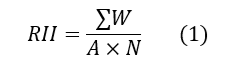
The primary metric for risk ranking, calculated as:
Where:
- = sum of severity scores (Likelihood × Impact) assigned to each risk factor by all respondents
- = highest possible weight (25)
- = total number of respondents (80)
RII values range from 0 to 1, with higher values indicating greater perceived importance. Risks were ranked by descending RII.
Descriptive Statistics: Mean scores, standard deviations, and frequency distributions supplemented RII analysis to characterize risk profiles and respondent demographics.
Correlation Analysis: Pearson correlation examined relationships between risk severity and project performance outcomes (cost, time, quality).
Analysis was performed using SPSS v28 and Microsoft Excel.
3.4.2 Qualitative Analysis
Interview transcripts and open‑ended survey responses underwent thematic analysis (Braun & Clarke, 2006): (1) familiarization with data through repeated reading; (2) initial coding of meaningful segments; (3) grouping codes into potential themes; (4) reviewing and refining themes; (5) defining and naming final themes; (6) producing the analytical narrative. Themes were mapped onto quantitative findings to explain why certain risks ranked highly and how they manifest in practice.
3.4.3 Integration of Methods
Quantitative rankings identified which risks matter most; qualitative analysis explained why they matter and how they operate in context. Case study data provided concrete illustrations of abstract risk categories. This triangulation enhanced validity and practical relevance.
3.5 Ethical Considerations
The study adhered to ethical research principles: informed consent obtained from all participants; anonymity and confidentiality assured (no personal identifiers in reporting); voluntary participation with right to withdraw; data stored securely with restricted access. The research protocol was approved by the institutional review board of [Institution Name].
3.6 Validity and Reliability
Validity: Content validity was ensured through literature‑grounded instrument design and expert review. Construct validity was supported by factor analysis confirming risk category groupings. External validity was enhanced by diverse sampling across organization types and project categories.
Reliability: Internal consistency assessed via Cronbach’s alpha (α = 0.87 for risk items, indicating good reliability). Test‑retest reliability confirmed with a 10% subsample (r = 0.91).
4. Results and Findings
4.1 Respondent Demographics
Table 1 presents the demographic characteristics of the 80 survey respondents.
Table 1: Respondent Demographics (N = 80)
| Characteristic | Category | Frequency | Percentage |
| Job Position | Site Engineer | 22 | 27.5% |
| Storekeeper | 18 | 22.5% | |
| Procurement Officer | 16 | 20.0% | |
| Contractor/Project Manager | 14 | 17.5% | |
| Other | 10 | 12.5% | |
| Experience | <5 years | 18 | 22.5% |
| 5–10 years | 24 | 30.0% | |
| 11–15 years | 19 | 23.8% | |
| >15 years | 19 | 23.8% | |
| Organization Type | Consultant | 28 | 35.0% |
| Contractor | 22 | 27.5% | |
| Supplier | 16 | 20.0% | |
| Client (Owner) | 14 | 17.5% | |
| Project Type | Residential | 31 | 38.8% |
| Commercial | 19 | 23.8% | |
| Infrastructure | 18 | 22.5% | |
| Educational | 12 | 15.0% |
The sample reflects broad sectoral representation, enhancing generalizability within Port Sudan’s construction industry.
4.2 Ranking of Risk Factors by Relative Importance Index
Table 2 presents the 18 risk factors ranked by RII, with mean severity scores and standard deviations.
Table 2: Risk Factor Ranking by Relative Importance Index (N = 80)
| Rank | Risk Factor | Mean Likelihood (1–5) | Mean Impact (1–5) | Mean Severity (1–25) | RII | Std. Dev. |
| 1 | Port/custom clearance delays | 4.6 | 4.7 | 21.6 | 0.89 | 2.1 |
| 2 | Price fluctuations of materials | 4.4 | 4.8 | 21.1 | 0.87 | 2.3 |
| 3 | Dependence on imported materials | 4.5 | 4.5 | 20.3 | 0.85 | 2.0 |
| 4 | Transportation/logistics problems | 4.3 | 4.6 | 19.8 | 0.83 | 2.2 |
| 5 | Lack of reliable suppliers | 4.2 | 4.5 | 18.9 | 0.81 | 2.4 |
| 6 | Delays in material delivery | 4.1 | 4.4 | 18.0 | 0.78 | 2.3 |
| 7 | Limited local availability | 4.0 | 4.3 | 17.2 | 0.75 | 2.1 |
| 8 | Poor procurement planning | 3.8 | 4.4 | 16.7 | 0.73 | 2.5 |
| 9 | Lack of skilled labor | 3.9 | 4.1 | 16.0 | 0.71 | 2.2 |
| 10 | Weather conditions (heat, humidity, salt) | 3.7 | 4.2 | 15.5 | 0.69 | 2.0 |
| 11 | Poor storage conditions | 3.6 | 4.1 | 14.8 | 0.67 | 2.3 |
| 12 | Material damage during storage | 3.4 | 4.0 | 13.6 | 0.62 | 2.4 |
| 13 | Theft or loss of materials | 3.2 | 3.9 | 12.5 | 0.58 | 2.6 |
| 14 | Communication gaps | 3.3 | 3.7 | 12.2 | 0.56 | 2.1 |
| 15 | Shortage of materials on site | 3.1 | 3.8 | 11.8 | 0.54 | 2.5 |
| 16 | Inaccurate inventory records | 2.9 | 3.6 | 10.4 | 0.49 | 2.3 |
| 17 | Poor site handling of materials | 2.8 | 3.5 | 9.8 | 0.47 | 2.2 |
| 18 | Excess materials | 2.4 | 3.1 | 7.4 | 0.38 | 2.0 |
Note: RII = Relative Importance Index; Severity = Likelihood × Impact.
Key Observations:
- The top five risks all relate to external supply chain vulnerabilities (port operations, import dependence, logistics, supplier reliability), reflecting Port Sudan’s position as a port city in a conflict‑affected national economy.
- Price fluctuations ranked second despite moderate likelihood (4.4/5), due to extremely high perceived impact (4.8/5) on project budgets.
- Storage and handling risks (ranks 11–17) were perceived as less critical than supply‑side risks, though still significant.
- Excess materials ranked lowest, suggesting that scarcity—not overstocking—is the dominant concern.
4.3 Impact on Project Performance
Respondents rated the perceived impact of materials management risks on four project outcomes. Table 3 summarizes the results.
Table 3: Perceived Impact of Materials Risks on Project Performance (N = 80)
| Performance Metric | Mean Rating (1–5) | % Rating “High” or “Very High” Impact |
| Project cost overrun | 4.3 | 78% |
| Project schedule delay | 4.1 | 72% |
| Quality reduction | 3.8 | 60% |
| Material waste increase | 3.6 | 54% |
Correlation analysis revealed strong positive relationships between top‑ranked risks and negative outcomes:
- Port/custom delays ↔ Cost overrun r = 0.76, p < 0.01
- Price fluctuations ↔ Cost overrun r = 0.81, p < 0.01
- Lack of reliable suppliers ↔ Schedule delay: r = 0.68, p < 0.01
These findings confirm that materials management risks substantially compromise project performance in Port Sudan.
4.4 Current Materials Management Practices
Survey data on current practices revealed significant gaps between ideal and actual management approaches (Table 4).
Table 4: Current Materials Management Practices (N = 80)
| Practice | % of Respondents |
| Use formal materials management system | 42% |
| Use software‑based tracking (e.g., ERP, specialized tools) | 28% |
| Use Excel/manual tracking only | 45% |
| Use no systematic tracking | 27% |
| Rate current practices as “Effective” or “Very Effective” | 31% |
| Rate current practices as “Ineffective” or “Very Ineffective” | 48% |
Qualitative Insights on Practice Gaps:
Interviewees highlighted several barriers to effective materials management:
“We plan procurement based on last month’s prices, but by delivery time, cement may have doubled. There is no mechanism to lock prices.” (Procurement Officer, Contractor)
“Our storage yard has no roof. When the khamsin winds bring sand and salt spray, reinforcement steel corrodes before we even use it.” (Site Engineer, Consultant)
“Customs clearance can take 3 days or 3 weeks—no one can predict. We either delay work or pay premiums for air freight.” (Project Manager, Client)
4.5 Case Study: Telecommunications Regulatory Authority Building
Analysis of monthly progress reports for Contract No. 2411‑015 (December 2025–April 2026) illustrated how top‑ranked risks manifest in practice.
Documented Challenges:
- Port/Customs Delays: Curtain wall mockup approvals delayed 21 days due to pending customs clearance of imported aluminum profiles.
- Price Volatility: Concrete and reinforcement costs increased 18% between contract signing and April 2026, requiring contract variation negotiations.
- Storage Limitations: On‑site storage capacity insufficient for bulk material deliveries, leading to double‑handling and minor damage to finish materials.
Mitigation Attempts: The contractor implemented advance bulk purchasing for critical items and negotiated price escalation clauses for subsequent variations.
Performance Outcomes:
- Schedule slippage: 28 days (3% of project duration) attributed primarily to material delivery delays.
- Cost impact: Estimated 12% budget increase due to material price escalation and expedited logistics.
- Quality: No major defects reported, though minor rework was required for materials exposed to saline air during storage.
This case corroborates survey findings: external supply chain risks drive delays and cost growth, while storage constraints create secondary quality risks.
4.6 Thematic Analysis of Qualitative Data
Thematic analysis of interviews and open‑ended responses yielded five overarching themes explaining the quantitative rankings.
Theme 1: Port‑Centric Vulnerability
Port Sudan’s dependence on maritime imports creates a single point of failure. Respondents consistently identified port congestion, customs bureaucracy, and military prioritization of cargo as root causes of delays. One supplier noted: “When military shipments arrive, civilian materials wait. There is no transparency in the queue.”
Theme 2: Market Instability and Forecasting Failure
Extreme price volatility undermines conventional procurement planning. With currency depreciation exceeding 200% since 2023 and import restrictions fluctuating unpredictably, contractors struggle to forecast costs or secure fixed‑price contracts. A project manager explained: “We quote projects in SDG, but suppliers demand USD. The exchange rate changes daily.”
Theme 3: Infrastructure Deficits Amplify Operational Risks
Inadequate storage facilities, poor road connectivity, and unreliable electricity exacerbate materials handling challenges. Several interviewees emphasized climate effects: “Port Sudan’s heat and salt air accelerate corrosion. Without covered, ventilated storage, materials degrade before installation.”
Theme 4: Skills Shortage Constrains Adaptive Capacity
The outmigration of experienced engineers and tradespeople has reduced firms’ ability to implement sophisticated materials management practices. A senior consultant noted: “We train new staff on the job, but they lack the experience to anticipate problems.”
Theme 5: Informal Adaptation as Survival Strategy
In the absence of formal systems, practitioners rely on personal networks, advance payments, and improvisation to keep projects moving. While enabling short‑term continuity, these approaches increase long‑term risk and inequity. A contractor admitted: “We call our cousin who knows someone at the port. It works, but it’s not scalable or fair.”
These themes contextualize the statistical rankings, revealing the systemic, interconnected nature of materials management risks in Port Sudan.
5. Discussion and Mitigation Framework
5.1 Interpretation of Key Findings
The dominance of port/customs delays, price fluctuations, and import dependence among top risks underscores Port Sudan’s structural vulnerability as a port city in a conflict‑affected economy. These are not merely operational challenges but manifestations of deeper systemic issues: institutional fragility, market distortion, and infrastructural deficit. The high perceived impact of these risks on cost and schedule aligns with global literature identifying supply chain uncertainty as a primary driver of project failure in developing contexts (Ogunlana et al., 2002; Ho et al., 2015).
The moderate ranking of storage and handling risks does not imply insignificance; rather, it suggests that practitioners perceive securing materials as a more immediate priority than preserving them. However, case study evidence indicates that poor storage conditions contribute to quality defects and rework—costs that may be underreported in survey responses due to attribution challenges.
The low adoption of formal management systems (42%) and digital tracking tools (28%) reflect both resource constraints and a rational adaptation to high‑uncertainty environments. When external risks dominate, investing in internal process optimization may yield limited returns—a phenomenon documented in fragile state literature (Goodhand, 2013).
5.2 Proposed Mitigation Framework
Based on empirical findings, we propose a five‑pillar mitigation framework tailored to Port Sudan’s context (table 5). Each pillar addresses specific risk categories while acknowledging resource constraints and implementation feasibility.
Table 5: Context‑Appropriate Mitigation Framework for Port Sudan
| Pillar | Key Actions | Target Risks | Stakeholders |
| Pillar 1: Strategic Local Sourcing & Supplier Diversification | Establish framework agreements with multiple suppliers; develop pre‑qualified local supplier database; explore local manufacturing alternatives. | Import dependence (RII=0.85); Lack of reliable suppliers (RII=0.81) | Contractors, industry associations, government |
| Pillar 2: Adaptive Procurement Planning | Include price escalation clauses in contracts; use rolling forecasts with buffer stocks for critical materials; adopt dual‑currency budgeting. | Price fluctuations (RII=0.87); Poor procurement planning (RII=0.73) | Clients, contractors, procurement officers |
| Pillar 3: Climate‑Adapted Storage Infrastructure | Invest in covered, ventilated storage with corrosion protection; implement modular, low‑cost storage units; adopt first‑in‑first‑out (FIFO) protocols. | Weather conditions (RII=0.69); Poor storage (RII=0.67); Material damage (RII=0.62) | Contractors, site managers, donors |
| Pillar 4: Simple Digital Tracking Tools | Deploy mobile‑compatible inventory apps (offline‑capable); use QR/barcode scanning for stock control; provide basic training for site staff. | Inaccurate inventory (RII=0.49); Shortage on site (RII=0.54); Theft (RII=0.58) | Contractors, technology providers, NGOs |
| Pillar 5: Workforce Training & Capacity Building | Conduct on‑site materials handling workshops; develop short courses in procurement and inventory management; establish mentorship programs with experienced professionals. | Lack of skilled labor (RII=0.71); Poor site handling (RII=0.47) | Contractors, training institutions, industry associations |
5.3 Implementation Considerations
- Phased Approach: Given resource constraints, implementation should prioritize quick wins (Pillars 4 and 5—digital tools and training) while building toward systemic changes (Pillars 1–3).
- Stakeholder Roles:
- Government: Facilitate port/customs process improvements; develop storage infrastructure guidelines; support training programs.
- Industry Associations: Coordinate supplier databases; organize shared storage initiatives; advocate for policy reforms.
- Contractors/Consultants: Adopt framework agreements; invest in basic digital tools; train site staff.
- Donors/NGOs: Fund pilot projects for storage infrastructure; support digital tool localization; facilitate knowledge exchange.
- Monitoring and Evaluation: Establish simple metrics (e.g., percentage reduction in delivery delays, cost variance, waste rates) to track mitigation effectiveness and enable adaptive management.
5.4 Limitations of Proposed Framework
The framework acknowledges inherent constraints:
- It cannot eliminate macro‑level risks (conflict, currency volatility) but aims to enhance adaptive capacity.
- It requires minimum levels of security, connectivity, and institutional cooperation to implement.
- Benefits may accrue unevenly, potentially favoring larger firms with greater implementation capacity.
Continuous stakeholder engagement and iterative refinement are essential to ensure relevance and equity.
6. Conclusions and Recommendations
6.1 Summary of Conclusions
This study provides the first empirical analysis of construction materials management risks in Port Sudan, a city experiencing unprecedented transformation as Sudan’s de facto capital amid ongoing conflict. Key conclusions include:
- External supply chain vulnerabilities dominate risk perceptions, with port/customs delays, price fluctuations, import dependence, logistics problems, and supplier reliability constituting the top five risks. These reflect Port Sudan’s structural position within a fragile national economy.
- Materials management risks substantially compromise project performance, with 78% of respondents reporting high cost overrun impacts and 72% reporting significant schedule delays. Quality and waste impacts, while moderate, remain consequential.
- Current management practices exhibit significant gaps, with fewer than half of firms using formal systems and only 28% employing digital tracking tools. Informal adaptation strategies enable short‑term continuity but increase long‑term vulnerability.
- Context‑specific mitigation requires a multi‑pillar approach addressing strategic sourcing, adaptive planning, climate‑adapted storage, simple digitalization, and workforce development. No single intervention suffices; integrated, phased implementation is essential.
- Research‑practice integration is critical: Academic risk frameworks must be translated into actionable, resource‑appropriate strategies for practitioners operating under extreme constraints.
6.2 Recommendations
For Practitioners (Contractors, Consultants, Suppliers):
- Prioritize supplier diversification and framework agreements with price escalation clauses to mitigate import‑related risks.
- Invest in basic covered storage infrastructure and corrosion protection for critical materials.
- Adopt simple, mobile‑compatible digital tracking tools to improve inventory visibility and decision‑making.
- Implement on‑the‑job training programs to build materials handling capacity among site staff.
For Policymakers (Municipal, State, National):
- Streamline port and customs procedures for construction materials, with transparent prioritization criteria.
- Develop and disseminate minimum standards for construction materials storage in coastal climates.
- Support industry associations in creating shared supplier databases and benchmarking initiatives.
- Integrate construction sector resilience into broader urban recovery and infrastructure planning frameworks.
For Researchers and Academia:
- Conduct longitudinal studies to track how risk profiles evolve as Port Sudan’s transition continues.
- Develop and test low‑cost digital tools tailored to low‑connectivity, low‑literacy construction contexts.
- Expand comparative research across conflict‑affected port cities to identify transferable mitigation strategies.
- Strengthening partnerships between academic institutions and industry to ensure research relevance and uptake.
6.3 Directions for Future Research
This study opens several avenues for further investigation:
- Quantitative modeling of risk interdependencies and cascading effects on project networks.
- Cost‑benefit analysis of proposed mitigation interventions to guide resource allocation.
- Gender‑disaggregated analysis of materials management roles and risk exposure.
- Climate resilience integration, examining how materials management practices can adapt to increasing extreme weather events.
- Digital innovation pilots, testing the feasibility and impact of context‑appropriate tracking technologies.
6.4 Final Reflection
Port Sudan’s construction sector operates at the intersection of conflict, displacement, and infrastructure crisis. The risks identified in this study are not merely technical challenges but manifestations of deeper political, economic, and social dynamics. Effective materials management in this context requires more than improved processes—it demands adaptive leadership, collaborative governance, and sustained investment in human and institutional capacity. By grounding risk mitigation in empirical evidence and local reality, this research aims to contribute to more resilient, equitable, and effective infrastructure delivery in Port Sudan and similar contexts worldwide.
References
Akintoye, A. (2000). Analysis of factors influencing project cost estimating practice. Construction Management and Economics, 18(1), 77–89.
Ameyaw, E. E., Chan, A. P., & Adjei‑Kumi, T. (2012). Risk assessment in public‑private partnership infrastructure projects: Empirical comparison between Ghana and China. Construction Innovation, 12(2), 214–237.
Assaf, S. A., & Al‑Hejji, S. (2006). Causes of delay in large construction projects. International Journal of Project Management, 24(4), 349–357.
Braun, V., & Clarke, V. (2006). Using thematic analysis in psychology. Qualitative Research in Psychology, 3(2), 77–101.
Chapman, C., & Ward, S. (2003). Project Risk Management: Processes, Techniques and Insights (2nd ed.). Wiley.
Coward, M. (2014). Urbicide: The Politics of Urban Destruction. Routledge.
Creswell, J. W., & Plano Clark, V. L. (2018). Designing and Conducting Mixed Methods Research (3rd ed.). Sage.
Elhag, A., & Mohamed, H. (2025). Informal construction networks and urban resilience in war‑affected African cities. Journal of Urban Planning and Development, 151(2), 04025012.
FAO (Food and Agriculture Organization). (2024). Water Scarcity and Urban Adaptation in the Horn of Africa. Rome: FAO.
Goodhand, J. (2013). Aiding Peace? The Role of NGOs in Armed Conflict. Kumarian Press.
Gunduz, M., Nielsen, Y., & Ozdemir, M. (2013). Quantification of delay factors using the relative importance index method for construction projects in Turkey. Journal of Management in Engineering, 29(2), 133–139.
Ho, W., Zheng, T., Yildiz, H., & Talluri, S. (2015). Supply chain risk management: A literature review. International Journal of Production Research, 53(16), 5031–5069.
ICG (International Crisis Group). (2023). Preventing a Catastrophic War in Sudan. Africa Report No. 317. Brussels: ICG.
Marshall, A. (2020). Syria’s War Economy: From Conflict to Reconstruction. Chatham House.
Meagher, K. (2019). War and Cities: The Urbanisation of Conflict. Polity Press.
Muya, M., Chileshe, N., & Mwanaumo, E. (2019). Small and medium construction enterprises in Sub‑Saharan Africa: Challenges and opportunities. Journal of Engineering, Design and Technology, 17(3), 567–585.
OCHA Sudan (UN Office for the Coordination of Humanitarian Affairs). (2025). Humanitarian Response Plan: Infrastructure & Shelter Sector Update. Khartoum: OCHA.
Ofori, G. (2015). Construction Industry Development in Developing Countries: Issues and Strategies. Routledge.
Ogunlana, S. O., Promkuntong, K., & Jearkjiran, V. (2002). Construction delays in a fast‑growing economy: Comparing Thailand with other economies. International Journal of Project Management, 20(1), 37–45.
Polat, G., & Ballard, G. (2004). The impact of materials management on project performance. Proceedings of the 12th Annual Conference of the International Group for Lean Construction, 305–314.
Sambasivan, M., & Soon, Y. W. (2007). Causes and effects of delays in Malaysian construction industry. International Journal of Project Management, 25(5), 517–526.
Schneider, M. (2018). Reconstruction Contracting in Iraq: Lessons for Future Conflicts. RAND Corporation.
Teravaninthorn, S., & Raballand, G. (2009). Transport Prices and Costs in Africa: A Review of the Main International Corridors. World Bank.
Thomas, H. R., & Sakarcan, A. S. (1994). Forecasting model for total craft labor cost. Journal of Construction Engineering and Management, 120(1), 224–239.
UNHCR (United Nations High Commissioner for Refugees). (2024). Sudan Emergency Update. Geneva: UNHCR.
WHO (World Health Organization). (2025). Water, Sanitation, and Health Risks in Rapidly Expanding IDP Settlements. Geneva: WHO Press.
World Bank. (2022). Sudan Economic Monitor: Port Sector Performance. Washington, DC: World Bank Group.
World Bank. (2024). Sudan Economic Monitor: Infrastructure Under Duress. Washington, DC: World Bank Group.
Zeng, J., An, M., & Smith, N. J. (2007). Application of a fuzzy based decision-making methodology to construction project risk assessment. International Journal of Project Management, 25(6), 589–600.
 English
  Arabic