

Investigating Teachers’ Perspectives towards Utilizing Skype App to Promote EFL Learners’ Speaking Skill
اتجاهات المعلمين نحو استخدام تطبيق سكايب لتعزيز مهارة التحدث لدى متعلمي اللغة الإنجليزية كلغة أجنبية
Dr. Saad Abbakar Bakheet Ahmed1, Dr. Sabir Mirgani Ali Ahmed2
1 University of Zalingei, Sudan.
2 Sudan University of Science and Technology, Sudan.
DOI: https://doi.org/10.53796/hnsj73/14
Arabic Scientific Research Identifier: https://arsri.org/10000/73/14
Volume (7) Issue (3). Pages: 210 - 223
Received at: 2026-02-12 | Accepted at: 2026-02-19 | Published at: 2026-03-01
Abstract: This study investigates teachers’ perspectives on the use of Skype applications to enhance EFL learners’ speaking skills in Sudanese universities. Adopting a descriptive analytical design, the researchers collected data through a structured questionnaire administered to 105 English language teachers. The data were analyzed using SPSS, employing descriptive statistics and Chi-square tests to examine the study hypothesis. The findings indicate that teachers generally hold positive attitudes toward integrating Skype into EFL classrooms. Results reveal that Skype facilitates real-life communication exposure, supports diverse oral activities, enhances speaking fluency through video interaction, and promotes authentic listening practice. The statistical analysis confirmed significant differences in favor of positive responses, supporting the hypothesis that Skype implementation contributes to improving learners’ oral communicative competence. The study recommends integrating Skype-based activities into English language curricula to foster active participation and develop speaking proficiency.
Keywords: Skype Application, EFL Learners, Speaking Skill, Oral Communicative Competence, Teachers’ Attitudes.
المستخلص: تهدف هذه الدراسة إلى تقصي اتجاهات معلمي اللغة الإنجليزية في الجامعات السودانية نحو استخدام تطبيق سكايب في تنمية مهارة التحدث لدى متعلمي اللغة الإنجليزية كلغة أجنبية. اعتمدت الدراسة المنهج الوصفي التحليلي، وتم جمع البيانات من خلال استبانة وُزعت على (105) من معلمي اللغة الإنجليزية. وقد تم تحليل البيانات باستخدام برنامج الحزم الإحصائية للعلوم الاجتماعية (SPSS)، مع توظيف الإحصاءات الوصفية واختبار مربع كاي للتحقق من فرضية الدراسة. أظهرت النتائج أن المعلمين يمتلكون اتجاهات إيجابية نحو دمج تطبيق سكايب في تدريس اللغة الإنجليزية، حيث يسهم في توفير نماذج للتواصل الواقعي، ودعم الأنشطة الشفوية المتنوعة، وتعزيز الطلاقة اللغوية من خلال التفاعل عبر الفيديو، إضافة إلى تنمية مهارات الاستماع في سياقات حقيقية. كما أكدت النتائج وجود فروق ذات دلالة إحصائية لصالح الاستجابات الإيجابية، مما يدعم فرضية الدراسة بأن توظيف سكايب يسهم في تطوير الكفاءة التواصلية الشفوية لدى المتعلمين. وتوصي الدراسة بدمج أنشطة قائمة على تطبيق سكايب ضمن مناهج اللغة الإنجليزية لتعزيز المشاركة الصفية وتنمية مهارة التحدث.
الكلمات المفتاحية: تطبيق سكايب، متعلمو اللغة الإنجليزية كلغة أجنبية، مهارة التحدث، الكفاءة التواصلية الشفوية، اتجاهات المعلمين.
Introduction
Skype app based online sources enables teachers and students to cancel distances, shorten time, and make the world more like a screen. The role of Skype app is not only in one field but in all walks of life like: scientific, cultural, and economic fields of life. Education is required to meet the demands of this growing scientific acceleration (Al Musa& Al Mubara, 2005). The main goal of education is not only to help the learners in cognitive domain but to make them able to improve their skills and competences according to needs and requirement of modern technological era (Al Musa& Al Mubara, 2005).
Technology is used mostly in all fields of life and play great role especially in teaching learning process that is why the previous research studies and practical experiences revealed that students who conduct their learning online are better than those students who try to learn the second language through traditional methods of learning second language like English, as seen in our daily routine that those university level young learners who use online sources like Skype, Facebook, Twitter, and WhatsApp users are more competent than those learners who do not use any source of online sources for learning of English as a foreign language (Pichette, 2003).
Statement of the problem
Skype apps presentation can be enjoyable for all instructors and learners who are eager to enhance their classroom abilities and knowledge. Teachers of English do not videos in their classroom. Therefore, website is a major provider with the largest amount of educational videos. EFL learners can benefit from the exposure to educational Skype apps to improve their oral communicative competence; however, our educational institutions are not paying attention to its benefits and ignoring it in their process of teaching English language. So the effectiveness of Skype apps presentation is highly recommended by teachers. It appears to promote students in an active communication. The researcher has tackled this issue so as to address this problem.
Study objective:
This Study sets out to answer the following objective:
To find out the implementation of Skype apps enhances EFL learners’ speaking skill.
Study Question:
What are teachers’ attitudes towards implementing Skype apps to enhance EFL learners’ speaking skill?
Study Hypothesis:
Teachers have positive attitudes towards implementing Skype apps to enhance EFL learners’ speaking skill.
Significance of the Study
This study will be of great significance to the students in terms of using. It will be of great significance to teachers of English to discover the ideal way of interaction through using Skype apps. It will be of great significance to the curriculums and syllabus designers to invent new way of information communication technology.
Study Scope
This study was limited to investigate teachers’ perspectives towards utilizing Skype apps to promote EFL learners speaking skill. It hoped that will tentatively cover the academic year (2018- 2019). It was conducted at Sudan University of Science and Technology, College of Languages, and study sample will be exclusively drawn from teachers of English at varies Educational institutions.
Methodology
The researcher adopted the descriptive analytical method. One instrument is used as primary tool for data collection. A questionnaire was given to teachers of English at varies educational institutions.
Definition of Skype
According to Wikipedia, Skype is free communication software that allows users to make calls, send instant messages and do video conferencing online. It is one of the best voices -over-internet services online and was created in 2003 by Niklas Zennstrom and Janus Friis but later on was owned by Microsoft particularly in the year 2011.
Skype is free software that turns your computer into a worldwide videoconferencing that allows you to talk –with or without a video –and to send instant written messages to other people who have Skype accounts wherever they are in the world, i.e. Skype is used to chat, talk or send attachments such as word documents and photos to other people (Kevin Jarret in Solomon and SChrum, 2010).
Technically, Skype is a VoIP (Voice over Internet Protocol) software. The VoIP is the ‘routing of voice conversations over the Internet or any other IP-based network’ (Fryer, Skype in the Classroom, 2005).
Skype is classified as a Technology Enhanced Learning (TEL) that is defined as ‘any online facility or system that directly supports learning and teaching. This may include a formal Virtual Learning Environment (VLE), an institutional intranet that has learning and teaching component, a system that has been developed in house or a particular suite of specific individual tools.’ (Trajkovik and Mishev, 2013:1).
In other words, Skype is a technological tool which could be used for educational purposes within a virtual educational environment.
The explosion of the internet across the globe has resulted in the rise of social media and new ways for people to communicate. It can also allow researchers to interview research participants anywhere in the world as long as the participant has access to the telephone or computer with a headset or webcam. This eliminates the need for travel and to find a private meeting location.
Skype in Classroom
Skype is a software application that uses voice over Internet protocol (VoIP) technology “which converts voice signals into data streams that are sent over the Internet and converted back to audio by the recipient’s computer” (Educause, 2007).
Skype provides both synchronous and asynchronous communication services. With a webcam and a headset, Skype users can have person –to person or person-to-group online chats or conferences, which enables communication without the limitations of time and space. It is this feature that makes Skype a potential tool for language teaching and learning.
According to Elia (2006), Skype facilitates language tandem exchange in which “two people of different mother tongues collaborate in the learning of each other’s language”.
Skype in the classroom, launched in March 2011, is a website especially designed for educational purposes. It is a platform where teachers and students can disseminate information about their classes, share educational resources, and find partners to start classroom projects.
A number of businesses and organizations (e.g. River & Rowing Museum, NASA Digital Learning Network, and Penguin Books) have partnered with Skype in the classroom to provide provocative and meaningful Skype lessons. Anyone who has a Skype account can use their Skype name and password to sign in to Skype in the classroom and decide to be a lesson participant or creator.
According to Cindy Phthisic(2010) in her article” the basic technical requirements for getting started with Skype, a web-based video conferencing tool”, there are some ways to exploring possibilities by using Skype in classroom:
- Reading to another class.
Classes ask volunteers to sign up and read to students. It can be students acting out a story as it is read or simply reading a book.
Older students can share a story with younger students or vice versa. This is a great activity for “Read across America Day,” and they will likely have many other classes eager to collaborate with another for a Skype call.
2. Connecting with reading buddies.
This option provides an opportunity for one-to-one interaction. A student in another class Skype in to read to or with another student similar to a virtual tutoring session. Becoming a virtual reading buddy is a great way for pre-service teachers to practice both teaching reading and working with technology
3. Sharing projects.
Students have worked all semester long on a project and teacher would love to have them make a formal presentation to another group of students. Students can virtually present projects to another class and have the other class critique their work.
To take this one step, teacher could pair students from each class to work on the project virtually and then work together to present the projects via Skype.
4. Polishing language skills.
Foreign-language teachers have embraced Skype as a powerful tool to reinforce second-language acquisition. By partnering with a class in another country, both classes can refine their conversational skills. It also serves as a way for students to gain firsthand knowledge of another culture. Be aware, however, that time-zone differences can sometimes make these collaborations prohibitive.
Definition of Speaking
Speaking is considered to be the most important active skill(Widdowson, 1994) for a foreign language learning (Khamkhien, 2010). It is producing utterances for communicating messages (Rodriques, 2000:32). It starts from infancy to be developed during childhood to maturity (Levelt, 1989: 2).
Speaking is an interaction process of constructing meaning that involves producing and receiving and processing information (Babu, 2010). Its form and meaning are depending on the content in which it occurs, including the participants themselves, their collective experiences, the physical environment, and the purpose of speaking.
It is often spontaneous, open ended, and evolving. However, speech is not always unpredictable – language functions (or patterns) that tend to recur in certain discourse situations (e.g. declining an invitation or requesting time off from work), can be identified and charted (Babu, (2010), for example, when a sales person asks “may I help you?”, the expected discourse sequence includes a statement of need, response to the need, other of appreciation, acknowledgement of the appreciation, and a leave-taking exchange, speaking requires that learners not only know now to produce specific points of language such as grammar, pronunciation, or vocabulary (linguistic conference), but also that they understand when, why and in what ways to produce language (socio linguistic conference). Finally speech has its own skills structure, and conversations different from written language (Burns & Joyce, 1997, Carter & McCarthy, 1995; Cohen, 1996). A good speaking synthesizes this array of skills and knowledge to succeed in given speech act.
Abdel Salam (2002) defined speaking as a collection of micro-skills which include syntax, grammar, morphology, pragmatics or social language, semantics and phonology. Speaking is an interactive process because it requires the involvement of another person unlike listening, reading or writing (Noll, 2006: 70). Speaking skill isn’t only producing the utterances, but it is the complete process of constructing meanings producing utterances and receiving and processing information (Brown, 1994) with confidence(Bygate, 1987).
The meaning formation depends on the context, purpose, subject matter of the speech and the speaker’s personality (Jaffe, 2011:202) and the physical environment of the situation. It also includes the participants, their relationship, their cultural backgrounds, and their experience in the topic. We need speaking for many reasons;
Educators, governments, ministries of education and employers need people who can speak English well. Companies and organizations want staff who can speak English for international marketing. Good English speaking students have a great chance of further education, of finding employment and gaining promotion. It also helps students to access up-t-date information in different fields of sciences (Baker &Westrup, 2003: 5)
In speaking, learners try out new vocabulary and develop working knowledge of language form and structure once visually prompt and culturally familiar information are provided. In oral learning, facing clues like intonation and gesture enhances understanding (Dawes, 2008: 44).
To know a certain amount of grammar and vocabulary doesn’t help learners of a foreign language to master it, they also need to employ the forms and the new vocabulary items into real-life situations. The teacher’s role has been shifted from building repertoire to teach and test items to building students’ skills in using these items (Jensen, Sandrock&Franklin: 2007:32).
Oral skills should be taught before writing skills. Time for oral rehearsal of the sentence is of key importance (Hiatt &Rooke, 2002: 31) as well.
National and international research indicates that student voice plays a crucial role when learners are actively involved in decision-making processes, engaged in exploratory and constructive learning experiences, provided with personalized learning opportunities, encouraged to share leadership responsibilities, and exposed to authentic real-life contexts (Department of Education and Early Childhood Development, 2009).
In speaking tests, it’s necessary to get students to actually say something to recognize that there is a difference between knowledge about a language and the skill to use it(Bygate, 2003). By this, learners of the language treat what they learnt and processed sounds and words to compose oral outcomes for specific purposes suiting the context in which it occurs. Such a process includes the participants or the speaking partners, the experience, the physical environment and the purposes for speaking (Baker &Westrup, 2003).
Speaking is integrated with listening skill. Speakers should have their audience and receive feedback for understanding the meanings of the messages sent by the speakers ( Jones,1996).
Listening is a deliberate process by which a sound is given a meaning (Ferrington, 2003).
The process was explained by Barclay (2011) who cited in her book that hearing is a physiological process in which sound waves are collected through the hearing machine to be transmitted to the brain for analysis and comprehension. Comprehension is to understand the native speech at normal speed in their world-like situations (Chastain, 1971:136).
Importance of Speaking Skill
Speakers can’t produce effective and appropriate outcomes until they have been exposed to some specific linguistic competences such as grammar, pronunciation and vocabulary, as well as the sociolinguistic competence such as register of the expression sand the contextualizing of the language. Teachers were used to focusing on teaching grammar and vocabulary in isolation which made it difficult if not impossible for teachers and assessors to assess language use ability (Mckay, 2006: 48).
Speech is not always unpredictable as language functions or patterns that tend to recur in certain discourse situations; inviting, requesting, offering, greeting, and introducing selves.
Speaking has a meaning when it enables children and young people to explore their own selves and clarify their identity. They can manage to understand and respect their own selves ( Ranson, 2000). When speaking happens, learners express their views; feel confident to speak up when issues of high interest occur. They also develop a range of skills, strategies and behaviors which assist them to manage the challengeable situations.
Fielding and Ruddock (2002) explained that speaking opportunities facilitate a stronger sense of membership, respect and self-worth, learning management, agency and personalizing learning. CelceMurcia’s(2001) stated that authenticity is very important when students ought to speak. The topics should be of great interests to the learners with focus on meanings, values, collaboration, social development and provision of a rich context.
The researcher sums up the importance of speaking as follows:
a)Speaking is the communication tool to transform ideas (Conrad &Dunek, 2012: 74), express feelings (Bar-On, 2004: 246), explain about discoveries, research results and discussions and responding to others.
b) Mastering speaking skills makes the speaker a well-rounded communicator who is a proficient in the four language skills. Such skillfulness provides the speaker with several distinct advantages which let them enjoy sharing idea with others and managing to understand and respect their own selves ( Ranson, 2000)
c) Mastering speaking skills helps the speaker to gain the attention of the audience and hold it till the completion of his/her message.
d) Speaking skills are important to achieve the career success. Speaking enhances one’s personal life by giving opportunities for travel, promotion, scholarships, or to attend conferences, international meetings, represents organizations in international events.
e)Speaking to the public gives speakers the power to influence people and shape their decisions (Griffin, 2008: 19).
f)Speaking is a cross-cultural communication system whose function is to regulate consensus with respect to the recognition of cross-cultural identities and the coordination of a nation’s political, economic, and social functions with other nations (Cushman & Cahn, 1985: 13).
g) Speakers of a foreign language develop a range of skills, strategies and behaviors which assist them to manage the challengeable situations.
h)Speaking opportunities facilitate a stronger sense of membership, respect and self-worth, learning management, agency and personalizing learning( Fielding and Ruddock, 2004).
For most people, the ability to speak English is very important. It has often been viewed as the most demanding of the other four skills. For that, we frequent ask the question “Do you speak English?” to foreign language learners rather than asking them “Do you write in English”. The question displays the importance of speaking as skill because mastering this skill means mastering other skills, as Ur (2000, p.12) states
“of all the four skills, speaking seems institutively the most important: people who know a language are referred to as ‘speaker’ of the language, as if speaking included all other kind of knowing”.
Speaking skill needs to be skilled in the other language skills. Therefore, with speaking, students can enhance their writing skill and develop their vocabulary and grammar.
In addition, good speaker needs good listener to improve his/her oral-aural skill. For instance, EFL learners can express themselves, argue, give opinions, ask, request and do other functions of language. So far, speaking is very important inside and outside classroom as well as speaking is a complex process whereby people sending and receiving messages verbally or none verbally.
Population of the Study
The population of the present study consists of Sudanese’s university teachers to check their perspectives towards Implementing Skype apps to promote students’ speaking skill. The sample of the study consists of (105) teachers of English which was given open- ended questionnaire.
Tools of the Study
The questionnaire was adopted as primary tool for collecting data for the purpose of the main study. It was designed for the teachers. The researchers have used the questionnaire as tool to collect the information of the study.
The questionnaire was given to the (105) teachers of English who have been selected randomly.
It uses Likert the 5-point scale (strongly agree, agree, neutral, disagree and strongly disagree). The statements are about the Investigating Instructors Attitudes towards Implementing Educational YouTube Videos to develop Oral Communicative Competence. The questionnaire includes (4) statements has given to (105) teachers of English. It was judged by experienced professors and doctors from Sudanese University. The responses of the questionnaire were given to an expert in statistics.
Results and Discussion
In this section, the data is analyzed and discussed in terms of the results of the teachers’ questionnaire. There was one question and one hypothesis to be answered and tested respectively. The respondents, on whom the questionnaire was applied, were 105 respondents. Method used to analyze the data was descriptive statistics (frequency and percentages)
Statistical Package for the social Sciences (SPSS) was used to analyze the data. Chi-Square tests were applied to examine the observed differences in the frequency distribution of responses on all the statements of the questionnaire in order to guarantee their statistical significance.
In analyzing the data, the following statistical tests were considered:
- Reliability coefficient was used to check the reliability of the test used in the study.
Descriptive statistics which include frequency, mean, SD and Chi- Square were used to describe the basic features of the data collection.
Analysis of Teachers’ Questionnaire
Hypothesis: Teachers have positive attitudes towards implementing Skype apps to enhance EFL learners’ speaking skill.
Item No.( 1): Using Skype Apps is considered tool for improving my learners’ speaking skill.
Table No (4.1 )The Frequency Distribution for the Respondents’ Answers of Question No.( 1)
|
Valid |
Frequency |
Percent% |
|
strongly agree |
4 |
13.3 |
|
Agree |
6 |
20 |
|
Neutral |
3 |
10 |
|
Disagree |
14 |
46.7 |
|
strongly disagree |
3 |
10 |
|
Total |
30 |
100.0 |
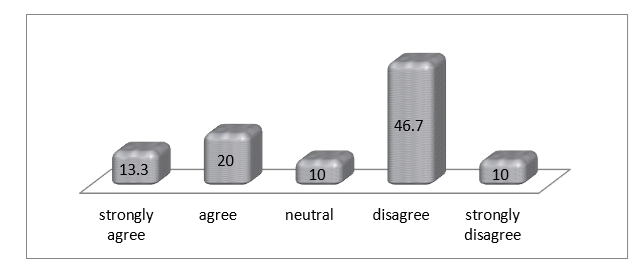
Figure No (4.1 )The Frequency Distribution for the Respondents’ Answers of Question No.( 1)
It is observed from the above table ( 4.1) and figure (4.1 )display that there are (4) participants in the study sample with percentage (13.3%) strongly agreed with that ” ): Using Skype Apps is considered tool for improving my learners’ speaking skill”. There are (6) participants with percentage (20.0%) agreed with that, and (3) participants with percentage (10.0%) were not sure that, and (14) participants with percentage (46.7%) disagreed. and (3) participants with 10% are strongly disagreed. This proves that Skype Apps should be taken into account when learning speaking skill.
Item No.(2): Using Skype Apps provides my learners with samples of real life communication .
Table No (4.2)The Frequency Distribution for the Respondents’ Answers of Question No.( 2)
|
Valid |
Frequency |
Percent% |
|
strongly agree |
19 |
60 |
|
Agree |
9 |
33.4 |
|
Neutral |
1 |
3.3 |
|
Disagree |
1 |
3.3 |
|
strongly disagree |
0 |
0 |
|
Total |
30 |
100.0 |
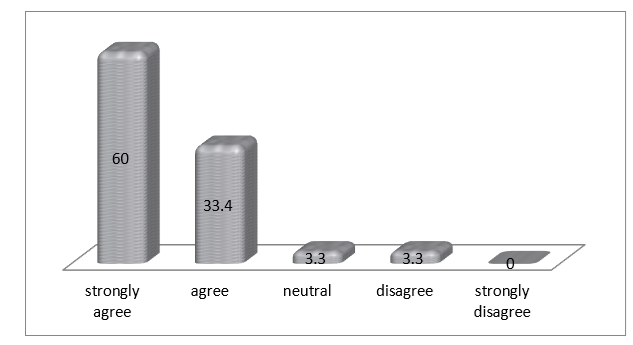
Figure No (4.2 ) The Frequency Distribution for the Respondents’ Answers of Question No.( 2)
It is clear from the above table (4.2 ) and figure ( 4.2) demonstrate that there are (19) participants in the study sample with percentage (60.0%) strongly agreed with that ” Using Skype Apps provides my learners with samples of real life communication “. There are (9) participants with percentage (33.3%) agreed with that, and (1) participants with percentage (3.3%) were not sure that, and (1) participants with percentage (3.3%) disagreed. and (0) participants with 0% are strongly disagreed. This indicates that students should expose to Skype Apps.
Item No.(3): Using Skype Apps in ELT helps my learners practice different kinds of oral activities.
Table No (4.3)The Frequency Distribution for the Respondents’ Answers of Question No.(3 )
|
Valid |
Frequency |
Percent% |
|
strongly agree |
17 |
53.3 |
|
agree |
11 |
36.7 |
|
neutral |
2 |
6.7 |
|
disagree |
1 |
3.3 |
|
strongly disagree |
0 |
0 |
|
Total |
30 |
100.0 |
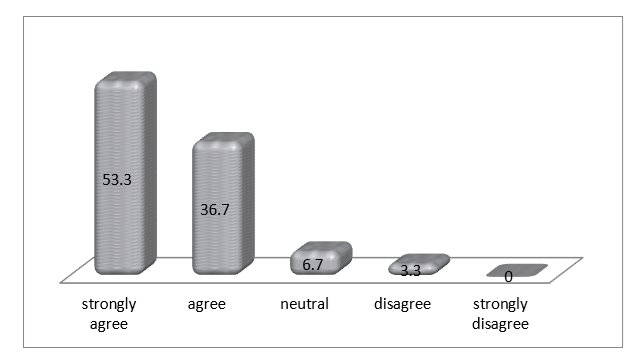
Figure No (4.3 ) The Frequency Distribution for the Respondents’ Answers of Question No.(3 )
It is noticed from the above table (4.3 ) and figure (4.3 ) that there are (17) participants in the study sample with percentage (53.3%) strongly agreed with that ” Using Skype Appsin ELT helps my learners practice different kinds of oral activities”. There are (11) participants with percentage (36.7%) agreed with that, and (2) participants with percentage (6.7%) were not sure that, and (1) participants with percentage (3.3%) disagreed. and (0) participants with 0% are strongly disagreed. This justifies that oral activities should be developed by using Skype Apps.
Item No.(4 ): Watching Videos through Skype Apps helps my learners enhance speaking fluency.
Table No (4.4 )The Frequency Distribution for the Respondents’ Answers of Question No.( 4)
|
Valid |
Frequency |
Percent% |
|
strongly agree |
15 |
50 |
|
Agree |
13 |
43.4 |
|
Neutral |
1 |
3.3 |
|
Disagree |
1 |
3.3 |
|
strongly disagree |
0 |
0 |
|
Total |
30 |
100.0 |
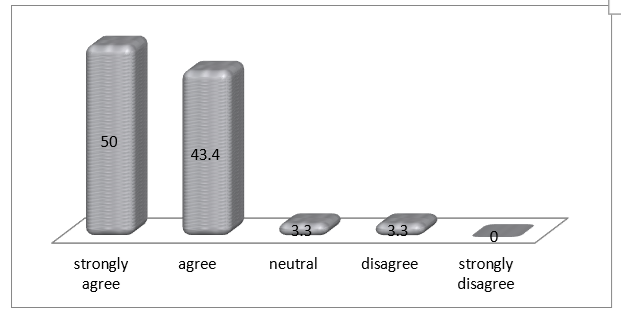
Figure No (4.4) The Frequency Distribution for the Respondents’ Answers of Question No.(4)
It is obvious from the above table (4.4 ) and figure (4.4 ) display that there are (15) participants in the study sample with percentage (50.0%) strongly agreed with that ” Watching Videos through Skype Apps helps my learners enhance speaking fluency “. There are (13) participants with percentage (43.4%) agreed with that, and (1) participants with percentage (3.3%) were not sure that, and (1) participants with percentage (3.3%) disagreed. and (0) participants with 0% are strongly disagreed. This proves that speaking fluency should be enhanced by watching Skype Videos.
Statement No (5): Applying Skype Appsinside EFL classroom helps my learners listen to the language in its real context.
Table No ( 4.5) The Frequency Distribution for the Respondents’ Answers of statement No.( 5)
|
Valid |
Frequency |
Percent |
|
|
strongly agree |
6 |
20.0 |
|
|
agree |
12 |
40.0 |
|
|
neutral |
3 |
10.0 |
|
|
disagree |
8 |
26.7 |
|
|
strongly disagree |
1 |
3.3 |
|
|
Total |
30 |
100.0 |
|
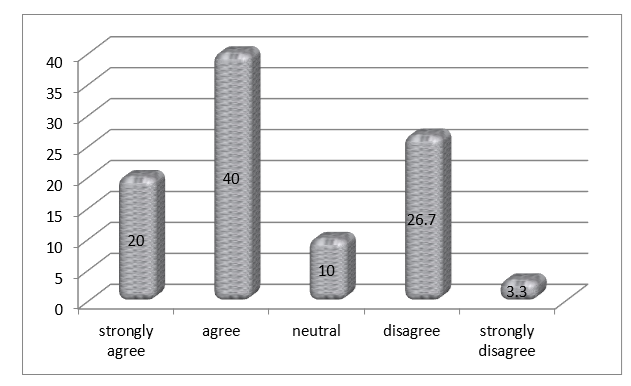
Figure No ( 4.5) The Frequency Distribution for the Respondents’ Answers of statement No.( 5)
From the above table (4.5 ) and figure ( 4.5) we can see that there are (6) participants in the study sample with percentage (20.0%) strongly agreed with “Applying Skype Apps inside EFL classroom helps my learners listen to the language in its real context.”There are (12) participants with percentage (40.0%) agreed with that, and (3) participants with percentage (10.0%) were not sure that, and (8) participants with percentage (26.7%) disagreed. and (1) participants with 3.3% are strongly disagreed. This indicates that Skype Apps should be applied inside classroom.
Table (4.16) the Mean and Standard Deviation and Chi-square Values Hypothesis (1) : Teachers have positive attitudes towards implementing Skype apps to enhance EFL learners’ speaking skill.
|
Nom. |
Statement |
mean |
SD |
Chi square |
p-value |
|
1 |
Using Skype Apps is considered tool for improving my learners’ speaking skill. |
3.7 |
0.4 |
20 |
0.023 |
|
2 |
Using Skype Apps provides my learners with samples of real life communication. |
2.4 |
0.7 |
25 |
0.010 |
|
3 |
Using Skype Apps in ELT helps my learners practice different kinds of oral activities.
|
3.3 |
0.7 |
23 |
0.006 |
|
4 |
Watching Videos through Skype Apps helps my learners enhance speaking fluency. |
2.5 |
3.8 |
15 |
0.046 |
|
5 |
Applying Skype Apps inside EFL classroom helps my learners listen to the language in its real context. |
3.4 |
2.3 |
22 |
0.000 |
Source: The researcher from applied study, SPSS 24
The calculated value of chi-square for the significance of the differences for the respondents’ answers in the No (1) question was (20) which is greater than the tabulated value of chi-square at the degree of freedom (4) and the significant value level (5%) which was (4.12). this indicates that, there are statistically significant differences at the level (5%) among the answers of the respondents, which support the respondent who agreed with the statement “Using Skype Appsis considered tool for improving my learners’ speaking skill.
The calculated value of chi-square for the significance of the differences for the respondents’ answers in the No (2) question was (25) which is greater than the tabulated value of chi-square at the degree of freedom (4) and the significant value level (5%) which was (4.12). this indicates that, there are statistically significant differences at the level (5%) among the answers of the respondents, which support the respondent who agreed with the statement “Using Skype Appsprovides my learners with samples of real life communication.
The calculated value of chi-square for the significance of the differences for the respondents’ answers in the No (3) question was (23) which is greater than the tabulated value of chi-square at the degree of freedom (4) and the significant value level (5%) which was (4.12). this indicates that, there are statistically significant differences at the level (5%) among the answers of the respondents, which support the respondent who agreed with the statement “Using Skype Appsin ELT helps my learners practice different kinds of oral activities.
The calculated value of chi-square for the significance of the differences for the respondents’ answers in the No (4) question was (15) which is greater than the tabulated value of chi-square at the degree of freedom (4) and the significant value level (5%) which was (4.12). this indicates that, there are statistically significant differences at the level (5%) among the answers of the respondents, which support the respondent who agreed with the statement “Watching Videos through Skype Apps helps my learners enhance speaking fluency.
The calculated value of chi-square for the significance of the differences for the respondents’ answers in the No (5) question was (22) which is greater than the tabulated value of chi-square at the degree of freedom (4) and the significant value level (5%) which was (4.12). this indicates that, there are statistically significant differences at the level (5%) among the answers of the respondents, which support the respondent who agreed with the statement “Applying Skype Apps inside EFL classroom helps my learners listen to the language in its real context.”
According to the previous results it’s clear that the first hypothesis of our study is accepted.
Conclusion
In conclusion, videos are the aids that can be present in both audio and visual for educational purposes.
To sum up the researchers’ point of view, EFL teachers can increases their knowledge in oral communicative competence via implementing educational YouTube Videos ,The study attempt to highlight Instructors Attitudes towards Implementing Educational YouTube Videos to develop Oral Communicative Competence , the results revealed that instructors have positive Attitudes towards Implementing Educational YouTube Videos to develop Oral Communicative Competence , the study recommended that Curriculum designers should integrate YouTube Videos in English syllabuses.
References
Djahida L (2017) The Role of Educational YouTube videos in Improving EFL Learners speaking skill , Mohamed Khidar University of Biskra , Faculty of letters and Language .
Medoukall F (2015) developing EFL learners Listening Comprehension Through YouTube videos , Mohamed Kheidar University of Biskra , Faculty of Arts and Languages.
Vian Y (2015) Teachers and students perceptions Towards The use of YouTube Videos in An English classroom , University of Hong Kong Faculty of education .
.
 English
  Arabic