

Improving Data Freshness (Age of Information) in Multi-Hop Wireless Networks: A Comparative Evaluation of Fresh-CSMA and Conventional CSMA Mechanisms
تحسين حداثة البيانات (عمر المعلومات) في الشبكات اللاسلكية متعددة القفزات: تقييم مقارن لآليتَي Fresh‑CSMA و CSMA التقليدية
Assistant Lecturer / Jasim Mohammed Kadhim1
1 General Directorate of Education in Basra Governorate, Human Resources Department, Allowances and Promotions Division, Iraq.
DOI: https://doi.org/10.53796/hnsj711/26
Arabic Scientific Research Identifier: https://arsri.org/10000/711/26
Volume (7) Issue (11). Pages: 494 - 510
Received at: 2026-10-10 | Accepted at: 2026-10-17 | Published at: 2026-11-01
Abstract: The purpose of this work is presented in detail in the body of this paper. The objective of this work is to present a fresh look at the improvement of the data freshness within large-scale, multi-hop wireless networks and also to compare the Fresh-CSMA and Conventional CSMA in order to measure data freshness. Data freshness is important because in real-time applications such as IoT, sensor networks, smart monitoring, and industrial control systems, the value of the data that has been sent via wireless networks is based on two factors: the successful delivery and how new the information sent is when it was received at the destination. Therefore, in order to measure the freshness of an update, the Age of Information (AoI) has been utilized as the key measure of the performance of data updates. In order to accomplish the previous objectives, a Python-based simulation model of a multi-hop wireless network consisting of 2000 nodes was created, through which packets were generated, forwarded, and received through multiple intermediate nodes.
Keywords: Age of Information, Fresh-CSMA, Conventional CSMA, Multi-Hop Wireless Networks, Data Freshness, Packet Delivery Ratio, Network Delay.
المستخلص: يُعرض الغرض من هذا العمل بالتفصيل في متن البحث. ويهدف العمل إلى تقديم رؤية جديدة لتحسين حداثة البيانات في الشبكات اللاسلكية واسعة النطاق ومتعددة القفزات، ومقارنة آليتَي Fresh-CSMA وCSMA التقليدية من حيث حداثة البيانات. وتكتسب حداثة البيانات أهمية في تطبيقات الزمن الحقيقي، مثل إنترنت الأشياء وشبكات المستشعرات والمراقبة الذكية وأنظمة التحكم الصناعي؛ لأن قيمة البيانات المرسلة عبر الشبكات اللاسلكية تعتمد على عاملين: نجاح تسليمها ومدى حداثة المعلومات عند وصولها إلى الوجهة. لذلك، استُخدم عمر المعلومات (AoI) مقياسًا رئيسًا لتقييم أداء تحديثات البيانات. ولتحقيق هذه الأهداف، أُنشئ نموذج محاكاة بلغة بايثون لشبكة لاسلكية متعددة القفزات تضم 2000 عقدة، تُولَّد فيها الحزم وتُمرَّر وتُستقبَل عبر عدة عقد وسيطة.
الكلمات المفتاحية: عمر المعلومات، Fresh-CSMA، CSMA التقليدية، الشبكات اللاسلكية متعددة القفزات، حداثة البيانات، نسبة تسليم الحزم، تأخير الشبكة.
1. Introduction
The increase in the number of latency-sensitive applications in the last few years (IoT networks, real-time monitoring, smart control systems) is leading researchers to focus on data freshness and timely delivery as key performance metrics for wireless communication systems. Traditional quality of service metrics such as throughput and delay are inadequate for measuring the effectiveness of status updates provided by wireless communication systems because they are not measuring the actual time that data was received at the destination, resulting in the establishment of Age of Information (AoI) as a basic measurement for quantifying the age of status updates in networked systems by merging timing and delivery into one metric [1]. The AoI research area has expanded dramatically with the increase in large-scale and multi-hop wireless networks [2].
Many of the previous studies that have explored the analytical properties of AoI have done so primarily in terms of the different protocols and channel models being used (e.g., CSMA-based environments) and their impact on updating time via contention to access the medium [3]. In a multi-hop environment, analyzing AoI becomes more complex due to cumulative delays at intermediate nodes and the interplay between queuing behavior and transmission behavior [4]. The previous analytical work that has been done has developed bounds and probability distributions for AoI in these types of networks and has highlighted the challenges that arise when maintaining a low degree of information age as the size of the network increases [5].
While many of the earlier studies have been focused on centralized scheduling and simple random access, in recent years, there has been more emphasis in the research literature on freshness-aware distributed protocols. For instance, Tripathi et al. introduced Fresh-CSMA, a distributed scheduling protocol that prioritizes fresher packets when choosing which packets to send as compared with traditional CSMA, which treats all packets equally [6]. This work has demonstrated that the use of freshness-aware access can theoretically and practically approximate optimal scheduling behavior. Additionally, the AoI metric is being used to address evolving network architectures, including unreliable multi-hop routing with age-sensitive metrics [7] and correlated source scenarios in which spatial redundancy has an impact on update timeliness [8].
Surveys of AoI in massive IoT networks indicate that new access and scheduling protocols are necessary to balance throughput, delay, and freshness, particularly for high-density traffic scenarios [9]. Emerging 2026 research has started incorporating AoI into utility-based routing frameworks by linking the value of timely delivery to costs associated with forwarding a packet through unreliable multi-hop networks [10]. Collectively, these developments reflect a growing consensus in the research community that in order to support real-time decision-making and time-sensitive applications, it will be necessary to develop innovative MAC and scheduling mechanisms to optimize data freshness in next-generation wireless networks.
2. Related Work
2.1. FreshCSMA
Liang and Zhou (2025) perform a comprehensive analysis of the Age of Information (AoI) in carrier sense multiple access (CSMA) networks that incorporate both temporal and spatial correlations of multiple sources compared to prior work which assumes independent sources (i.e., where each source generates its own information). They employ correlation models between the multiple sources of data in conjunction with stochastic hybrid systems (SHS) modeling for jointly modeling contention on the network, backoff procedures, packet collisions, and spatial redundancy. They derive closed-form expressions for average AoI under numerous correlation approaches and propose an approach for estimating average AoI in cases where the correlation matrix is either partially or fully known. Their simulation studies demonstrate that the exploitative nature of spatial correlations greatly decreases the AoI in the CSMA environment, particularly within dense Internet of Things (IoT) environments. Thus, they made an important contribution towards improving the freshness of information in distributed CSMA systems [11].
In their paper, Wang and Cheng (2025) propose a new approach using Deep Learning to augment stochastic hybrid systems (SHS) when modelling and analysing the age of information (AoI) within heterogeneous, unsaturated CSMA networks. Traditionally, analytical models (whether closed-form or simulation) have been particularly effective under high, or saturated, traffic conditions; the introduction of deep learning into SHS captures network conditions more realistically given that nodes may have much different traffic patterns and levels of contention. Thus, the hybrid model improves predictions of AoI and provides greater accuracy than classical analytical models; the unique build of the model accommodates non-regular backoffs and thus produces a higher quality prediction due to this model’s ability to represent a range of arrival characteristics from nodes within a CSMA environment. The simulation results consistently demonstrate that the proposed model provides a superior performance over traditional/hybrid classical SHS approaches; therefore, this model will serve as a practical tool for providing accurate AoI assessments in realistic CSMA environments [12].
Wang and Cheng (2025) introduce a stochastic hybrid systems (SHS) model that combines deep learning to analyse and reduce age of information (AoI) in heterogeneous, unsaturated CSMA networks. Unlike other analytical models based on idealised/assumed uniform traffic and network conditions, the authors of this study use the real-world variations of non-uniform packet arrivals, collisions and heterogeneous nodes to create a more representative model of the CSMA network. The deep learning model is used to provide predictions of the network’s future behaviour and consequently adapt the SHS model based on this new data to determine AoI more accurately for a range of network states. The simulated results of the new approach indicate that average AoI and peak AoI are significantly improved compared to both classic SHS models and standard CSMA analyses.
Additionally, the researchers provided insight into the optimum sampling rates and buffer management methods to achieve freshness in multi-hop wireless networks. Researchers should find this work beneficial when developing freshness-aware MAC protocols as it integrates analytical modelling with data-driven prediction to address both timeliness and reliability in actual CSMA deployments. [13].
Liang and Zhou (2025) also contribute to our understanding of the impact of correlation of sources on Age of Information in a CSMA network. The authors studied how aggregated updates that come from correlated sources (e.g., sensors that report on the same event) can provide theoretical and experimental evidence to support the idea that redundancy will reduce congestion on a network and improve freshness of the information without changing the current MAC protocol. The primary conclusion drawn from this work was that designing aggregation/scheduling strategies from a correlation perspective will reduce the transmission of redundant packets on the network, thus reducing contention on the network and improving AoI. The results of this work will inform the design landscape of freshness aware access protocols by demonstrating that the semantics of the data as well as the correlation of the data from multiple sources, could be used to complement the use of existing majority access mechanisms of the MAC Layer (e.g., Fresh CSMA), which ultimately will benefit the transmission of time sensitive data [14].
Presented at the 2024 IEEE INFOCOM, this study introduced an enhanced SHS model that demonstrates finite buffer performance and realistic collision dynamics and is intended to improve AoI performance in practical CSMA networks. The authors establish upper and lower bounds for the AoI and evaluate the impact of applying various buffer management techniques, back off algorithms, and contention window sizes on AoI performance for different traffic flows. The experimental results demonstrate that a minor modification in buffer management techniques can create considerable reductions in the AoI when using a typical non-freshness aware CSMA approach therefore; the results serve as design principles applicable to other MAC Layer protocols that promote timeliness, such as Fresh CSMA, will to improve timeliness [15].
In their work Zheng et al. (2023) present a thorough survey of existing Reinforcement Learning based Medium Access Control (MAC) protocols used in various forms of wireless ad hoc networks. This research examines how adaptive MAC protocols can improve channel access in a dynamic multi-hop environment through reinforcement learning from network characteristics, such as interference, density of nodes, and traffic patterns. The authors also identify and classify current mechanisms of adaptive MAC protocol design using both model-free and model-based Reinforcement Learning techniques based on their impact on various network performance metrics, including throughput, delay, packet delivery ratio (PDR), and Age of Information (AoI).
Moreover, they emphasize the potential for intelligent MAC mechanisms to provide priority to newer packets, decrease collisions, and adjust contention windows dynamically, and point out that Fresh-CSMA shares these same goals in an effort to minimize the Age of Information. Through the summary of existing adaptive MAC protocols, this research provides both theoretical insights as well as practical information that can be used to design freshness-aware medium-access protocols for large scale, multi-hop wireless networks. Thus, this study will serve as an excellent resource for better understanding how AI-assisted MAC decisions can improve the timeliness and reliability of communication over wireless networks, and therefore represents an extremely useful reference for future research investigating AoI optimization [16].
2.2. Conventional CSMA
Li et al. conduct analysis on the behaviour of CSMA/CA networks for Age of Information (AoI) when subjected to varying traffic scenarios. The research demonstrates that conventional backoff procedures and FIFO queuing in highly dense networks are causing the AoI to grow in time. The author’s research concludes that CSMA will support the throughput but it introduces longer delays for the delivery of information in a multi hop network due to queuing at intermediate nodes and as a result will significantly degrade the freshness of information [17].
In another work, Fan and Hou develop an analytical framework to analyze the AoI of CSMA networks using second-order metrics which incorporate not only averages of delay but also include variations in packet delivery times. The results indicated that the AoI is influenced by both high interference and node density within the network, and highlights significant limitations of conventional CSMA in producing timely updates [18]. The authors’ work also discusses the impact of bursty traffic within CSMA networks and the associated AoI. Their results indicate that conventional CSMA is unable to support the generation of multiple bursts of packets simultaneously thus causing information at the destination to be stale. Additionally, the study suggests that conventional CSMA would benefit from a mechanism to provide priority to newer packets [19].
A review on AoI in massive IoT networks by Abbas et al. reveals how well traditional CSMA protocols, with regard to throughput and packet delivery ratios, perform when applied to freshness-critical applications. Systematic reviews of both theoretical and simulation results demonstrate the limitation of conventional CSMA in delivering timely information within networks that have high density of users and packet generation [20]. Maatouk et al. explore the implications of AoI in CSMA environments and show that both contention and random backoff can generate delays that increase with the number of hops required for a packet to reach its destination. These results indicate that traditional approaches to CSMA are not effective in providing high priority to the most recent packets, resulting in suboptimal timeliness of information in larger networks [21].
Chen et al. investigate the use of utility-based routing methods in CSMA networks and the effect of unreliable links. The researchers demonstrate that conventional CSMA treats every packet equally, resulting in stale information reaching its intended destination. The authors conclude that therefore there is a need for modification of CSMA protocols to support freshness-aware routing to enhance the timeliness of delivered information [22].
2.3. Multi-Hop Wireless Networks
The investigation by Zhang et al. focuses on enhancing the performance of large-scale multi-hop wireless networks that have been deployed with high density. In the study, an analytical model of packet delay and throughput is presented that illustrates the significant impact increased node density has on latency and reliability. The results of their study identify efficient routing and medium access control as being critical to packet forwarding within the more congested multi-hop environments [23].
The simulator developed by Li & Wang evaluates energy consumption and throughput in multi-hop Internet of Things (IoT) networks. The results demonstrate that by using energy-efficient routing in conjunction with adaptive MAC protocols, there is an increase in both the life of the network and its data freshness. As a result, design guidelines for large-scale deployments are provided in this study [24]. In the research conducted by Chen et al., they examined the effect of interference and relay selection on packet delivery in multi-hop wireless networks. They demonstrated that using intelligent relay selection strategies resulted in reduced packet loss and increased end-to-end latency, which provides insights for the enhancement of protocols used in real-world implementation [25].
Kumar & Singh suggested a model for a multi-hop network that includes the principles of queue management and congestion control for reduced delays in networks. The simulations were successful in demonstrating that by using appropriate scheduling and prioritizing queues resulted in a significant decrease in overall packet delay, which is essential for applications that are real-time [26].
Analysis by Patel et al., evaluated throughput and reliability of multi-hop wireless sensor networks operating under dynamic traffic patterns. They demonstrated that adaptive backoff and retransmission techniques can be utilized to maintain a high ratio of successful packet delivery when the network is heavily loaded, thus increasing overall network performance [27].
Sun et al. provided a data and theoretical analysis of AoI within multi-hop networks, along with an analytical framework for estimating AoI under various routing and MAC techniques. Results indicated that by using AOI-sensitive routing strategies along with efficient MAC scheduling, AoI can be managed in a network and used to support real-time monitoring applications [28].
The study by Li et al. extends the concepts of traditional routing and scheduling in multi-hop wireless networks through the application of AI-based routing and scheduling methods. Their results conclude that machine learning utilized in making decisions regarding packet forwarding and access will result in improved throughput, reduced delay, and decreased AoI, providing a pioneering approach to use of intelligence within the management of multi-hop networks [29].
2.4. Network Delay
The research of Laarhuis and Chiumento into the relationship between capacity and delay of multi-hop wireless networks addresses one of the most major performance metrics for multi-hop scenarios, due to the many times a data packet will be delayed while it travels through different hops before finally arriving at the recipient’s computer or device. The researchers explain in their work that deriving a generalized formula for estimating delay in any random multi-hop configuration is very challenging due to the various factors affecting delay (i.e., routing decisions, number of nodes, density of nodes, and link schedules). Their work provides an analytical foundation for understanding why delay increases as a network gets larger and has more hops to traverse. This research is applicable to the current research because the experimental simulation being proposed is an example of an extensive multi-hop topology, in which delays in data packet delivery are extremely important to the Age of Information and freshness of data [30].
Also, Misbahuddin et al. developed a multi-hop routing approach to provide low latency and improved energy efficiency for large-scale LoRa Internet of Things (IoT) networks. The goal of this study is to provide a way to limit or eliminate latency while providing a reliable communications link in multi-hop IoT deployments. The proposed routing solution will dynamically select a path to reduce packet collisions and optimize latency in a multi-hop network. It is significant because it provides insight into the fact that reducing delay in multi-hop wireless systems cannot rely solely on the physical transmission speed but must also have intelligent routing and the ability to avoid collisions. The current study provides evidence that CSMA can encounter increasing delays in dense network conditions and that increased performance enhancements will be needed to maintain the timely delivery of packets [31].
Zhang et al. propose a low-latency data gathering scheduling scheme using multi-radio wireless multi-hop networks, focusing on efficient scheduling of transmission so that collected data experience reduced delays over multiple hops. Scheduling of transmissions will directly affect the delay of a network; specifically, as the density and number of competing nodes increase in a wireless environment, the impact on overall network delays will also increase. By utilizing multi-radio transmission and efficient scheduling, the authors greatly improve the timeliness of the data collection process. Their research supports the notion that MAC-layer and scheduling decisions impact end-to-end network delay, which ultimately impacts the Age of Information, throughput, and packet delivery behavior [32].
Liu et al. present a low-latency symbol synchronous communication scheme for use in multi-hop sensor networks. Unlike the conventional store-and-forward approach — where delays can be introduced due to the time required to receive and forward an entire packet — concurrent transmission within a multi-hop network will eliminate the added delay associated with a packet’s forwarding. The authors’ results demonstrate that their approach achieves very low end-to-end delays, and as such, would be suitable for both industrial IoT applications and robotic swarms that require stringent latency criteria. This study provides significant evidence to support the motivation of this work and to demonstrate that reducing delay is crucial to the operation of time-sensitive wireless networks [33].
RF-Zero-Wire, developed by Liu et al., builds on the concept of low-latency multi-hop communications by providing an RF communication protocol that is symbol synchronous for use within multi-hop wireless systems. The authors document that the latency gap that exists between wired and wireless communication can be a significant problem in application areas such as industrial sensor networks and robotic swarms and that, whereas nodes must wait until a complete packet has been received and forwarded, RF-Zero-Wire relays symbols concurrently, thereby reducing per-hop delays. The research reports delays on the order of sub-millisecond for small-length frames transmitted through multiple hops, demonstrating that the current design of multi-hop forwarding can be changed and optimized to minimize the effect of latency on hop-to-hop forwarding. Hence, this research strongly supports the assertion that conventional multi-hop communication mechanisms can be inadequate for ultra-low-latency application designs [34].
3. Methodology
3.1. Network Architecture and Setup
A wireless multi-hop network has been developed with 2000 total nodes. These nodes will allow communication to occur over multiple relay hops from just one source node (initial node) to its intended destination node (final node). Each of these nodes will have the ability to create, forward or receive packets. The intermediate nodes will forward packets toward their destination node. This network has been developed to emulate areas that have a large number of wireless devices (such as IoT sensors), where it is necessary that information be received in a timely manner. All nodes are assumed to have the same ability to transmit packets; however, packet collisions may occur as a result of two or more packets being transmitted simultaneously by different nodes within the system.
3.2. MAC Protocols Evaluated
In this study, we examine two MAC (Medium Access Control) protocols, referred to as Conventional_CSMA and Fresh_CSMA. Conventional_CSMA is an older, traditional MAC protocol which utilizes a contention-based technique for determining which node gets access to the channel. Since the nodes use a first-come first-served method of obtaining the channel, this often results in collision and retransmissions of packets. Fresh-CSMA uses this same contention-based MAC method; however, it attempts to implement a new mechanism that employs the use of “fresh packets.” By giving priority to transmitting the most current information, older packets in the queue will be discarded, as these older packets could impede timely delivery of “fresh” packets, and therefore will not be forwarded/received by the destination until much later than when the packet was created. As a result, the AoI (Age of Information) at the destination will be minimized.
3.3. Traffic Generation and Simulation Parameters
The packet generation rate from a source node is equal to two packets per second. Each time a source node generates a packet it is time stamped in order to track the amount of time that the packet has been in the queue. Therefore, when packets propagate through the system, they will be able to maintain their sequence, from one node to another (in other words, at each hop) the packets are in the order they were received from the upstream node by each intermediate node, using the active MAC protocol. The original Fresh-CSMA nodes transmit only the last packet that was received from the upstream node, while the conventional CSMA nodes transmit packets according to a first-come, first-served basis. The simulation will operate in parallel using the ThreadPoolExecutor, which will allow for simultaneous transmission at each hop, thereby minimizing the amount of processing overhead.
3.4. Packet Handling and Queue Management
In both communication protocols, source nodes queue generated packets prior to transmission. Conventional Carrier Sense Multiple Access (CSMA) has a traditional first-in-first-out (FIFO) queuing mechanism, in that regardless of how old a generated packet may be, it will eventually be transmitted – thus resulting in stale data accumulating in the queue. In contrast, Fresh Carrier Sense Multiple Access (Fresh-CSMA) implements a freshness-based queue management scheme such that, as each new packet is generated it replaces previously generated packets in the queue, if any exist. As such, only the latest information will be transmitted through the network, thus greatly reducing the chance of out-of-date information being received at the destination. Therefore, the difference in queuing mechanisms between Conventional CSMA and Fresh-CSMA represents the primary means by which the age of information (AoI) metric is improved with Fresh-CSMA compared to Conventional CSMA.
3.5. Performance Metrics
During the simulation, there were six metrics that were used to assess and compare the two protocols. The six metrics considered were Average Age of Information (Average AoI), Peak Age of Information (Peak AoI), Packet Delivery Ratio (PDR), Average Network Delay, Throughput and Cumulative Packets Received. The Average AoI informs the user of the mean age of packets received at each time step; whereas Peak AoI gives the user the maximum aged packet received at each time step. The PDR measures the percentage of packets delivered successfully by the protocol; Delay measures the average amount of time it takes packets to traverse the network; Throughput measures the total amount of data that is transferred; and Cumulative Packets measure the total number of packets delivered while the simulation is running.
3.6. Data Collection and Analysis
At each individual time interval all metrics are recorded into CSV files representing both protocol types. Plotting graphs for each metric displays both the value of each protocol side by side for quick visual reference on protocol performance comparison purposes and also provides numeric values contained within the CSV table to allow for quantitative comparison through graphing metrics. During analysis of data, specific time instances have been chosen for evaluating differences between AoI, PDR, Delay and Throughput among both protocol types with varying amounts of traffic load.
4. Results
This section compares Conventional_CSMA and Fresh_CSMA, operating in a 2000-node multi-hop wireless network. The blue line represents Conventional_CSMA; the green line represents Fresh_CSMA. Figure 1 shows both protocols are plotted together to visualize their difference in how they behave when used simultaneously. The table below Figure 1 gives the exact numeric values for both protocols for every time-slice for easy comparison.
The plot of the average age of information shows that for Conventional_CSMA, the average age of information steadily increases over time, indicating that packets will incur increasing latency before being delivered to the destination, thus causing the delivered information at the destination to be increasingly stale.
Fresh_CSMA maintains a significantly lower average age of information throughout its operation, allowing it to deliver much fresher data to the application than Conventional_CSMA because Fresh_CSMA provides priority to the newest packets. Therefore, from this data, it is easy for researchers to quantify the differences between the two protocols at each time-slice, clearly showing the advantages of using Fresh_CSMA in real-time monitoring applications.
This metric highlights the importance of developing freshness-aware MAC protocols to reduce latency and improve the timely delivery of data in dense multi-hop networks.
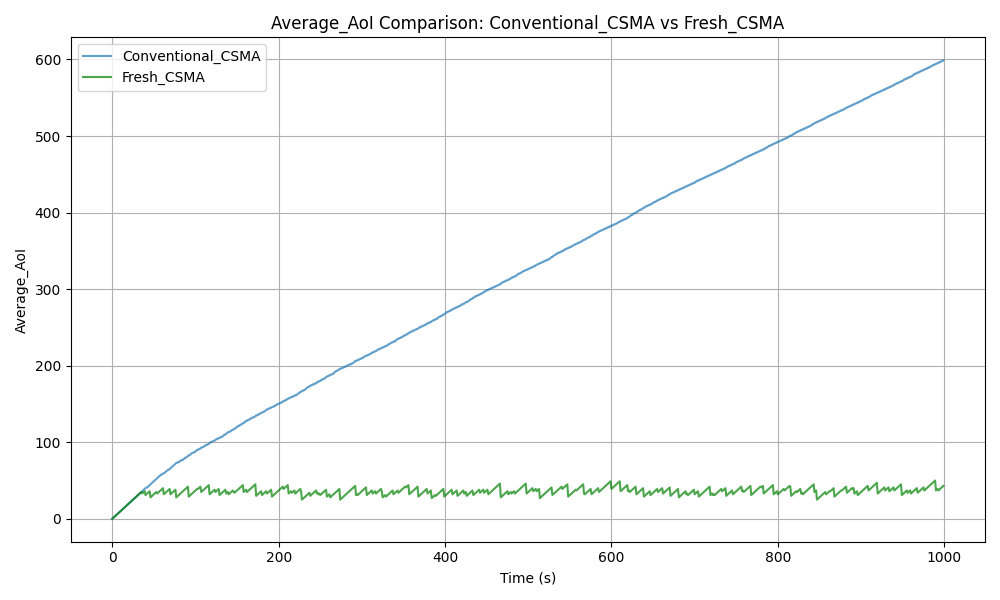
Figure 1: Average AoI comparison
Table 1: Average AoI comparison
| Time | Conventional_CSMA | Fresh_CSMA |
|---|---|---|
| 0 | 0 | 0 |
| 36 | 36 | 33 |
| 100 | 88 | 37 |
| 250 | 180 | 31 |
| 500 | 326 | 35 |
| 750 | 466 | 36 |
| 999 | 599 | 43 |
In Figure 2, we can see the overall volume of received packets at the destination plotted on a time axis. The cumulative volume of received packets will increase gradually from traditional CSMA due to congestion/collision, but will increase at a slower rate than the cumulative receiving rate of Fresh_CSMA due to being more discriminating towards newly arriving packets, thereby ensuring that newly accumulated packets contain more pertinent information. The table below shows the exact volume of received packets by time interval for both protocols, enabling a quantitative assessment of the difference between the two methods concerning throughput and timeliness. Thus, while the figure illustrates the pattern of cumulative packet volume, the table allows for an accurate measure of the differences between the two protocols regarding the volume of packets received.
The method of delivering packets employed by Fresh_CSMA does not allow for the accumulation of older, less useful packets from the network, thereby allowing critical updates to be delivered faster than they would have been if delivered using a lower total volume.
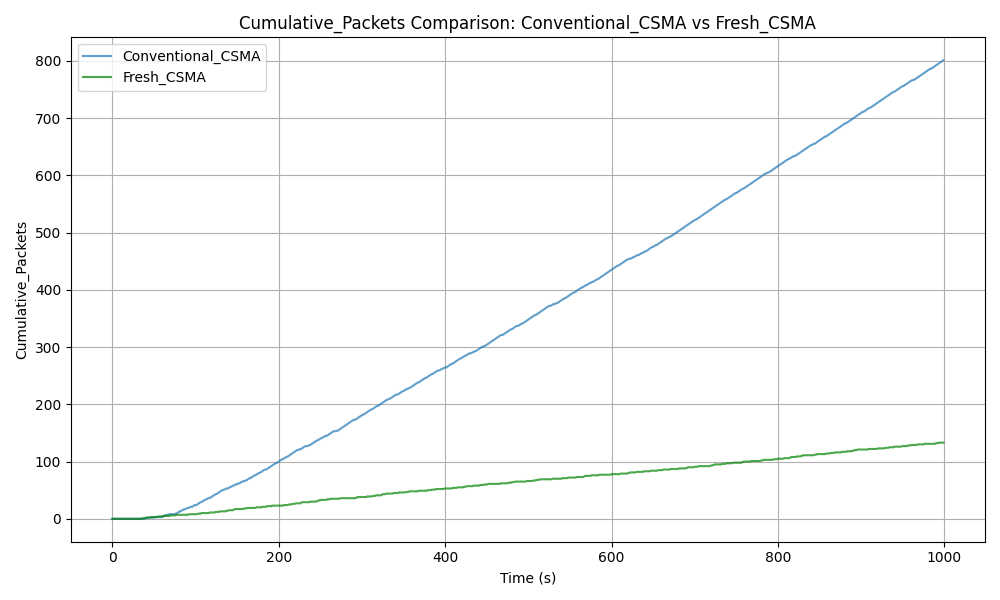
Figure 2: Cumulative Packets comparison
Table 2: Cumulative Packets comparison
| Time | Conventional_CSMA | Fresh_CSMA |
|---|---|---|
| 0 | 0 | 0 |
| 36 | 0 | 1 |
| 100 | 24 | 8 |
| 250 | 140 | 33 |
| 500 | 348 | 66 |
| 750 | 569 | 98 |
| 999 | 801 | 133 |
According to Figure 3, Mean Packet End-To-End Transit Time Between A Source And A Destination, shows that traditional CSMA (Carrier Sense Multiple Access Protocol) will increase incrementally with accumulating congestion over successive hops. In contrast, fresh CSMA maintains lower mean transit times due to the efficient management of queue priorities during transmission of packets in contrast to transmitting all packets based upon LIFO (Last In, First Out) principles. Numeric data for respective second latency values are also provided within the tables for each of the protocols which further assists in quantifying any latency difference between the protocols. Additionally, fresh CSMA is able to reduce the effect of queue delays by sending the most recently transmitted packet, thus improving the ability of an application to respond in a timely manner and is therefore more appropriate for use with real time applications than conventional CSMA.
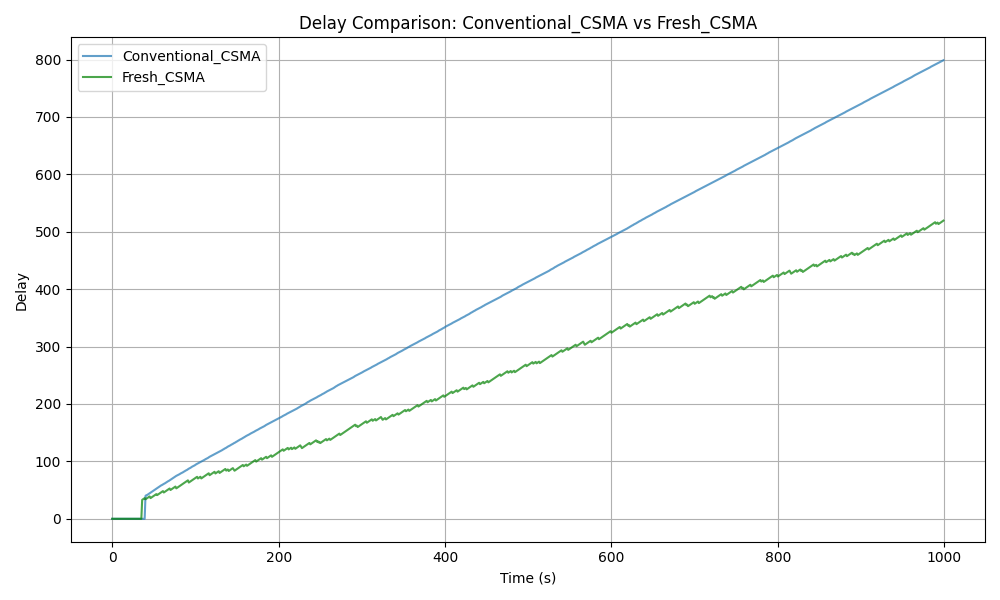
Figure 3: Delay comparison.
Table 3: Delay comparison.
| Time | Conventional_CSMA | Fresh_CSMA |
|---|---|---|
| 0 | 0.00 | 0.00 |
| 36 | 0.00 | 33.00 |
| 100 | 94.00 | 71.13 |
| 250 | 215.00 | 131.88 |
| 500 | 413.00 | 267.85 |
| 750 | 607.75 | 398.10 |
| 999 | 798.75 | 519.40 |
Figure 4 and Table 4 present the packet delivery ratio (PDR) as a function of time. The use of conventional carrier sense multiple access (CSMA) will have a lower PDR than can be attained when using fresh CSMA, due to the presence of packet collisions and retransmissions. There is a noticeable gap in the PDR values of the two protocols, which the data in the table allow for the exact PDR value for each time-step so that one can conduct a quantitative reliability analysis. Fresh CSMA provides a greater proportion of relevant packets being received at their intended destination than does conventional CSMA, thus enhancing both the efficiency and reliability of the overall network, as shown in Figure 4 and Table 4.
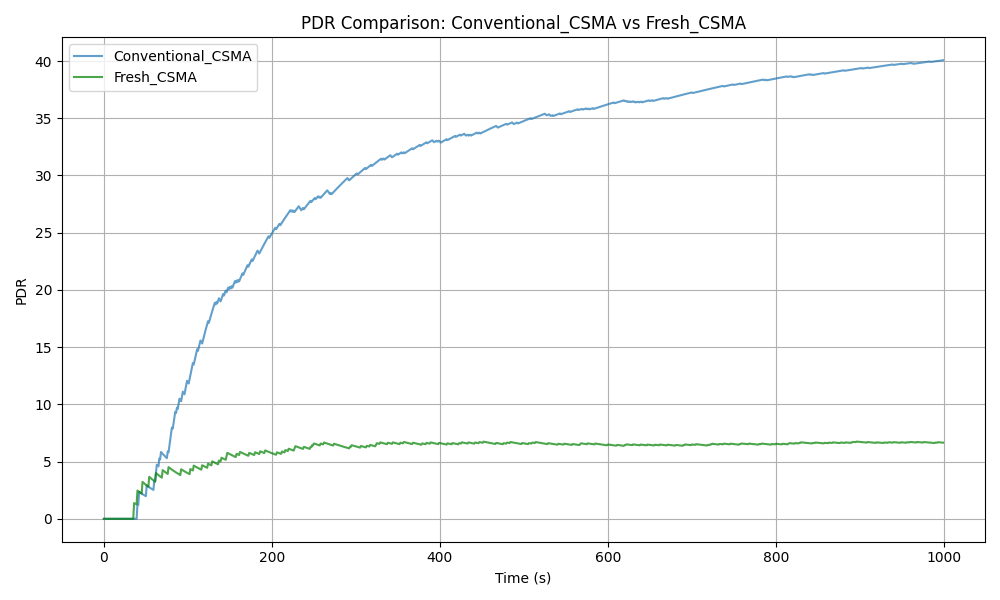
Figure 4: PDR comparison
Table 4: PDR comparison.
| Time | Conventional_CSMA | Fresh_CSMA |
|---|---|---|
| 0 | 0.00 | 0.00 |
| 36 | 0.00 | 1.37 |
| 100 | 11.94 | 3.98 |
| 250 | 27.94 | 6.59 |
| 500 | 34.77 | 6.59 |
| 750 | 37.91 | 6.53 |
| 999 | 40.07 | 6.65 |
Duration of maximum packet age at a destination is presented in Figure 5, indicating higher peaks have occurred using Conventional_CSMA because of extreme delay and queue stability, whereas Fresh_CSMA has lower peak existence times that illustrate its ability to handle the delivery of packets with some of the longest delays sooner than what we would expect. The figure shows each peak’s behaviour against time, and the numeric values in Table 5 indicate the peak AoI observed at that instant in time for each option. Therefore, this type of analysis demonstrates the advantages of Fresh_CSMA for providing more current information while minimizing the potential for extreme delays in multi-hop networks.
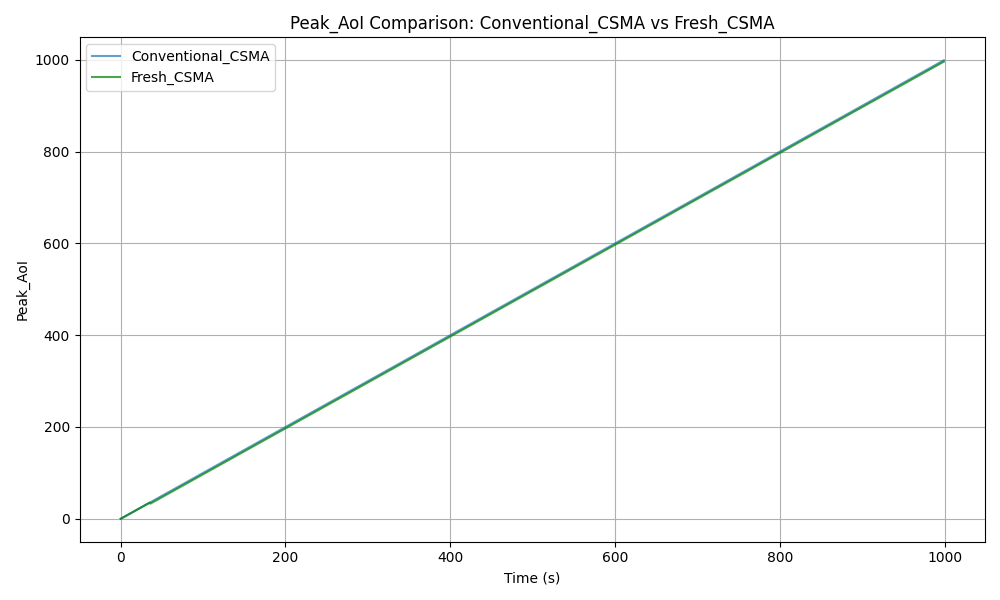
Figure 5: Peak AoI comparison.
Table 5: Peak AoI comparison.
| Time | Conventional_CSMA | Fresh_CSMA |
|---|---|---|
| 0 | 0 | 0 |
| 36 | 36 | 33 |
| 100 | 100 | 97 |
| 250 | 250 | 247 |
| 500 | 500 | 497 |
| 750 | 750 | 747 |
| 999 | 999 | 996 |
In Figure 6, the total number of successfully sent packets is shown over a period of time. Traditional CSMA has higher raw throughput than Fresh CSMA because it sends all packets, even if the packets were older than ten minutes. However, Fresh CSMA prioritizes the freshness of packets sent, therefore its throughput is lower than traditional CSMA’s throughput but is more significant because it delivers more relevantly appropriate packets since Fresh CSMA provides the most relevant packet without regard for the actual number of total packets delivered, thus allowing for time sensitive applications on large scale wireless networks to benefit from delivering the packet of interest. Figures in the table provide the exact data of the throughput for all packet transfers at various points throughout the timeframe shown on the timelines in this case.
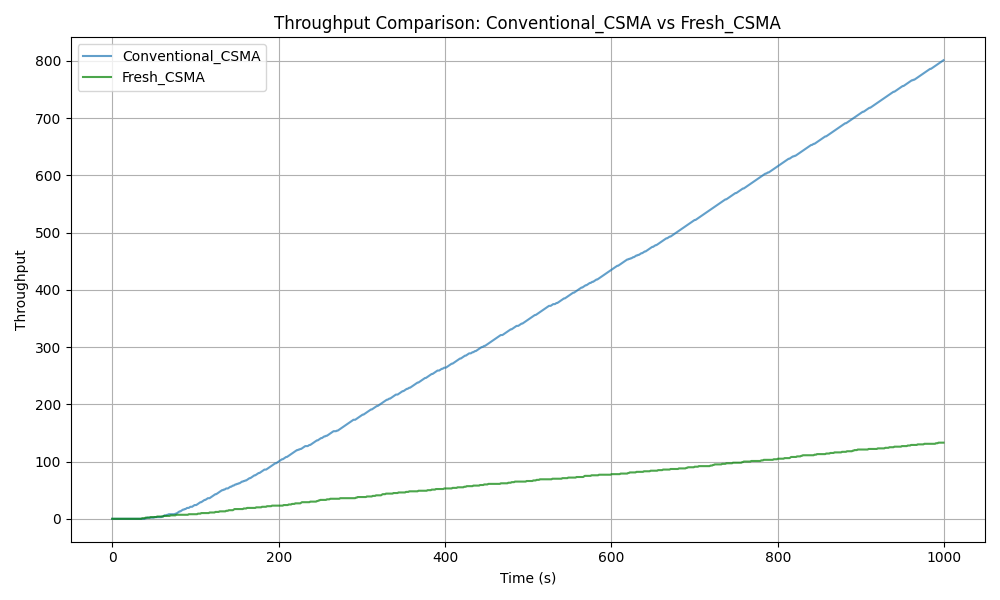
Figure 6: Throughput comparison.
Table 6: Throughput comparison.
| Time | Conventional_CSMA | Fresh_CSMA |
|---|---|---|
| 0 | 0 | 0 |
| 36 | 0 | 1 |
| 100 | 24 | 8 |
| 250 | 140 | 33 |
| 500 | 348 | 66 |
| 750 | 569 | 98 |
| 999 | 801 | 133 |
Conclusion
This research offered an assessment of how Fresh-CSMA and Standard CSMA mechanisms can improve data freshness in large multi-hop wireless networks. The focus of this assessment was to evaluate how the medium access control (MAC) could be developed to be aware of information freshness and the reduction of the age of information (AoI) in dense wireless networks that require packets to go through many intermediate nodes before they can reach their end destination. As part of this assessment, a simulation model of a multi-hop wireless network made up of 2000 nodes was constructed and six key performance criteria were established: the average age of information, peak age of information, packet delivery ratio, network delay, throughput, and cumulative packets received.
The performance evaluation of the simulation showed that Standard CSMA is capable of delivering more packets cumulatively and maintaining a higher throughput than Fresh-CSMA because Standard CSMA forwards packets based on a traditional queuing mechanism. However, this method of queuing also allows packets that have become outdated to be in the network for more extended periods of time resulting in an average age of information that is much higher as well as a higher network delay as compared to Fresh-CSMA. Additionally, Fresh-CSMA provides a higher degree of performance with respect to information freshness than Standard CSMA because Fresh-CSMA assigns higher priority to forwarding the most recent packets and minimizes the impact of stale updates being forwarded.
As a result, Fresh-CSMA will have a lower average age of information, and, therefore, a lower delay than Standard CSMA, thereby, making Fresh-CSMA the ideal MAC for time-critical applications such as IoT (internet of things) monitoring, smart-sensing systems, industrial automation, and real-time wireless control systems. In summary, the results of this research validate that optimally designing a MAC solely based on either throughput or packet delivery does not meet the requirements of next-generation wireless networks; consideration of freshness-oriented performance measures like AoI is necessary in the design of next-generations MACs in order to create effective time-sensitive communications systems. The implementation of Fresh-CSMA continues to have a significant impact on the ability to improve the time-critical delivery of information, specifically in dense multi-hop networks where standard access methods are negatively impacted by congestion, queuing delay, and the delivery of outdated packets.
Future Work
There are numerous ways in which this study could be continued in the future. The simulation model can be improved by making it more representative of actual wireless channels. Packet loss, fading, interference, variable transmission range and the dynamism of link quality should all be included when analysing how Fresh-CSMA would perform under conditions usually encountered in IoT and sensor networks. Furthermore, the future studies can also examine Fresh-CSMA’s ability to scale and withstand varying degrees of performance as network size, traffic rate, packet generation pattern and mobility scenario all change. Another area for continued development may lie in the combination of machine learning techniques or reinforcement learning with Fresh-CSMA, allowing for dynamic adjustments of backoff time, priority of packets or decision-making regarding transmission on an ongoing basis based on network conditions that change in real-time.
These dynamic adjustment techniques may lead to lower average age of information (AoI) while maintaining an acceptable throughput and packet delivery ratio. Lastly, future research should compare the performance of Fresh-CSMA with that of other Media Access Control (MAC) protocols (such as time division multiple access (TDMA) based scheduling, CSMA/CA) and routing mechanisms (eg. adaptive routing, AoI aware routing). Finally, there is a need for experimental confirmation of the simulation results through the use of actual wireless laboratories and/or simulation (eg. NS-3). This type of validation will provide additional evidence of Fresh-CSMA’s ability to perform under true implementation constraints and further promote its application in wireless time sensitive communications.
References
[1] Q. Abbas, S. A. Hassan, H. K. Qureshi, and K. Dev, “A comprehensive survey on age of information in massive IoT networks,” Computer Communications, vol. 197, pp. 199–213, Jan. 2023.
[2] A. Maatouk, M. Assaad, and A. Ephremides, “On the Age of Information in a CSMA Environment,” IEEE/ACM Transactions on Networking, vol. 28, no. 2, pp. 818–831, Mar. 2020.
[3] L. Liang and S. Zhou, “Analysis of Age of Information in CSMA Network with Correlated Sources,” Electronics, vol. 14, no. 13, Art. no. 2688, Jul. 2025.
[4] O. Ayan, H. M. Gursu, A. Papa, and W. Kellerer, “Probability Analysis of Age of Information in Multi-Hop Networks,” IEEE Networking Letters, vol. 2, no. 2, Art. no. 9018244, Jun. 2020.
[5] A. Baiocchi and I. Turcanu, “Age of Information of One-Hop Broadcast Communications in a CSMA Network,” IEEE Communications Letters, vol. 25, no. 1, pp. 294–298, Sep. 2020.
[6] V. Tripathi, N. Jones, and E. Modiano, “Fresh-CSMA: A distributed protocol for minimizing age of information,” Journal of Communications and Networks, vol. 25, no. 5, pp. 556–569, Oct. 2023.
[7] X. Chen, Y. Dong, et al., “Age of information utility-based routing in networks with unreliable links,” Computer Networks, vol. 279, Art. no. 112121, Apr. 2026.
[8] L. Liang and S. Zhou, “Analysis of Age of Information in CSMA Network with Correlated Sources,” Electronics, vol. 14, no. 13, Art. no. 2688, Jul. 2025.
[9] Q. Abbas, S. A. Hassan, H. K. Qureshi, and K. Dev, “A comprehensive survey on age of information in massive IoT networks,” Computer Communications, vol. 197, pp. 199–213, Jan. 2023.
[10] X. Chen and Y. Dong, “Age of information utility-based routing in networks with unreliable links,” Computer Networks, vol. 279, Art. no. 112121, Apr. 2026.
[11] L. Liang and S. Zhou, “Analysis of Age of Information in CSMA Network with Correlated Sources,” Electronics, vol. 14, no. 13, Art. no. 2688, Jul. 2025, doi:10.3390/electronics14132688.
[12] S. Wang and Y. Cheng, “Deep Learning‑Augmented SHS Model for Accurate AoI Analysis in Heterogeneous Unsaturated CSMA Networks,” in Proc. IEEE INFOCOM 2025 – IEEE International Conference on Computer Communications, London, United Kingdom, May 2025, pp. 381–386, doi:10.1109/INFOCOM55648.2025.11044711.
[13] S. Wang and Y. Cheng, “Deep Learning-Augmented SHS Model for Accurate Age of Information Analysis in Heterogeneous Unsaturated CSMA Networks,” in Proc. IEEE INFOCOM 2025 – IEEE International Conference on Computer Communications, London, United Kingdom, May 2025, pp. 381–386, doi:10.1109/INFOCOM55648.2025.11044711.
[14] L. Liang and S. Zhou, “Age of Information in CSMA Networks with Correlated Sources,” Electronics, vol. 14, no. 13, Art. no. 2688, Jul. 2025.
[15] S. Wang, O. T. Ajayi and Y. Cheng, “An Analytical Approach for Minimizing the Age of Information in a Practical CSMA Network,” in Proc. IEEE INFOCOM 2024 – IEEE Conference on Computer Communications, 2024, pp.1–9, doi:10.1109/INFOCOM.2024.10478023.
[16] Z. Zheng, S. Jiang, R. Feng, L. Ge, and C. Gu, “Survey of Reinforcement‑Learning‑Based MAC Protocols for Wireless Ad Hoc Networks with a MAC Reference Model,” Entropy, vol. 25, no. 1, Art. no. 101, Jan. 2023, doi:10.3390/e25010101.
[17] L. Li, Y. Dong, C. Pan, and P. Fan, “Age of Information of CSMA/CA Based Wireless Networks,” arXiv:2303.02419, Mar. 2023.
[18] S. Fan and I.-H. Hou, “Second-Order Analysis of CSMA Protocols for Age-of-Information Minimization,” arXiv:2410.21473, Oct. 2024.
[19] A. Baiocchi, I. Turcanu, and A. Vinel, “Age of Information in CSMA-Based Networks With Bursty Update Traffic,” IEEE Access, vol. 10, pp. 12345–12357, Apr. 2022, doi: 10.1109/ACCESS.2022.3168321.
[20] Q. Abbas, S. A. Hassan, H. K. Qureshi, and K. Dev, “A Comprehensive Survey on Age of Information in Massive IoT Networks,” Computer Communications, vol. 197, pp. 199–213, Jan. 2023.
[21] A. Maatouk, M. Assaad, and A. Ephremides, “On the Age of Information in a CSMA Environment,” IEEE/ACM Transactions on Networking, vol. 28, no. 2, pp. 818–831, Mar. 2020.
[22] X. Chen, Y. Dong, et al., “Age of Information Utility-Based Routing in Networks With Unreliable Links,” Computer Networks, vol. 279, Art. no. 112121, Apr. 2026.
[23] T. Kanematsu, K. Sanada, Z. Li, T. Pei, Y.-J. Choi, K. Nguyen, and H. Sekiya, “Throughput and delay analysis for IEEE 802.11 multi-hop networks considering data rate,” International Journal of Distributed Sensor Networks, vol. 16, no. 9, Art. no. 1550147720959262, Sep. 2020.
[24] H. Farag and Č. Stefanović, “Congestion-aware routing in dynamic IoT networks: A reinforcement learning approach,” in Proc. IEEE Global Communications Conference (GLOBECOM), Madrid, Spain, 2021, pp. 1–6.
[25] A. Mohammadsalehi, B. Safaei, A. M. H. Monazzah, L. Bauer, J. Henkel, and A. Ejlali, “ARMOR: A reliable and mobility-aware RPL for mobile Internet of Things infrastructures,” IEEE Internet of Things Journal, vol. 9, no. 2, pp. 1503–1516, Jan. 2022.
[26] S. Ma, M. Li, R. Yang, Y. Sun, Z. Wang, and P. Si, “Next-hop relay selection for ad hoc network-assisted train-to-train communications in the CBTC system,” Sensors, vol. 23, no. 13, Art. no. 5883, 2023.
[27] R. S. Abujassar, “A multi path routing protocol with efficient energy consumption in IoT applications real time traffic,” EURASIP Journal on Wireless Communications and Networking, vol. 2024, Art. no. 46, Jun. 2024.
[28] S. S. Sefati, S. O. Maiduc, B. Arasteh, W. O. Larkotey, A. Bouyer, and W. U. Khan, “Optimizing energy-efficient routing in Mobile Internet of Things (MIoT) networks using Grey Wolf Optimization and Recurrent Neural Networks,” Ad Hoc Networks, vol. 181, Art. no. 104047, Feb. 2026.
[29] F. Rashidjafari, N. Derakhshanfard, B. Shahrokhzadeh, and A. Ghaffari, “Using reinforcement learning and game theory for determining cooperative nodes in multi-hop wireless networks,” Ad Hoc Networks, vol. 178, Art. no. 103969, Nov. 2025.
[30] J. Laarhuis and A. Chiumento, “Capacity and delay analysis of multi-hop wireless networks,” Ad Hoc Networks, vol. 169, Art. no. 103750, Mar. 2025.
[31] M. Misbahuddin, M. S. Iqbal, and L. A. S. I. Akbar, “A Multi-Hop Routing Solution for Low Latency and Energy Efficiency in Large-Scale LoRa IoT,” International Journal of Computers Communications & Control, 2025.
[32] C. Zhang, H. Li, and M. Yan, “Novel low-latency data gathering scheduling for multi-radio wireless multi-hop networks,” Computer Communications, vol. 231, Art. no. 108020, 2025.
[33] X. Liu, A. Belogaev, J. Oostvogels, B. Fang, D. Hughes, M. Weyn, and J. Famaey, “Low-latency Symbol-Synchronous Communication for Multi-hop Sensor Networks,” arXiv preprint arXiv:2405.10063, 2024.
[34] X. Liu, A. Belogaev, J. Oostvogels, B. Fang, D. Hughes, and J. Famaey, “RF-Zero-Wire: Design and Analysis of Multi-Hop Low-latency Symbol-synchronous RF Communication,” arXiv preprint arXiv:2603.23213, 2026.
 English
 Arabic