

The Role of Lasers in Improving the Mechanical and Surface Properties of Polycarbonate
دور الليزر في تحسين الخواص الميكانيكية والسطحية لمادة البولي كربونات
Zahraa Jassim Mohammed Al-Jaafari¹, Ali Mehri¹*, Maryam Jamaati²
¹ Department of Physics, Babol Noshirvani University of Technology, Babol, Iran
General Directorate of Education of Wasit; Email: wwwzahra4@gmail.com
² Department of Computer Engineering, Iraniane University, Tehran, Iran
* Corresponding author: Ali Mehri. ORCID: 0009-0005-2655-8920
DOI: https://doi.org/10.53796/hnsj710/40
Arabic Scientific Research Identifier: https://arsri.org/10000/710/40
Volume (7) Issue (10). Pages: 806 - 815
Received at: 2026-09-10 | Accepted at: 2026-09-20 | Published at: 2026-10-01
Abstract: This narrative review examines the role of laser processing in modifying the surface and mechanical performance of polycarbonate, with emphasis on roughness, wettability, surface chemistry, and joining. Published findings are analyzed in relation to wavelength, pulse duration, fluence, and scanning conditions, while comparisons with other polymers clarify material-dependent responses. The reviewed evidence indicates that controlled irradiation can generate micro- and nanostructures, alter water contact angle, and improve interfacial conditions for polymer joining. A published polycarbonate–polystyrene welding study reported a contact-angle decrease from 86.3° to 43.4° and a maximum joint shear strength of 13.65 MPa. Other observations show that wetting behavior may evolve with surface aging. Increased roughness does not invariably improve wettability, and improved joining does not establish increased hardness or wear resistance. The fluence–contact-angle regression included in this paper is treated as an illustrative calculation rather than original experimental evidence. The review concludes that laser processing offers a versatile route to functional polycarbonate surfaces, provided that performance gains are assessed alongside transparency loss, thermal damage, and long-term stability using application-specific characterization.
Keywords: Polycarbonate; Laser processing; Surface roughness; Wettability; Laser welding.
المستخلص: تتناول هذه المراجعة السردية دور المعالجة بالليزر في تعديل الأداء السطحي والميكانيكي للبولي كربونات، مع التركيز على الخشونة وقابلية البلل وكيمياء السطح والربط. وتُحلَّل النتائج المنشورة في ضوء الطول الموجي ومدة النبضة وكثافة الطاقة وظروف المسح، مع مقارنة استجابة البوليمرات المختلفة. وتشير الأدلة إلى أن التشعيع المنضبط يمكن أن يُنتج تراكيب ميكروية ونانوية، ويغيّر زاوية تلامس الماء، ويحسّن ظروف الربط بين البوليمرات. وقد أظهرت دراسة منشورة للحام البولي كربونات والبولي ستايرين انخفاض زاوية التلامس من 86.3° إلى 43.4°، وبلوغ مقاومة القص القصوى للوصلة 13.65 ميغاباسكال. كما تتغير قابلية البلل مع تقادم السطح. ولا تعني زيادة الخشونة تحسّن البلل دائماً، ولا يثبت تحسّن الربط زيادة الصلادة أو مقاومة التآكل الاحتكاكي. ويُعرض انحدار كثافة الطاقة وزاوية التلامس بوصفه حساباً توضيحياً، وليس دليلاً تجريبياً أصلياً. وتخلص المراجعة إلى أن الليزر يتيح تطوير أسطح وظيفية للبولي كربونات، بشرط تقييم الأداء إلى جانب فقدان الشفافية والضرر الحراري والاستقرار طويل الأمد باستخدام اختبارات تناسب التطبيق.
الكلمات المفتاحية: البولي كربونات؛ المعالجة بالليزر؛ خشونة السطح؛ قابلية البلل؛ اللحام بالليزر.
1 Introduction
Polycarbonate (PC) is an engineering thermoplastic valued for its low weight, optical transparency, and impact resistance. These properties support its use in optical components, protective products, medical devices, and electronic housings. Its usefulness nevertheless depends on surface performance: scratching, inadequate interfacial adhesion, and an unsuitable response to liquids can limit particular applications. Surface modification therefore seeks to improve the relevant function while retaining the bulk properties needed by the component.
Laser processing provides a non-contact approach to localized surface modification. By adjusting wavelength, pulse duration, fluence, scanning conditions, and the number of exposures, it is possible to change surface topography and chemistry. Such modification may improve wetting or joining, but excessive exposure can also discolor the material, introduce defects, or reduce transparency. Laser treatment must therefore be evaluated against a defined application rather than assumed to improve every property (Steen & Mazumder, 2010; Obilor et al., 2022).
The aim of this paper is to examine how laser irradiation affects the surface and mechanical performance of polycarbonate, with particular attention to roughness, wettability, surface chemistry, and laser-assisted joining. Comparisons with polyethylene and other polymers provide context for material-dependent responses. The paper also distinguishes measured outcomes reported in published studies from illustrative calculations, so that numerical trends are interpreted within their evidential limits.
2 Review approach and scope
This paper is a narrative analytical review of published research, supported by an illustrative analysis of the fluence–contact-angle relationship. It does not report a new laser-processing experiment. The experimental dimensions, laser settings, and material measurements discussed below belong to the cited studies. No systematic-review protocol, complete search strategy, or meta-analysis is claimed.
The analysis considers the interaction mechanisms, processing parameters, surface characterization methods, and application-specific performance of laser-modified polymers. Polycarbonate is the main material of interest; results for other polymers are used as comparisons rather than as interchangeable evidence. The review separates surface wettability from bulk mechanical strength, and joint strength from surface hardness. These distinctions are essential because an improvement in one measurement does not establish an improvement in the others.
3 Fundamentals of laser–polymer interaction
3.1 Fluence and the ablation threshold
Laser fluence is the incident pulse energy per unit area and is commonly expressed in J/cm². For an approximately uniform beam, F = Eₚ/A, where Eₚ is pulse energy and A is the irradiated area. Average laser power, expressed in watts, is a different quantity; it cannot be treated as fluence without specifying the pulse repetition rate, beam area, and scanning conditions. Equal average powers may produce different surface responses when spot size or pulse overlap changes (Steen & Mazumder, 2010).
The ablation threshold is the fluence at which measurable material removal begins under specified conditions. Below this threshold, heating or chemical modification may occur without substantial removal. Above it, bond scission, material ejection, and surface excavation become increasingly important. The threshold depends on wavelength, pulse duration, optical absorption, pulse history, and the surrounding environment. It is therefore a processing-dependent quantity rather than a fixed universal value for polycarbonate (Srinivasan, 1986).
The practical purpose of determining the threshold is to identify a useful processing window. A low dose may produce insufficient modification, whereas an excessive dose may create cracks, deep pores, or carbonized regions. Repeated irradiation also changes the condition of the surface encountered by subsequent pulses. Reporting fluence together with scan speed, line spacing, and pulse overlap is therefore more informative than reporting laser power alone.
3.2 Photothermal and photochemical mechanisms
In a photothermal process, absorbed laser energy is converted into heat, which can cause local softening, melting, decomposition, and material removal. This contribution is particularly relevant when the exposure permits heat to accumulate. In a photochemical process, sufficiently energetic photons can contribute to breaking molecular bonds. Ultraviolet irradiation can promote this mechanism in polymers, although thermal and photochemical effects may coexist (Srinivasan, 1986).
Ultrashort pulses deposit energy over very short timescales and can reduce the extent of heat diffusion during irradiation. They do not, however, guarantee that all processing is athermal: subsequent energy relaxation, repeated pulses, and high repetition rates may still produce thermal effects. Femtosecond processing should therefore be described as offering precise energy delivery with potentially limited heat-affected regions, rather than as eliminating heat under all conditions (Chichkov et al., 1996).
3.3 Wavelength pulse duration and scanning conditions
The response of polycarbonate depends on its absorption at the selected wavelength. Shorter wavelengths have higher photon energies, while infrared processing may rely more strongly on thermal absorption or nonlinear processes, depending on intensity and material properties. Pulse duration controls the timescale of energy deposition, and scanning speed determines how many pulses overlap at a location. Line spacing, focusing, polarization, and the number of passes further influence the resulting texture (Steen & Mazumder, 2010; Vorobyev & Guo, 2013).
A suitable parameter combination must be chosen for the required function. A texture intended to increase bonding area may be unsuitable for an optical window, where scattering and haze must remain low. Similarly, a surface designed to repel droplets may be inappropriate for an adhesive joint. Optimization should therefore include both the targeted response and possible loss of transparency, dimensional accuracy, or mechanical integrity.
4 Surface roughness morphology and optical effects
Laser irradiation may generate grooves, protrusions, pores, or periodic structures through localized removal and subsequent reorganization of the surface. The morphology depends on the absorbed dose and scanning strategy. Increasing exposure can increase texture depth, but the relation is not necessarily linear and does not imply that a rougher surface is always better. Roughness must be interpreted alongside the geometry, chemistry, and intended use of the modified surface.
For polycarbonate, the most important trade-off is often between useful surface texture and optical quality. Features that increase interfacial area may also scatter light or reduce transmission. The appearance of darkened or cracked regions at higher doses indicates that modification can pass into damage. Surface roughness and visual appearance should therefore be evaluated together, rather than using roughness as an isolated indicator of improvement.
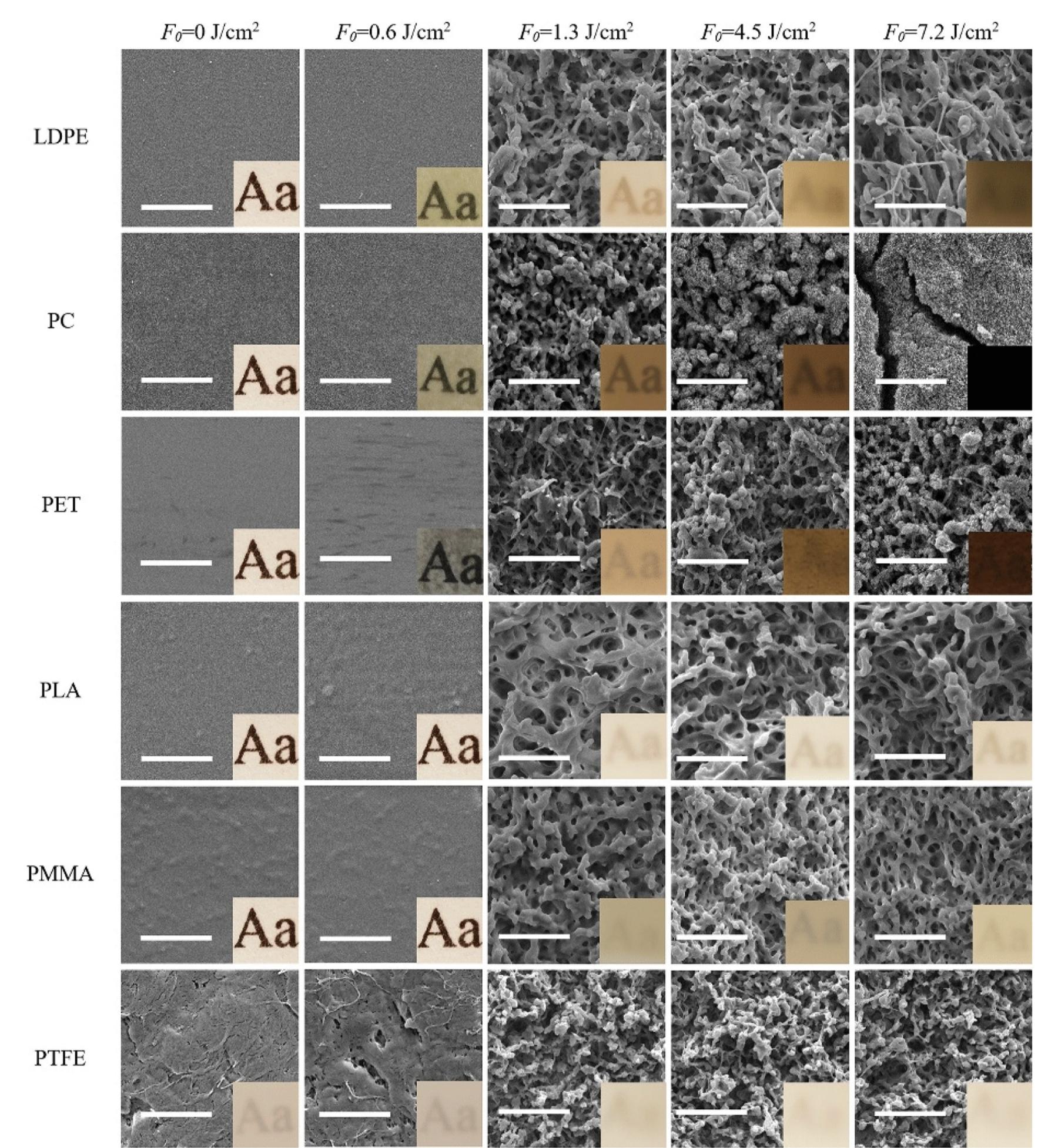
Figure 1. Surface morphology and visual appearance of LDPE, PC, PET, PLA, PMMA, and PTFE at the indicated laser fluences. The inset photographs show samples placed over printed letters to illustrate changes in transparency. Fluence is expressed in J/cm². Source: Obilor et al. (2022), Figure 6.
Figure 1 illustrates the material-dependent nature of irradiation. LDPE denotes low-density polyethylene; PET, polyethylene terephthalate; PLA, polylactic acid; PMMA, poly(methyl methacrylate); and PTFE, polytetrafluoroethylene. The PC row shows that visible darkening and structural disruption can accompany higher exposure. These observations support cautious dose selection; they do not directly quantify hardness, wear resistance, or biocompatibility.
5 Wettability and contact-angle interpretation
5.1 Surface chemistry and water contact angle
Water contact angle is a practical indicator of apparent wettability under a specified measurement procedure. A lower angle indicates greater wetting by water, whereas a higher angle indicates reduced wetting. A surface with a very low contact angle is described as superhydrophilic, not superhydrophobic. Droplet volume, observation time, surface aging, and contamination can affect the measurement, so these conditions must be stated when comparing results.
Laser irradiation can alter both surface texture and chemical composition. Bond scission and reactions with the surrounding atmosphere may introduce or redistribute oxygen-containing groups. Such changes can increase the polar contribution to surface energy, but their extent depends on processing conditions. Contact angle alone cannot identify the functional groups formed: chemical characterization is needed to support that interpretation.
Polycarbonate contains carbonate groups, whereas polyethylene consists predominantly of nonpolar hydrocarbon chains. This difference is relevant to surface chemistry, but it does not establish that PC will always show a larger wettability change. Optical absorption, oxidation, processing atmosphere, and texture also matter. Plasma modification studies provide complementary evidence that polymer wettability can change through surface activation; they should not be cited as direct measurements of laser-treated PC (Morent et al., 2011).
5.2 Roughness and wetting models
For a chemically homogeneous rough surface that is fully wetted by the liquid, the Wenzel relation is cos θ* = r cos θY, where θ* is the apparent contact angle, θY is the intrinsic angle of a smooth surface, and r is the actual-to-projected surface-area ratio. Roughness strengthens the existing wetting tendency: it decreases the apparent angle when θY is below 90° and increases it when θY is above 90°. Thus, increased roughness does not universally reduce contact angle (Wenzel, 1936).
If liquid rests on a composite interface containing trapped air, a Cassie–Baxter description may be more appropriate. One common form is cos θ* = fₛ(cos θY + 1) − 1, where fₛ is the fraction of projected area in contact with solid. Selecting between these descriptions requires evidence about liquid penetration and interfacial structure. Neither model proves the chemical mechanism of laser modification, and both have limitations on heterogeneous or evolving surfaces (Cassie & Baxter, 1944).
5.3 Published observations on structured polycarbonate
Vlahou et al. (2025) investigated PC structures formed using 258 nm femtosecond pulses. Their study considered fluence, effective pulse number, energy dose, and polarization. Figure 2 provides a useful comparison of pristine PC, laser-induced periodic surface structures (LIPSS), and nanosphere-like topographies. The illustrated measurements also show why surface aging should be considered when assessing wettability.
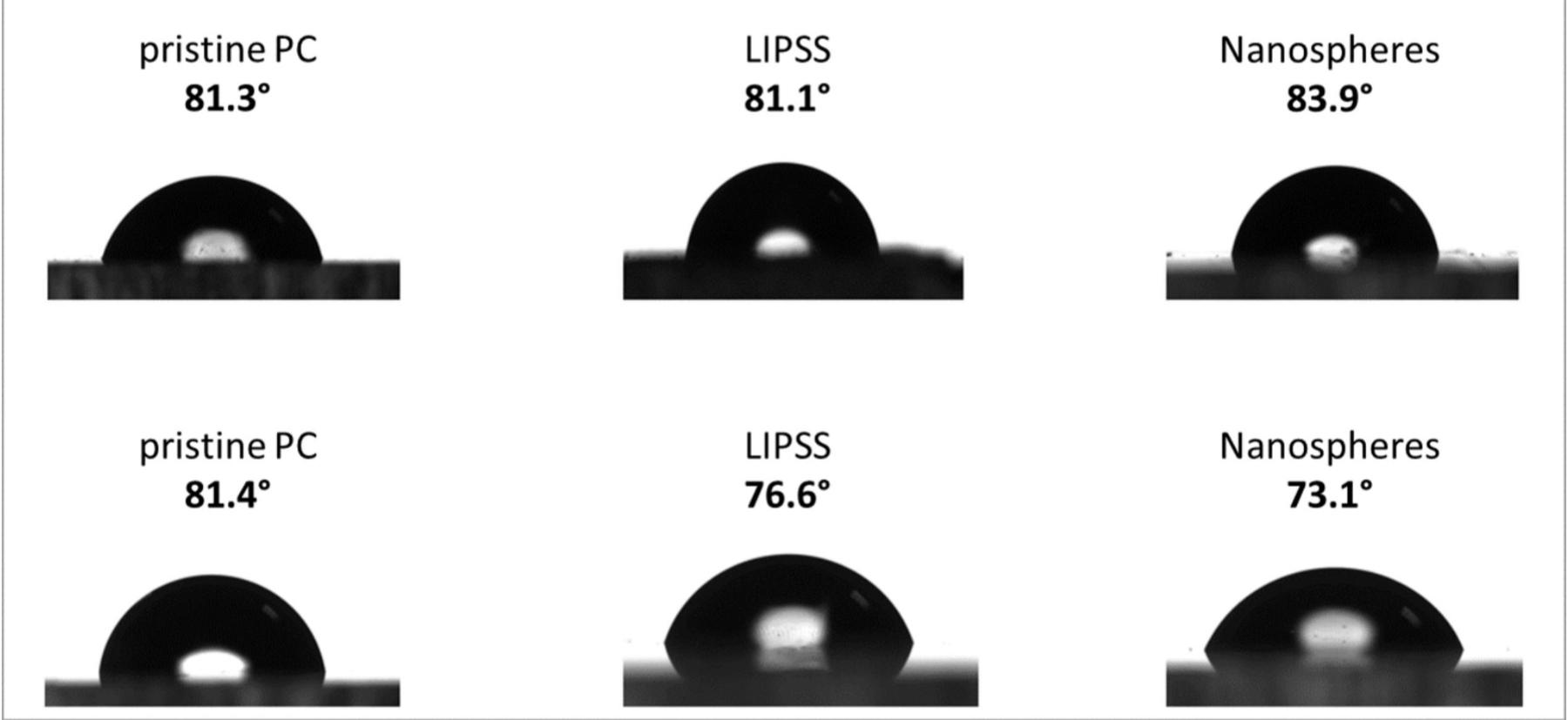
Figure 2. Water contact angles on pristine and laser-structured PC. The first row shows initial measurements; the second row shows measurements repeated one year after irradiation. LIPSS denotes laser-induced periodic surface structures. Source: Vlahou et al. (2025).
The initial angles in Figure 2 are 81.3°, 81.1°, and 83.9° for pristine PC, LIPSS, and nanosphere-like structures, respectively. After one year, the illustrated angles are 81.4°, 76.6°, and 73.1°. The figure therefore does not show a large immediate decrease in contact angle for every texture. Instead, it indicates an evolving response whose magnitude depends on topography and observation time (Vlahou et al., 2025).
An instructive comparison is the biodegradable Arbofill Fichte material examined by Rusu et al. (2025). Its texture-dependent wetting behavior demonstrates that results for different polymers should be interpreted within their own experimental conditions. This material is not polycarbonate, and its contact-angle values cannot be used as direct evidence of PC performance. The study also distinguishes dynamic droplet spreading from a single static contact-angle reading.
6 Laser surface modification and mechanical performance
6.1 Laser-assisted joining of polycarbonate and polystyrene
Zhai et al. (2025) examined laser direct transmission welding of transparent PC and polystyrene (PS) following femtosecond surface modification. The processing description and quantitative results discussed here are attributed to that published experiment, rather than to a new experiment conducted for this review.
Their approach used ultrafast surface treatment before near-infrared welding. The reported setup used 520 nm irradiation with 300 fs pulses for surface modification and an 808 nm semiconductor laser for joining. These are different processing stages: surface treatment modifies absorption and interfacial conditions, while the subsequent welding stage creates the joint. Consequently, ablation power and welding power must not be treated as interchangeable variables (Zhai et al., 2025).
The reported surface roughness increased from 0.61 to 5.49 μm and optical absorption from 12.73% to 32.35% across the investigated treatment conditions. The PC water contact angle decreased from 86.3° to 43.4°. The maximum reported PC–PS joint shear strength was 13.65 MPa. These results indicate a route to absorber-free joining under the investigated conditions, but they do not establish a corresponding increase in surface hardness or scratch resistance (Zhai et al., 2025).
Joint shear strength is calculated as σ = F/(L × B), where F is the failure force, L is the weld length, and B is the weld width. If force is measured in newtons and area in mm², the resulting stress is in MPa. Comparisons require consistent specimen geometry, loading conditions, and failure modes; otherwise, differences in nominal strength can reflect differences in the test arrangement.
6.2 Hardness wear and chemical resistance
The mechanical consequences of irradiation depend on whether surface restructuring, chain scission, cross-linking, or damage dominates. A texture may improve mechanical interlocking in an adhesive or welded interface while reducing resistance to abrasion at exposed peaks. Likewise, a contact-angle reduction does not demonstrate improved hardness. Direct hardness, scratch, wear, or tensile tests are needed for those conclusions.
For polymer applications, chemical resistance and environmental durability are more precise terms than metallic corrosion resistance. Changes in surface chemistry may affect resistance to solvents or cleaning agents, while localized degradation can weaken the treated region. The evidence considered here supports tunable surface and joining behavior more directly than it supports universal improvement in bulk mechanical properties.
7 Characterization requirements
A meaningful assessment combines morphology, chemistry, wetting, optical response, and mechanical performance. Optical or confocal microscopy can quantify texture and roughness; scanning electron microscopy can reveal finer structures. FTIR can help identify changes in chemical groups, while XPS characterizes near-surface composition. Claims of newly formed hydroxyl or carboxyl groups should be supported by suitable spectra rather than inferred from droplet spreading alone.
Wettability testing should state the liquid, droplet volume, measurement time, number of replicates, and storage conditions. Advancing and receding angles, where relevant, help describe hysteresis. Optical measurements should include transmission and, for transparent components, haze or scattering. Mechanical tests should match the proposed application, such as scratch testing for protective covers or joint shear testing for welded assemblies.
Untreated controls are necessary to distinguish treatment effects from cleaning, handling, and storage. A comparison among laser types also requires consistent material grades and well-described exposure conditions. Different polymers, wavelengths, and specimen geometries should not be pooled into a common quantitative relationship without a justified normalization procedure.
8 Results and discussion
8.1 Evidence synthesis
The reviewed evidence shows that laser processing can modify PC topography, wettability, and joining performance. These responses are related but remain distinct outcomes. Table 1 summarizes selected values already discussed in the manuscript; it is not a pooled dataset and should not be interpreted as a ranking of processing efficiency.
Table 1. Selected published observations on laser-modified polycarbonate
| Source and condition | Untreated or initial | Treated or later | Interpretation |
|---|---|---|---|
| Zhai et al. (2025): PC water angle | 86.3° | 43.4° | Greater water wettability |
| Zhai et al. (2025): roughness | 0.61 μm | 5.49 μm | Increased surface texture |
| Zhai et al. (2025): optical absorption | 12.73% | 32.35% | Changed optical response |
| Zhai et al. (2025): PC–PS joining | Not compared here | 13.65 MPa maximum | Joint shear strength |
| Vlahou et al. (2025): LIPSS water angle | 81.1° initially | 76.6° after one year | Time-dependent wetting |
| Vlahou et al. (2025): nanosphere water angle | 83.9° initially | 73.1° after one year | Time-dependent wetting |
Note. The Zhai et al. values describe their own processing conditions. The Vlahou et al. values compare initial and aged textured surfaces, not untreated and treated specimens measured at the same time. These distinctions prevent a misleading direct comparison.
The evidence also limits the claim that PC invariably responds more strongly than polyethylene. Chemical structure matters, but the laser dose and wavelength alter absorption and reaction pathways. A defensible comparison requires matched conditions and equivalent measurement methods. In particular, neither a roughness increase nor a contact-angle decrease alone establishes improved mechanical durability.
8.2 Illustrative fluence–contact-angle analysis
The illustrative dataset comprises five fluence–angle pairs: (0, 92°), (0.50, 78°), (1.00, 65°), (1.50, 52°), and (2.00 J/cm², 40°). Because no traceable experimental source, replicates, or measurement uncertainties are provided for these points, they are retained only as an illustrative dataset. They are not presented as measurements performed by the authors or as data from Bizi-Bandoki et al. The cited 2011 paper by those authors concerns metals, not polycarbonate (Bizi-Bandoki et al., 2011).
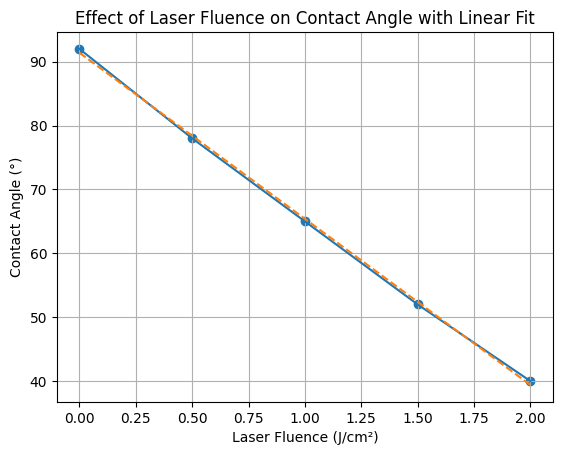
Figure 3. Illustrative relationship between fluence and contact angle using the five illustrative numerical pairs. The points and fitted line are a mathematical example, not validated experimental evidence for PC.
Ordinary least-squares fitting of these five points gives θ = −26.0F + 91.4, where θ is in degrees and F is in J/cm². The fitted slope describes the illustrative decrease of approximately 26° per unit increase in fluence within this dataset. It must not be generalized beyond the displayed range or used to select processing parameters without measured validation.
The example is consistent with a decreasing contact-angle trend, but a close linear fit cannot establish a physical mechanism. It does not demonstrate statistical significance, chemical-group formation, or a universal response to irradiation. Actual data may show thresholds, saturation, aging, and non-monotonic behavior. Mechanistic interpretation therefore requires independent chemical and morphological measurements.
8.3 Applications and practical limitations
Potential applications include adhesion promotion, polymer joining, liquid-handling components, and biomedical surface engineering. For coating or adhesive applications, the relevant outcome is durable bonding after environmental exposure. For optical products, any benefit must be balanced against loss of transparency. For medical uses, increased wettability cannot substitute for direct biological testing.
Zhu et al. (2025) used picosecond laser processing to investigate PC surface microstructures and cell adhesion, providing application-specific evidence rather than a general guarantee of biocompatibility. Microfluidic applications likewise require control of liquid–surface interaction, but practical performance also depends on device geometry, stability, and fabrication requirements (Whitesides, 2006).
The limitations of this review include the heterogeneous materials and processing conditions of the cited literature and the absence of original experimental measurements. The illustrative fluence dataset cannot support estimates of reproducibility or predictive accuracy. The conclusions therefore concern reported mechanisms and selected published observations, not a newly validated processing protocol.
9 Conclusions
Laser irradiation is a useful route for engineering the surface of polycarbonate when the dose, wavelength, pulse duration, and scanning conditions are selected for a specific function. It can change surface morphology and wettability and can support joining strategies, but treatment quality must be assessed alongside possible thermal damage and optical deterioration.
Published PC observations show that wetting behavior depends on both surface chemistry and texture and may evolve with storage time. Increased roughness does not necessarily lower contact angle; the Wenzel and Cassie–Baxter descriptions apply under different interfacial conditions. The distinction between hydrophilic and hydrophobic behavior must therefore remain explicit.
The PC–PS joining study provides direct evidence of improved joining capability under its investigated conditions. Its shear-strength result should not be interpreted as proof of increased surface hardness, wear resistance, or bulk strength. Such properties require separate measurements. The illustrative regression describes a numerical example only and adds no independent experimental evidence.
10 Recommendations
Future experiments should vary a defined set of laser parameters while keeping material grade, preparation, and measurement conditions controlled. Fluence, spot size, repetition rate, scan speed, line spacing, and pass number should be reported together, with untreated controls and sufficient replicate measurements.
Morphological analysis should be combined with FTIR or XPS, standardized wetting measurements, optical characterization, and application-relevant mechanical testing. Long-term stability should be assessed after storage, cleaning, and environmental exposure. Medical applications require direct cytocompatibility and biological-response testing.
Comparisons of UV, visible, and infrared processing should account for material absorption and cumulative dose. Optimization should target a measurable function while constraining damage and transparency loss. Predictive or machine-learning approaches may assist parameter selection only when trained and validated on traceable experimental datasets.
References
Bizi-Bandoki, P., Benayoun, S., Valette, S., Beaugiraud, B., & Audouard, E. (2011). Modifications of roughness and wettability properties of metals induced by femtosecond laser treatment. Applied Surface Science, 257(12), 5213–5218. https://doi.org/10.1016/j.apsusc.2010.12.089
Cassie, A. B. D., & Baxter, S. (1944). Wettability of porous surfaces. Transactions of the Faraday Society, 40, 546–551. https://doi.org/10.1039/TF9444000546
Chichkov, B. N., Momma, C., Nolte, S., von Alvensleben, F., & Tünnermann, A. (1996). Femtosecond, picosecond and nanosecond laser ablation of solids. Applied Physics A, 63, 109–115. https://doi.org/10.1007/BF01567637
Morent, R., De Geyter, N., Desmet, T., Dubruel, P., & Leys, C. (2011). Plasma surface modification of biodegradable polymers: A review. Plasma Processes and Polymers, 8(3), 171–190. https://doi.org/10.1002/ppap.201000153
Obilor, A. F., Pacella, M., Wilson, A., & Silberschmidt, V. V. (2022). Micro-texturing of polymer surfaces using lasers: A review. The International Journal of Advanced Manufacturing Technology, 120, 103–135. https://doi.org/10.1007/s00170-022-08731-1
Rusu (Ostahie), P.-D., Bialas, O., Wozniak, A., Adamiak, M., Appiah, A., Tampu, C., Mazurchevici, S.-N., Kyratsis, P., Tzotzis, A., Nedelcu, A., Mindru, T.-D., & Nedelcu, D. (2025). Characterization of laser-textured surfaces of parts of a biodegradable polymer. Coatings, 15(2), 246. https://doi.org/10.3390/coatings15020246
Srinivasan, R. (1986). Ablation of polymers and biological tissue by ultraviolet lasers. Science, 234(4776), 559–565. https://doi.org/10.1126/science.3764428
Steen, W. M., & Mazumder, J. (2010). Laser material processing (4th ed.). Springer. https://doi.org/10.1007/978-1-84996-062-5
Vlahou, M., Protopapa, N., Maragkaki, S., Tsibidis, G. D., & Stratakis, E. (2025). Fabrication of highly uniform laser-induced periodic structures on polycarbonate via UV femtosecond pulses. Optics & Laser Technology, 189, 113121. https://doi.org/10.1016/j.optlastec.2025.113121
Vorobyev, A. Y., & Guo, C. (2013). Direct femtosecond laser surface nano/microstructuring and its applications. Laser & Photonics Reviews, 7(3), 385–407. https://doi.org/10.1002/lpor.201200017
Wenzel, R. N. (1936). Resistance of solid surfaces to wetting by water. Industrial & Engineering Chemistry, 28(8), 988–994. https://doi.org/10.1021/ie50320a024
Whitesides, G. M. (2006). The origins and the future of microfluidics. Nature, 442, 368–373. https://doi.org/10.1038/nature05058
Zhai, K., Yang, F., Gu, Q., Lin, Y., Liu, M., Ouyang, D., Chen, Y., Zhang, Y., Lue, Q., & Ruan, S. (2025). Research on laser direct transmission welding of transparent polystyrene and polycarbonate based on laser surface modification. Polymers, 17(3), 409. https://doi.org/10.3390/polym17030409
Zhu, Q., Yin, C., Liang, J., Lin, X., Cui, B., & Dai, Y. (2025). Biocompatible hydrophilic polycarbonate surfaces via picosecond laser processing for improved cell adhesion. Surfaces and Interfaces, 76, 107946. https://doi.org/10.1016/j.surfin.2025.107946
 English
 Arabic