

Geotechnical Characterization of Expansive Soils and Mitigation of Associated Engineering in Khartoum
التوصيف الجيوتكنيكي للترب المتمددة وطرق الحد من المشكلات الهندسية المصاحبة لها في الخرطوم
Dohia Abd Elmagid Alshareef1, Wegdan Deyab Elgaali Deyab2
1 Msc Student Red Sea University Faculty of Engineering, Sudan.
Email: douhiya@gmail.com
2 Assistant Professor, Department of Civil Engineering, Faculty of Engineering, Red Sea University, Sudan.
DOI: https://doi.org/10.53796/hnsj71/7
Arabic Scientific Research Identifier: https://arsri.org/10000/71/7
Volume (7) Issue (1). Pages: 100 - 105
Received at: 2025-12-01 | Accepted at: 2025-12-07 | Published at: 2026-01-01
Abstract: Expansive soils represent one of the most critical geotechnical hazards affecting structural foundations, particularly when buildings are founded directly upon them. These soils underground significant volumetric changes with variations in moisture content, leading to uplift pressures that cause considerable damage to lightly loaded structures. Typical manifestations include differential settlement, fractures, and cracks across structural elements. This study investigates the geotechnical behaviour of expansive soils in Khartoum, Sudan—an area characterized by semi-arid climatic conditions and extensive deposits of swelling clay. Laboratory analyses of soil samples collected from various locations indicate expansive indices ranging from moderate to very high. The findings highlight that foundation design in such environments requires the implementation of subsurface improvement measures and effective moisture-control barriers before construction. The study further recommends the use of waffle-slab or ribbed-raft foundations as effective design solutions for mitigating expansion-related damage in lightly loaded structures.
Keywords: Expansive Soil, Engineering Hazard, Moisture Content, Optimum Design, Subsurface Improvement, Geotechnical Properties.
المستخلص: تمثل الترب المتمددة أحد أخطر المخاطر الجيوتكنيكية التي تؤثر في الأساسات الإنشائية، خصوصًا عندما تُشيَّد المباني مباشرة فوقها. إذ تتعرض هذه الترب لتغيّرات حجمية كبيرة نتيجة تبدّل محتوى الرطوبة، مما يؤدي إلى توليد ضغوط رافعة تتسبب بأضرار كبيرة في المنشآت ذات الأحمال الخفيفة. وتشمل المظاهر الشائعة لهذه المشكلات: الهبوط المتباين، والتشققات، والكسور في العناصر الإنشائية. تتناول هذه الدراسة السلوك الجيوتكنيكي للترب المتمددة في مدينة الخرطوم، السودان، وهي منطقة تتميز بمناخ شبه جاف وبتراكمات واسعة من الطين المتمدد. وقد أظهرت التحاليل المخبرية لعينات التربة المأخوذة من مواقع مختلفة أن مؤشرات التمدد تتراوح بين المتوسطة والمرتفعة جدًا. وتؤكد النتائج أن تصميم الأساسات في مثل هذه البيئات يتطلب تنفيذ معالجات تحت السطح ووسائل فعّالة للتحكم في الرطوبة قبل البدء في البناء. كما توصي الدراسة باستخدام أساسات من نوع الشبكية (Waffle Slab) أو الحصيرة المُضلَّعة (Ribbed-Raft Foundation) كحلول تصميمية فعّالة للحد من الأضرار المرتبطة بتمدد التربة في المباني ذات الأحمال الخفيفة.
الكلمات المفتاحية: تربة متمددة، الخطر الهندسي، محتوى الرطوبة، التصميم الأمثل، تحسين التحت-سطحي، الخصائص الجيوتكنيكية.
Introduction
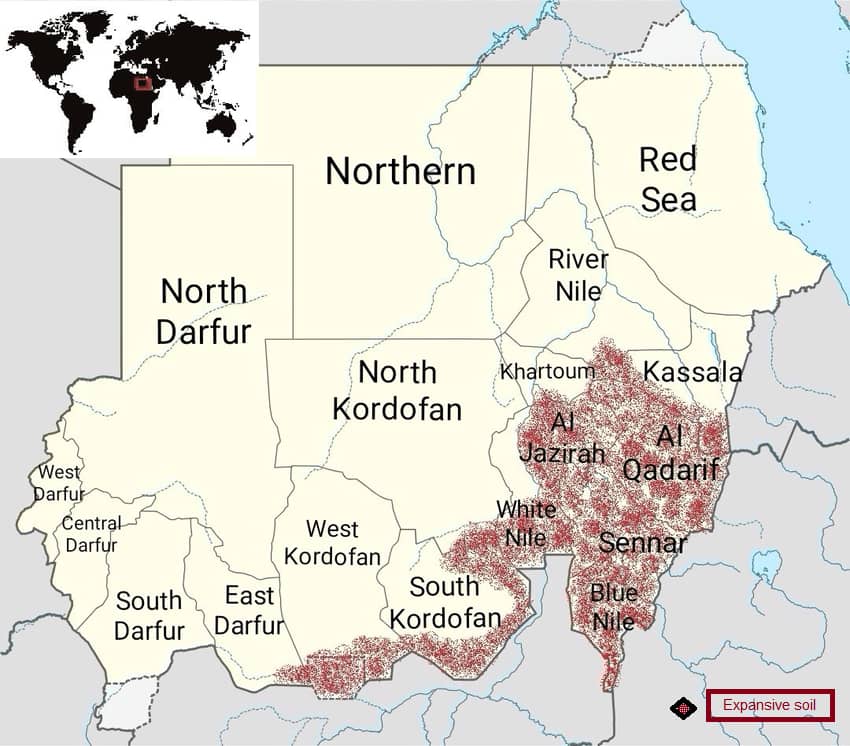
Expansive soils pose a substantial threat to the stability and serviceability of structures founded upon them. These soils can exert significant uplift pressures that result in cracking and structural distortion, particularly in lightly loaded buildings (H. Elarabi, 2010). The annual cycles of wetting and drying induce alternating swelling and shrinkage, making arid and semi-arid regions highly susceptible to this form of damage. In Sudan, where a large portion of the country experiences semi-arid climatic conditions, expansive clays are widespread and problematic for civil construction. Several buildings constructed on swelling clays in areas such as Kafouri in Khartoum State have exhibited severe serviceability problems manifested as surface cracking, floor deformation, and foundation movement. These failures often lead to significant economic losses for property owners. Although expansive soils are the principal cause, other contributing factors include inadequate foundation design, poor construction practices, and insufficient surface drainage (M. Zumarwi, 2017). The distribution of expansive soils across Sudan is illustrated in Figure 1 (M. Zumarwi, 2017). Understanding their geotechnical characteristics is therefore essential for developing appropriate design and mitigation strategies to ensure the long-term stability of structures.
Problematic Nature of Expansive Soils
Construction on expansive soils presents one of the most challenging issues in geotechnical engineering, especially in regions where seasonal wet and dry cycles are pronounced. These soils undergo significant volumetric changes upon wetting and drying, producing swelling and shrinkage movements that can jeopardise the stability of light and moderately loaded structures. The principal causes of moisture variation in expansive soils include climatic fluctuations, infiltration from garden irrigation, leakage from underground utilities, and inadequate storm-water drainage systems. When moisture increases, clay minerals absorb water and expand; during drying, they contract. This continual alternation of expansion and contraction produces differential movements that propagate through the superstructure, leading to cracking, distortion, and progressive degradation of the building’s serviceability.
Case Study
To investigate the nature and extent of foundation distress in residential structures built on expansive soils, field and laboratory studies were conducted in selected areas of Khartoum, Sudan. For each representative building, a trial pit approximately 2 m deep was excavated adjacent to the structure. The pits were dug manually using pick-axes and shovels to minimise disturbance. Disturbed soil samples were collected, sealed, and transported to the Soil Mechanics Laboratory at the University of Khartoum for testing. A comprehensive series of laboratory tests was performed to determine the physical and index properties, as well as the swelling characteristics, of the collected soils. The results confirmed that the foundation materials were highly plastic clays with considerable expansiveness. Table 1 summarises the key geotechnical properties obtained from the four sampling locations within the study area.
|
Soil Property |
Al Manshiya |
Kafouri |
El Sababi |
Wad Nubawi |
|
Clay content (%) (> 2 µm) |
63 |
69 |
59 |
49 |
|
Liquid limit (%) |
78 |
85 |
74 |
55 |
|
Plastic limit (%) |
20 |
23 |
25 |
19 |
|
Plasticity index (%) |
60 |
65 |
50 |
40 |
|
Free swell index (%) |
187 |
224 |
180 |
91 |
|
Swell pressure (kPa) |
70 |
96 |
65 |
55 |
|
Degree of expansion |
High |
Very High |
High |
Moderate |
|
Soil classification |
CH |
CH |
CH |
CH |
Table 1. Geotechnical Properties of Expansive Soils in the Khartoum Area
Foundation Design
Design of foundations founded on expansive soils must be approached as an integrated geotechnical–structural problem in which soil behaviour, groundwater regime and surface-water management are considered together. The objective of design is to reduce or accommodate volumetric changes of the soil so that movement transferred to the structure remains within acceptable serviceability limits. The principal design strategies may be grouped under: (a) avoidance and separation, (b) ground improvement and moisture control, and (c) structural measures. Each category is discussed below.
Avoidance and separation
Where practicable, expansive layers should be avoided by founding on non-expansive strata. If avoidance is not feasible, separation of the structure from the active zone of moisture fluctuation is recommended. The depth of the active zone should be estimated from field and laboratory data and from climatic considerations; foundations should be placed below this depth where possible. Alternatively, a buffer of non-expansive engineered fill (well-compacted granular material) may be used beneath foundations to reduce the transmission of heave to the structure.
Moisture control and drainage
Moisture variation is the driving mechanism for swelling/shrinkage. Therefore, effective moisture control is fundamental. Design measures include:
Installation of continuous moisture barriers (e.g. low-permeability membranes) around and beneath foundations to reduce infiltration.
Provision of positive surface drainage (graded paving, gutters, downpipes) to direct water away from foundations.
Isolation of landscaping and irrigation from immediate foundation zones; planting of drought-tolerant species and use of buffer strips.
Repair and maintenance plans for underground service pipework to prevent leaks.
Good moisture control reduces seasonal cycles and hence the magnitude of volumetric change.
Ground improvement methods
Where problematic soils must be retained in situ, ground improvement can be used to reduce swell potential or increase stiffness:
Removal and replacement (undercutting): The most direct method is to remove the highly expansive surface soils and replace them with compacted non-expansive granular fill to a depth determined from swell and overburden calculations. This approach is straightforward for shallow foundations and light structures.
Chemical stabilisation: Lime or fly ash stabilisation may be employed to alter the mineralogy and plasticity of clayey soils, thereby reducing swell potential and increasing shear strength. The type and dosage must be selected following laboratory mix-design tests (e.g. plasticity reduction, unconfined compressive strength and swell tests).
Vertical drains and wick drains: Installation of vertical sand drains combined with preloading may be used where consolidation and reduction of moisture content are required. Although typically applied for consolidation of soft clays, vertical drains may assist in accelerating pore-water dissipation and stabilising moisture regimes in certain contexts.
Geosynthetics: Geotextiles and geogrids may be used to reinforce fills and reduce differential movement. Geomembranes may be used as horizontal barriers beneath slabs.
Structural foundation options
Selection of foundation type must reflect soil conditions, structural loading and acceptable movement limits:
Waffle slab and ribbed raft systems: For lightly-loaded residential structures on expansive soils, waffle (ribbed) slabs or stiffened rafts are effective. These systems increase slab stiffness and distribute differential movements, thereby reducing localised distress. Slab thickness, rib spacing and reinforcement should be designed based on expected swell pressures and measured subgrade stiffness. Provision of movement joints and sufficient slab footing details is required to accommodate residual differential movements.
Raft foundations (solid or reinforced): A uniformly reinforced raft resting on a prepared subgrade can be used where swell pressures are moderate and uniformly distributed. The raft should be designed to tolerate the anticipated range of vertical movements without loss of serviceability.
Pile and deep foundation solutions: For heavy structures or where shallow mitigation is impractical, piles transferring load to deeper, non-expansive strata must be adopted. Where piles pass through active swell zones, designs must ensure that vertical and lateral movement of the surrounding soil does not impose unacceptable forces on the pile head. Use of pile caps, flexible connections, or doweled/hinged connections can be considered to decouple superstructure from ground movement.
Composite solutions: Combining shallow, stiffened slabs with local deep foundations (e.g. piled footings for heavy columns) can offer an economical compromise.
Design details and good practice
The following specific design and detailing practices are recommended:
Edge and service detailing: Slab edges and openings (for services) are the most vulnerable zones; edges should be designed with suitable reinforcement and flexible joints. Services should be routed to minimise soil disturbance and to allow access for repair.
Swell pressure allowance: Measured swell pressures should be used in design as a distributed upward load; conservative factors should be applied where data are limited.
Differential movement assessment: Differential movement between supports should be estimated using site data and assumed swell profiles; structural design must account for the worst-case differential settlement/heave over relevant spans.
Construction quality control (CQC): Strict CQC is critical — compaction of fills, moisture conditioning, membrane installation, and concrete workmanship should be monitored and recorded.
Monitoring and maintenance: Instruments (e.g. settlement plates, piezometers) should be installed for long-term monitoring in critical projects. A maintenance plan for surface drainage and landscaping must be provided.
Risk-based design approach
A risk-based design philosophy is recommended. Where uncertainties exist (e.g. spatial variability of swell), conservative design or staged approaches (e.g. temporary preloading, trial sections) may be adopted to reduce residual risk. A geotechnical engineer should be engaged throughout design and construction.
Conclusion:
The findings of this study demonstrate that expansive soils within the Khartoum region present considerable geotechnical challenges, with swelling indices ranging from moderate to very high across the tested locations. These soils exhibit significant volume changes in response to moisture fluctuations, leading to differential heave, cracking, and structural distress in lightly loaded buildings.
Laboratory investigations confirmed that the dominant soil type is highly plastic clay (CH), characterised by elevated liquid limits, high plasticity indices, and substantial free-swell values. Field observations further corroborated the laboratory results, as numerous buildings showed signs of uplift-related damage, including wall separation, slab distortion, and foundation cracking.
The study underscores the importance of adopting appropriate foundation systems and soil improvement measures when constructing in expansive soil environments. Techniques such as ribbed raft and waffle slab foundations, soil replacement, moisture barriers, and ground improvement methods were found to be effective in mitigating swelling-induced structural damage.
In conclusion, comprehensive geotechnical assessment, coupled with the implementation of suitable foundation design strategies, is essential for ensuring structural stability and reducing long-term maintenance costs in areas dominated by expansive soils. Continued monitoring and further research on moisture control, soil stabilisation, and foundation performance are recommended to enhance building resilience in the region.
Recommendations:
1. Site investigation: A comprehensive site investigation programme should be conducted prior to design, including trial pits, in-situ testing where appropriate, and laboratory determination of Atterberg limits, free-swell index and swell pressure for representative samples. Spatial variability should be characterised.
2. Moisture management: A moisture management plan must be developed and implemented prior to and during the life of the structure; this should include impermeable barriers, positive drainage and restrictions on irrigation near foundations.
3. Choose appropriate foundation type: For light residential structures on very expansive clays, stiffened waffle slabs or ribbed rafts founded on a compacted non-expansive subbase are recommended. For heavy buildings, a piled solution to non-expansive strata is preferred.
4. Employ ground improvement when required: When removal/replacement is not feasible, lime or fly ash stabilisation should be considered following laboratory mix design.
5. Construction supervision and monitoring: Construction should be supervised by an experienced geotechnical engineer and monitoring instruments should be installed for critical structures.
References
B. Das. (2006). Principles of Geotechnical Engineering (6th ed.). Thomson.
Chen, F. H. (1988). Foundation on Expansive Soils. Elsevier Scientific Publishing Company, Amsterdam.
Elarabi, H. (2010). Damage Mechanism of Expansive Soil. Conference on Graduate Studies and Scientific Research, University of Khartoum.
Eldin, H. S., et al. (2021). Design and Analysis of Ribbed Raft Foundations Resting on Shrink–Swell Soils.
Katti, A. R. (1994). Behaviour of Saturated Expansive Soils and Control Methods. A.A. Balkema, Rotterdam.
Sorochan, E. (1991). Construction of Buildings on Expansive Soil. Proceedings of the 5th Geotechnical Conference, France, 272–295.
Zumarwi, M. (2017). Distribution of Expansive Soils in Sudan.
Acknowledgment
The authors would like to express their sincere gratitude to the Red Sea University and the Sea Ports Corporation of Sudan for their continuous support and collaboration during this study.
 English
  Arabic