
A Critical Discourse Analysis of Language and Power in Al-Husseini Theatre's Play
التحليل النقدي للخطاب للغة والسلطة في مسرحية من المسرح الحسيني
Dr. Aseel Kareem Mohammed Al-Tamimi1, Asst. Lect. Zainab Ayad Ali Al-Zubaidi2
1 College of Education for Humanities/English Department/Babylon University. Iraq.
Email: Hum218.aseel.kareem@uobabylon.edu.iq
2 College of Education for Humanities/English Department/Babylon University, Iraq.
Email: hum774.zanab.ayaad@uobabylon.edu.iq
DOI: https://doi.org/10.53796/hnsj69/6
Arabic Scientific Research Identifier: https://arsri.org/10000/69/6
Volume (6) Issue (9). Pages: 89 - 100
Received at: 2025-08-07 | Accepted at: 2025-08-15 | Published at: 2025-09-01
Abstract: This study explores the intersection of language and power in the context of Al-Husseini Theatre through the lens of Critical Discourse Analysis (CDA), focusing specifically on the play Al-Hur Al-Riahi's Voice by Ridha Al-Kufaji. Using Fairclough’s and Van Dijk’s CDA models, the research analyzes how discursive strategies—such as positive self-representation and negative other-representation—are employed by the character Al-Hur to construct ideological meaning and assert social power. The analysis is conducted at both the micro level (linguistic structures like sentence modes and vocabulary formality) and the macro level (themes of dominance, power, and ideology). Results show that Al-Hur frequently uses formal language, imperative sentences, and rhetorical questions to assert authority and justify his moral stance. At the macro level, power emerges as the most dominant theme, with language functioning as a tool to challenge and transform ideological hierarchies. The study concludes that CDA is effective in exposing underlying power dynamics and ideological constructs in theatrical discourse, offering insights into how language can both reflect and produce social change.
Keywords: Critical Discourse Analysis, language, power, dominance, Al-Husseini Theatre, self-representation, ideology.
المستخلص: تتناول هذه الدراسة تقاطع اللغة والسلطة في سياق المسرح الحسيني من خلال منهج التحليل النقدي للخطاب (CDA)، مع التركيز بشكل خاص على مسرحية صوت الحر الرياحي للكاتب رضا الكفاجي. وباستخدام نماذج فيركلاف وفان دايك في التحليل النقدي للخطاب، تحلل الدراسة كيف يستخدم شخصية "الحر" استراتيجيات خطابية مثل التمثيل الإيجابي للذات والتمثيل السلبي للآخر من أجل بناء المعنى الأيديولوجي وإبراز السلطة الاجتماعية. يتم التحليل على مستويين: المستوى الجزئي (البنى اللغوية مثل أنماط الجمل واللغة الرسمية) والمستوى الكلي (مواضيع الهيمنة والسلطة والأيديولوجيا). أظهرت النتائج أن "الحر" يستخدم بشكل متكرر لغة رسمية وجملاً أمرية وأسئلة بلاغية لإثبات سلطته وتبرير موقفه الأخلاقي. وعلى المستوى الكلي، تبرز السلطة كموضوع مهيمن، حيث تُستخدم اللغة كأداة لتحدي وتحويل البنى الأيديولوجية. وتخلص الدراسة إلى أن التحليل النقدي للخطاب أداة فعالة في كشف الديناميكيات الخفية للسلطة والبنى الأيديولوجية في الخطاب المسرحي، مما يقدم فهماً لكيفية انعكاس اللغة وإنتاجها للتغيير الاجتماعي.
الكلمات المفتاحية: التحليل النقدي للخطاب، اللغة، السلطة، الهيمنة، المسرح الحسيني، تمثيل الذات، الأيديولوجيا.
Introduction
Wodak and Meyer (2010, p. 1) emphasise that critical linguistics and critical discourse analysis (CDA henceforth) are interchangeable terms; however, recently, CDA has become more widely used and preferred to refer to the theory formerly known as critical linguistics. Accordingly, CDA regards “language as a social practice” and considers the context of language use to be essential. It also examines the relationship between language and power. For CDA, ideology is seen as a vital element in establishing and revealing unequal power relations.
1. Literature Review
Dijk (2001, p. 352) defines Critical Discourse Analysis as “a type of discourse analytical research that primarily studies the way social power abuse, dominance, and inequality are enacted, reproduced, and resisted by text and talk in social and political contexts. With such dissident research, critical discourse analysts take an explicit position, and thus want to understand, expose, and ultimately to resist social inequality.” This suggests that CDA addresses the concepts of despotism alongside social and political power inequality. Consequently, it is essential to recognise the contribution of critical theory to the understanding of critical discourse analysis, particularly in relation to critique and ideology. In this context, it becomes increasingly essential to critically analyse ideology (despotism) and its relation to social structures and processes, demonstrating how individuals exert their despotism towards others (ibid., p. 2). As Widdowson (2000) states, CDA involves uncovering the implicit ideologies within texts. It reveals the underlying ideological biases and, consequently, the exercise of power through texts.
2. Notions of CDA
The aspect that makes discourse analysis critical is its focus on how language produces and reproduces domination, abuse of power, and despotism (Van Dijk, 2001, p. 96). The concepts of CDA are illustrated as follows: “power” and “ideology.” These concepts will be addressed briefly as follows:
a. Power: CDA has emphasised control and power due to their significance in both the development and interpretation of any linguistic interaction. Power is a concept that is dynamic in CDA, as it often analyses the language used by individuals who have a significant impact on others and who are responsible for social, political, or economic imbalances (Van Dijk, 1993, p. 21). Ideology comprises the set of beliefs, values, and ways of thinking and feeling through which humans perceive the world and interpret what they consider to be reality. Fairclough and Wodak (1997) expand on Fairclough’s definition, stating that “ideologies are particular ways of representing and constructing society which reproduce unequal relations of power, relations of domination and exploitation” (Mazid, 2014, p. 35).
Van Dijk (1998, p. 162) defines power as follows: “a group A has or exercises power over another group B when the members of A are usually able to control the members of B.” He also notes that this hierarchy involves the domination and control of others’ actions, both mentally and physically, over their freedom, wishes, interests, will, and so on. He (2001, pp. 355–4) defines power in “terms of control” with reference to the “social power of groups or institutions.” Luke (1974) observes that during the exercise of power, one interlocutor tends to force the other(s) towards different aims and interests. Foucault (1977, p. 27) considers power to be ‘owned’ by certain privileged groups or exercised “simply as an obligation or a prohibition on those who do not have it.”
b. Power and Dominance: Fairclough’s (1989) attempt to uncover the dominance patterns and power exercised in any text that is ideologically motivated and oriented leads him to define the relationship between power and language in terms of social power and ideology. He (2003) also indicates that the nature of this dialectic relationship between language and social reality is realised through social events, texts, social practices, orders of discourse, and social structures, which means that language is an integral part of social life, forming a core element of his framework. Strauss and Feiz (2014, p. 321) observe that power and dominance are exercised through the manufacturing of consent via ideology in the underlying use of discourse. This discourse of power and dominance is utilised within institutional, legal, political, academic, and even personal ideologies, whereby inequality, injustice, and abuse are normalised and presented as common-sense assumptions — as given, as natural, as the taken-for-granted norms of society. In this way, dominance is co-produced; it is condoned, ignored, rationalised; hence, it becomes taken for granted, and notions of powerfulness and powerlessness are collaboratively perpetuated and institutionalised.
c. Language: Language refers to the use of a system of communication that includes a set of sounds or written symbols. Discourse analysis is sometimes described as the study of language beyond the sentence level. Discourse analysts examine larger segments of language as they unfold. Some discourse analysts consider the broader discourse context to understand how it influences the meaning of individual sentences. Language plays a vital role in the ideological process. It serves as the connecting element between individuals’ knowledge of the world and their social practices, since it mediates both their thought and behaviour (web source 1).
Critical language studies have mainly concentrated on traditional interactional sociolinguistic analysis, which links specific linguistic features to social communication (Blommaert, 2005). This approach to text-based analysis has emphasised the connection between language and society rather than how language influences the social order (Fairclough, 2001). The issues connecting globalisation to discourse and the ideological dimension, as well as the impact of this phenomenon on social affairs, have received limited attention. Literature has generally examined the relationship between discourse and ideology in an abstract way. Ontologically, many procedures, values, and beliefs of institutions are embedded within concrete texts and broader contexts of social practices (Fairclough, 2001).
3. Levels of Analysis
This section comprises two levels: micro and macro, each of which is relevant to CDA. Language use, discourse, verbal interaction, and communication are part of the micro-level of social analysis, whereas power, dominance, and ideology are typically associated with the macro-level of analysis. The CDA approach, based on Van Dijk (2009), critically examines power and language in the Al-Husseini Theatre at both micro- and macro-levels. It is important to remember that when analysing these ideologies critically, researchers must perform both micro- and macro-level analyses. A micro-level analysis focuses on grammatical elements, including vocabulary, phrases, and sentences.
3.1 Micro-level Analysis
Micro-level (linguistic) text analysis concentrates on describing specific linguistic features that are particularly relevant to the text being examined. These features depend on the lexical characteristics of the text’s genre, including grammar and vocabulary (Rheindorf, 2019, p. 143). Fairclough (1989) states that formal features have three types of value: experiential, relational, and expressive. Following Fairclough’s (1989) model, the study focuses solely on the relational value of grammar, which encompasses three sentence modes: declarative, imperative, and grammatical question.
3.2 Macro-level Analysis
Macro-level (social) analysis concentrates on the broader social formation to interpret the findings of the text analysis (ibid.), by considering the concepts of CDA in terms of power and ideology. Depending on the text, the focus may be on historical, political, or cultural formations, or a combination of these. The analysis mainly examines the details of the social formation and the changes within it, along with the reasons behind these changes. Interpretation “The interpretation stage reveals the hidden power relations and the purpose of this stage is to establish whether the verbal cues in the text contain certain assumptions or other hidden elements that are not obvious at a first glance” (Fairclough, 1989, p. 129). Overall, this stage was used to interpret the findings from the first stage — description — and to assign a discourse to the text as well. Explanation, as Fairclough (1989) states, has two aspects, depending on whether the focus is on social struggle processes or power relations. Conversely, explanation shows what power relations influence discourses. The explanation stage clarifies what has been obtained and interpreted in the interpretation stage by examining the interaction and social context.
4. Contextual Strategy of Positive Self-presentation and Negative Other-presentation
Van Dijk (2005) views texts as ideological portrayals of the self (positive representation) and others (negative representation). This study focuses on the ideologies of positive self-representation and negative other-representation that have been embedded in the concept of power. Consequently, these ideologies are becoming ingrained in the discourse of language and power.
Van Dijk (2004, p. 42) proposes ideological strategies that are evident in recognising the core strategies of positive self-presentation and negative other-presentation. Positive self-presentation is an ideological feature used to portray a person as superior to others, while negative other-presentation considers others as inferior; this means distinguishing between the superior and the inferior, us and them. These two strategies focus on participants as social groups rather than individuals (Van Dijk, 2009). CDA is a significant model for demonstrating power in the language of characters in the play (Al-Hur Al-Ryiahi’s Voice), on one hand, and their intended meaning on the other, in a way that CDA facilitates. The main aim is to explore the power of language used by the characters in the play (Al-Hur Al-Ryiahi’s Voice) by Rida Al-Kafaji.
5. Data Description
Ridha Al-Kufaji takes the lead in developing the Al-Husseini Theatre theory, which outlines specific principles in response to the perceived decline in various societies. The theatre believes that individuals must relinquish themselves during hardships, casting aside all human desires, and must never bow to injustice. Therefore, Al-Husseini Theatre is not associated with any particular group or religion; instead, it serves as a connection for those who prefer death over submission to the mundane. In this play, the writer creates scenes to portray key characters as self-sacrificing; Al-Hur Al-Riahi tends to focus on a single goal. The lesson of this theatre, therefore, is to enlighten the human mind with aesthetic insights and knowledge (Al-Khufaji, 2000).
6. Model of Analysis
CDA is a significant model for illustrating the language and power in the characters of the play, on the one hand, and their intended meaning, on the other, in a manner facilitated through CDA. The primary concern is to discover the discursive strategies employed by the characters in the play (Al-Hur Al-Ryiahi’s Voice) by Rida Al-Kafaji. The study adopts Van Dijk (2005) and Fairclough (1989) as models of analysis for the current study. The analysis demonstrates how power and language are critically employed in this novel by using specific features, based on Van Dijk’s (2005) model of contextual strategies as self-positive representation and other-negative representation and notions of CDA, and Fairclough (1989) as a model of rational value and interpretation. The model of analysis is schematised as shown in the figure below:
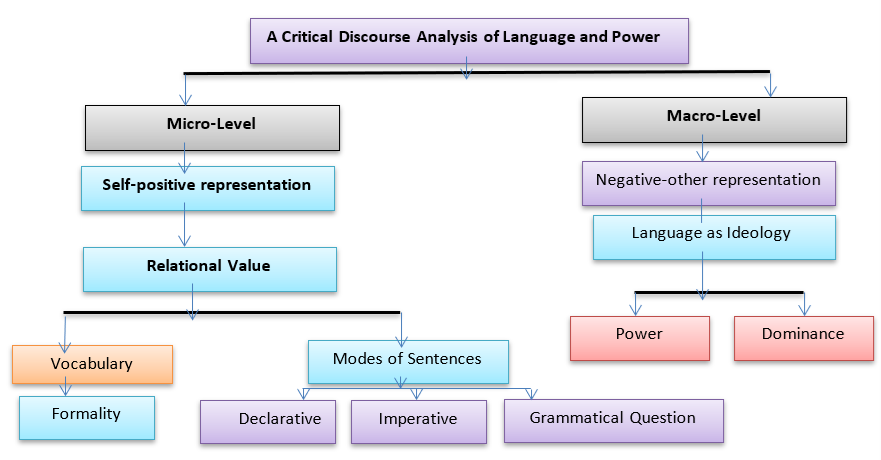
Figure (1): A Model of Analysing Language and Power from a CDA Perspective
7. Data Analysis
Extract (1)
Al-Hur said:
Now, you are but forlorn and alone…. Hur!
Tomorrow…. Tomorrow, what will you do?
Is it sanity, Hur?
Children…. Old men and women………
My longing desire escalates much to the dawn of tomorrow…
The dawn approaching ….
Never to be entangled with everlasting humanity…
Never deny Ameia’s conveniences ….
In this text, Al-Hur is alone and recapitulates his inquiries and intentions while soliloquising about Al-Taff’s battle and how he chose to fight Abn Al-Zahra (pbuh) in Karbala. Accordingly, the writer Ridha Al-Khufaji clarifies that Al-Husseini Theatre relies on both theoretical and practical techniques to demonstrate the effects of language and power in Al-Hur’s speech.
This text will be analysed at both micro and macro levels regarding the discursive strategies of self-positive representation and negative-other representation. At the micro level, Al-Hur is speaking to himself about his encounter with Imam Al-Hussein, son of Ali (pbuh), during Ashura.
Positive self-presentation is an ideological feature used by Al-Hur (pbuh) to denote his superiority as a leader in Abuabidallah’s army compared to others. He then soliloquises, saying, “Children… Old men and women…” as a negative other-presentation strategy to portray Abuabidallah and his army as inferior in comparison to Al-Imam Al-Hussein and his children. Regarding vocabulary, Al-Hur employs specific formal terms, such as “forlorn, dawn approaching, everlasting and humanity,” to refer to eternal life and his humanity in his dealings with the children, the old men, and the women in Al-Taff’s Battle.
Regarding the modes of the sentences, he uses a declarative sentence such as “Now, you are but forlorn and alone…, Hur” to refer to his intense encounter with Al-Hussein (pbuh) in Karbala. Another type of sentence used in this text is grammatical questions like “what will you do” and “Is it sanity Hur”; he asks himself what to do with Abin Al-Zahra (pbuh) because he is the leader of Umeiya’s army.
Engaging in the macro-level analysis of this play, the study employs Al-Hur’s language to uncover the hidden ideology in his speech and to examine his exercise of power as a leader within his army. It also considers his eventual decision to abandon his forces and join Al-Hussein’s army. Overall, CDA critically reveals the concealed power dynamics by analysing the play. By uncovering the concepts of dominance and power, which are ideologically driven, it demonstrates the relationship between his authority and language in his speech (Al-Hur), particularly in terms of social power and ideology. Power and dominance serve as macro-level units of analysis that operate to produce consent through ideology, as reflected in his discourse.
Extract (2)
My soul,
Where am I now?
Inform me by Allah.
Voice:
You’ll live here, this is your heaven , observe!
Al-Hur
Oh, Allah, is it really my heaven?
But where are my soldiers?
Where is my vicinity?
Inform me but the truth.
Al-Hur falls asleep at night; he hears a voice saying, “Hur, this is your heaven.” This voice serves as a sign to affirm his Islam and guides him to join Al-Hussein’s entourage.
This text will be analysed from both micro and macro levels concerning the discursive strategies of self-positive and negative-other representations. At the micro-level of analysis, Al-Hur is falling asleep when he hears a voice speak to him, showing him paradise to prepare the way for him to engage with Al-Husseini’s entourage.
Positive self-presentation is an ideological feature used by Al-Hur (pbuh) to emphasise his superiority as a leader in Abuabidallah’s army over others. He then dreams and speaks with a voice about heaven, asking, “Where am I now?” Regarding the negative other-presentation strategy, he considers Abuabidallah and his army as inferior in comparison with Al-Imam Al-Hussein. In terms of vocabulary, Al-Hur employs certain formal words such as “soul, heaven, vicinity and truth” to understand what has happened to him and how his life may change suddenly, prompting thoughts about heaven and eternal life.
Regarding the modes of the sentences, he uses imperative sentences, such as “Inform me by Allah,” “Inform me the truth,” and “observe,” to address the voice that tells him what happened to him. The voice speaks to him about the intense meeting between him and Al-Hussein (pbuh) in Karbala. Another mode of sentence used in this text is grammatical questions, as in “Where am I now?” and “Where is my vicinity?” He asks the voice about the place he perceives as a heavenly one.
Focusing on analysing this play at a macro level, the study employs Al-Hur’s language to uncover the hidden ideology in his speech and demonstrates his power as a leader of his army. Over time, he considers leaving them to join Al-Hussein’s army.
Extract (3)
Al-Hur said:
By Allah, I never flinch from the whip of the despot..
But what are you talking about?
Voice
It’s reputed, you are a master of yourself and people,
We know thee in detail
Optimise Hur
Optimise Hur!
Al-Hur
Oh, my Allah, I am dreaming
In this text, Al-Hur is surprised by the voice’s advice to master himself and decides to indulge with Al-Hussein’s entourage.
According to the micro and macro levels of analysis regarding the discursive strategies of both self-positive and negative-other representations, this text will be analysed. At the micro-level, Al-Hur addresses the voice again to understand what he desires from him by showing him paradise, in an attempt to persuade him to join Al-Hussein’s followers. Positive self-presentation is an ideological feature employed by Al-Hur (pbuh) to emphasise his superiority as a leader in Abuabidallah’s army compared to the voice. In terms of vocabulary, Al-Hur employs specific formal words, such as “despot” and “flinch,” to describe what has happened to him and how his life will suddenly change, prompting him to reflect on heaven and eternal life.
Regarding the modes of the sentences, he uses a grammatical question, such as “What are you talking about?” to ask the voice what it means and what it wants from him in order to understand it. The voice speaks to him by discussing the choices in his life, and he says, ‘You are the master of your life and others.’ Another mode of sentence used in this text is the imperative sentence, as in “Optimise Hur”. The voice orders Al-Hur to remain optimistic in order to meet Al-Hussein (pbuh) in Karbala.
Upon analysing this play on a macro level, Al-Hur’s language is assertive because he is a leader in Umiyia’s army. Therefore, CDA attempts to expose and uncover the hidden ideology by analysing his speech as a speech of power. Power and dominance are also utilised in this text; Al-Hur employs his authority as a leader in the army and asserts his dominance by repeatedly asking the voice what message it wants to deliver and by showing self-abnegation of everything mundane.
Generally, CDA reveals the hidden power by analysing the play critically. Exploring the terms dominance and power in this ideologically motivated and oriented text leads him to illustrate the relationship between his power and language in his speech (Al-Hur) in terms of social power and ideology. Power and dominance are examined as components of macro analysis used to create consent through ideology in the underlying use of his discourse.
Extract (4)
Al-Hur said:
You’ve said eternity
Whoever never desires eternity?
Eternity is everlasting life
It’s never gained but by a deed that’s never obliterated….
The Voice
Everlasting deed never knows limits
Exorcise the soul pregnant with elusions and leave intimidation
In this text, Al-Hur speaks with a voice about the eternal day and then recapitulates his inquiries and intentions in a soliloquy concerning Al-Taff’s battle and how he chose to fight the son of Al-Zahra (pbuh) at Karbala.
This text will be analysed at both micro and macro levels, focusing on discursive strategies of self-positive and negative-other representation. At the micro-level of analysis, Al-Hur is speaking to the voice about the everlasting day and eternity with Imam Al-Hussein, son of Ali (pbuh).
Positive self-presentation is an ideological feature used by Al-Hur (pbuh) to signify his superiority as a leader in Abuabidallah’s army compared to others. Then, he tells the voice, “Eternity is everlasting life,” with a look of surprise, as he knows he will take his army to fight Abin Al-Zahra (pbuh) in Karbala. In terms of vocabulary, Al-Hur employs formal terms such as “eternity, everlasting, desire, and obliterated” to refer to the everlasting life that everyone aspires to attain.
Regarding the modes of the sentences, he uses the declarative sentence “Eternity is everlasting life” to address the voice about the everlasting day. Another mode of sentence used in this text is a grammatical question, as in “Whoever never desires eternity?”; he asks the voice whether everyone desires to have eternal life. An imperative sentence is also employed by the voice to command Al-Hur to exorcise his soul and return to his mind and God, as in “Exorcise the soul pregnant with elusions and leave intimidation.”
In analysing the macro level of this play, Al-Hur’s language is highly expressive when speaking about the everlasting day. He is also one of the leaders in Umayya’s army. Thus, CDA attempts to reveal and uncover hidden ideology by analysing his speech as an expression of power. Power and dominance are also evident in this text; Al-Hur utilises his authority as a leader in the army and asserts his dominance by repeatedly asking for the voice to speak, in order to understand what it wants from him.
Uncovering the terms ‘dominance’ and ‘power’ in this ideologically motivated and oriented text leads him to demonstrate the relationship between his power and language in his speech (Al-Hur), in terms of social power and ideology. Power and dominance are viewed as units of macro-analysis exercised to manufacture consent through ideology in the underlying use of discourse.
Extract (5)
Al-Hur Said:
A voice emerges from night
Saturates my heart,
Penetrates through my blood…
Such voice I never disregard the cauldron of its secrets,…
The Voice
Never be in haste, Hur
Your standpoint never means the soldiers…
In this text, Al-Hur is speaking to himself about the voice and its coming to him, especially on the night before he fights Al-Hussein (pbuh) in Al-Taff’s valley.
This text will be analysed at both micro and macro levels concerning the discursive strategies of self-positive representation and negative-other representation. At the micro-level of analysis, Al-Hur is speaking to the voice about the secret behind its arrival before the start of the battle. Using specific formal vocabularies such as “Saturates, cauldron, secrets”, Al-Hur attempts to identify the main reason why the voice speaks to him, as the dawn approaches, to lead his army and confront Al-Hussein (pbuh).
Regarding the modes of the sentences, he uses a declarative sentence, such as “A voice emerges from night”, to address the voice about its emergence in the night. Al-Hur also employs an imperative sentence to order the voice to answer him and reveal the secret behind its coming this night, as in “Saturates my heart, and Penetrates through my blood…”.
In dealing with the macro-level analysis of this play, Al-Hur is in a dilemma as to why this voice emerges at night and warns him not to act hastily in deciding to fight Al-Imam Al-Hussein (pbuh). Therefore, Al-Hur’s language is highly expressive when describing the emergence of the voice. Using Critical Discourse Analysis (CDA), the study aims to uncover the hidden ideology by analysing his speech as an expression of power. Power and dominance are also integral to this text; Al-Hur employs his authority as a leader in the army and asserts his dominance by asking the voice twice what it wants from him.
8. Results
Table (1): frequencies and occurrences of micro and macro levels of analysis in Al-Hur Al-Riahi’s Voice:
|
Macro level of analysis |
Micro level of analysis |
||||||
|
Percentage |
Frequency |
Items |
Percentage |
Frequency |
Items |
No. |
|
|
%25 |
3 |
Negative-other Representation |
%14.28 |
5 |
Self-positive Representation |
1 |
|
|
%41.66 |
5 |
Power |
%37.14 |
13 |
Formality |
2 |
|
|
%33.33 |
4 |
Dominance |
%8.57 |
3 |
Declarative sentence |
3 |
|
|
%22.85 |
8 |
Imperative sentence |
4 |
||||
|
%17.14 |
6 |
Grammatical Question |
5 |
||||
|
%99.99 |
12 |
%99.98 |
35 |
Total |
|||
Figure (2): Micro Level of Analysis
According to the results above in Table 1 and Figure 2, positive self-presentation is an ideological feature used by Al-Hur (pbuh) to denote his superiority over others because he is a leader in Abuabidallah’s army. Therefore, this strategy receives the highest percentage compared to negative other-representations, accounting for 14.28%. Regarding formality, it is the most frequently used in Al-Hur’s speech when discussing the reason for his nighttime appearance, especially the night before the battle begins with Al-Imam Al-Hussein (pbuh) in Karbala, which accounts for 37.14%. Concerning the modes of sentences, imperative sentences are more commonly used by Al-Hur to command the voice to tell him why it comes and to show him the heavens; this accounts for 22.85%.
Figure (3): Macro Level of Analysis
As the results shown in the table and figure above indicate, the macro-level analysis of power reveals that A-Hur more frequently utilises power than dominance to reflect his authority as a leader of the army, accounting for 41.66%. Al-Hur’s language is assertive because he is a leader in Umiyia’s army. Therefore, CDA aims to expose and uncover the underlying ideology by analysing his speech as a speech of power.
9. Conclusions
It concludes that:
1. Positive self-representation and negative other-representation are both used in this play, but the former is more frequently utilised than the latter, since they are embedded with the idea of power. Accordingly, these ideologies are being entrenched in discourse related to language and power.
2. At the micro level of analysis, formality is more frequently used in Al-Hur’s speech when discussing the voice about the reason for its coming at night, especially the night before the battle begins with Al-Imam Al-Hussein (pbuh) in Karbala. Additionally, imperative sentences are more commonly employed by Al-Hur’s speech to command the voice regarding its arrival at night.
3. Critically, the study aims to uncover any dominance patterns and the exercise of power in ideologically driven texts in Al-Hur’s speech, in order to clarify the relationship between power and language, particularly regarding social power and ideology.
References
Blommaert, J. (2005). Discourse: A Critical Introduction. Cambridge: Cambridge University Press.
Fairclough, N. (1989). Language and Power. London: Longman.
Fairclough, N. (2001). Language and Power (2nd ed.). London: Longman.
Fairclough, N. and Wodak, R. (1997). “Critical discourse analysis”, in T.
Fairclough, N. (1993). Critical Discourse Analysis and the Marketization of Public Discourse: The Universities, Discourse and Society.
Rheindorf, M. (2019). Revisiting the Toolbox of Discourse Studies: New Trajectories in Methodology. Springer.
Ridha, K. (2000). Al-Husseini Theatre Theory under Explication. Dar Al-Dhia: Al-Najif.
Van Dijk, T. (2004). Communicating Ideologies. New York: Academic Press.
Van Dijk, T. A. (1993). Principles of Critical Discourse Analysis. Discourse & Society.
Van Dijk, T. A. (1995). Aims of Critical Discourse Analysis. Japanese Discourse
Van Dijk, T. A. (2001). Critical Discourse Analysis. In D.T. Schiffrin & H. Hamilton (eds.), Handbook of Discourse Analysis. Oxford: Blackwell.
Van Dijk, T. A. (2009). Critical Discourse Studies: A Sociocognitive Approach. In R. Wodak & M. Meyer (eds.) Methods of Critical Discourse Analysis. London.
Widdowson, H. G. (2000). Linguistics. Shanghai: Shanghai Foreign Language Education Press.
Wodak, R. Meyer, M. (2010). Methods of Critical Discourse Analysis. Sage publication.
Wodak, R. (1995). “Critical Linguistics and Critical Discourse Analysis”. In J. Verschuren,
Jan-Ola Ostman andJan Blommaert (eds.) Handbook of Pragmatics Manual. Amsterdam: John Benjamins Publishing Company.
Online Resources
https://www.google.com/search?hl=ar-IQ&gbv=2&q=language+&oq=language+&aqs=heirloom-srp..0l5
 English
  Arabic