

Speaking Competence Difficulties Faced by EFL Iraqi Students at Al Iraqia University
صعوبات الكفاءة في التحدث التي يواجهها طلاب اللغة الإنجليزية كلغة أجنبية في الجامعة العراقية
SAAD SAMEER DHARI1, ASHRAF AL. MOHAMAD2
1 Al Iraqia University _ Department of Principles of Jurisprudence, Baghdad, Iraq.
Email: Saad.s.dhari@aliraqia.edu.iq
2 University of Tabouk, Kingdom of Saudi Arabia.
Email: Sunset440033@yahoo.com
DOI: https://doi.org/10.53796/hnsj67/22
Arabic Scientific Research Identifier: https://arsri.org/10000/67/22
Volume (6) Issue (7). Pages: 339 - 355
Received at: 2025-06-07 | Accepted at: 2025-06-15 | Published at: 2025-07-01
Abstract: This research examines the speaking difficulties encountered by EFL students at Al Iraqia University in Baghdad, Iraq. Data were collected from 100 undergraduate students using questionnaires, interviews, and classroom observations. The data were subsequently categorized by gender to analyze disparities between male and female learners. The results indicate that students have speaking anxiety, a restricted vocabulary, pronunciation difficulties, and inadequate speaking practice. Female students frequently exhibit higher levels of anxiety, whereas male students express greater concern about linguistic limitations. The research advocates for more interactive speaking exercises and customized assistance for both sexes.
Keywords: Speaking difficulties, anxiety, vocabulary, pronunciation, gender differences.
المستخلص: تتناول هذه الدراسة صعوبات التحدث التي يواجهها طلاب اللغة الإنجليزية كلغة أجنبية في الجامعة العراقية في بغداد، العراق. تم جمع البيانات من 100 طالب جامعي باستخدام الاستبيانات، والمقابلات، والملاحظات الصفية. بعد ذلك، تم تصنيف البيانات حسب الجنس لتحليل الفروقات بين الطلاب الذكور والإناث. تشير النتائج إلى أن الطلاب يعانون من قلق عند التحدث، ومحدودية في المفردات، وصعوبات في النطق، بالإضافة إلى قلة الممارسة الفعلية للتحدث. كما أظهرت النتائج أن الطالبات غالبًا ما يظهرن مستويات أعلى من القلق، بينما يعبر الطلاب الذكور عن قلق أكبر بشأن القيود اللغوية. توصي الدراسة بإجراء المزيد من التدريبات التفاعلية على التحدث وتقديم دعم مخصص لكل من الذكور والإناث.
الكلمات المفتاحية: صعوبات التحدث، القلق، المفردات، النطق، الفروقات بين الجنسين.
1. Introduction
1.1 Background of the Study
There is much evidence in the literature on the challenges that EFL students encounter while trying to speak English. For example, Chaima, M. (2021) emphasizes how worry might impede one’s ability to talk competently. Problems with pronouncing words, a limited vocabulary, and nervousness are common among EFL students. These challenges are exacerbated in the Iraqi setting since students’ native language, Arabic, affects their level of fluency while speaking. The study’s male and female students expressed comparable difficulties, echoing previous research.
1.2 Statement of the Problem
There has been a lack of studies on the speaking skills of Iraqi EFL students, especially those at Al Iraqia University. This is especially true regarding gender variations in language learning difficulties. Iraqi students, particularly those at the university level, have a little bit of the subject of many studies despite the large amount of research on speaking issues among EFL students worldwide. Because teachers can’t pinpoint their pupils’ unique struggles and put solutions into action due to this lack of study, the situation is quite worrying. Despite the increasing importance of public speaking in Iraq, students continue to struggle with expressing themselves clearly and effectively in English.. Al Dilaimy, H. (2024). These difficulties often involve communication hindered by self-doubt and anxiety, as well as problems with pronunciation, syntax, vocabulary, and general fluency. In the case of Iraqi universities, and Al Iraqia University in particular, there is a dearth of actual evidence about these challenges.
There is a lack of research on the challenges both male and female English as a foreign language (EFL) students at Al Iraqia University encounter while trying to improve their speaking skills.
1.3 Research Objectives
- To find out what Iraqi EFL students at Al Iraqia University struggle with most regarding their speaking competency.
- To learn more about the kinds and levels of speech impairments and whether gender has a role.
1.4 Research Questions
The following questions will guide the investigation:
- How far do Al Iraqia University English as a Foreign Language (EFL) students struggle with speaking competence?
- Are these speaking problems different for both genders?
1.5 Significance of the Study
Several factors make this study noteworthy. In the first place, it sheds light on the unique difficulties that Iraqi EFL students have in terms of expressive language. Educators can benefit from this study’s identification of the main challenges by creating more effective, student-centered lesson plans. Nazim, M. et al (2024).
The second important finding is that the effect of gender on fluency in speech is being investigated. Teachers can better assist students of both sexes in acquiring a second language if they have a better grasp of the unique obstacles that each gender faces while trying to do so. Khasawneh, M. A. S. (2024).
Lastly, this study adds to the literature on English as a foreign language (EFL) instruction by shedding light on the specific cultural and pedagogical obstacles that students encounter.
1.6 Scope of the Study
This research only covers the domain of Al Iraqia University, namely the College of Islamic Science, an Iraqi public institution located in Baghdad. The primary focus of the study will be students in their second and third years of an undergraduate EFL degree from a variety of departments. Their English skills are assumed to be basic to advanced.
This study will analyze survey and interview responses from male and female students to uncover frequent speaking challenges.
2. Literature Review
This chapter examines what is known about the difficulties EFL (English as a Foreign Language) students encounter while trying to become fluent speakers. Previous research on the speaking problems of Iraqi students is reviewed, along with important topics such as the significance of speaking abilities in language acquisition, typical speaking issues faced by learners, the role of gender in language learning, and more. The literature review provides a theoretical framework, some background information, and a list of research gaps that this study intends to fill.
2.1 The Importance of Speaking in Language Acquisition
Effective communication relies on the use of the fourth major language skill—speaking—along with listening, reading, and writing. Since speaking is the most immediate way for people to communicate with one another, it is crucial for language learning. It is commonly believed that one’s level of language competency is proportional to how well one can speak the language. Fluent second-language speakers, according to Brown (2012), possess not just linguistic knowledge (vocabulary, grammar, etc.) but also strong organizational skills, excellent verbal and nonverbal communication abilities, and the capacity to have lively and engaging discussions.
For many students of English as a foreign language, the art of public speaking poses the greatest challenge. Limited possibilities for pupils to practice English in natural situations outside of the classroom are a common problem in many non-English-speaking nations, including Iraq. Because of this lack of exposure to the language in context, learners who do well on reading and writing assessments may nevertheless have difficulty when it comes to public speaking (Grieve, R et al, 2021).
Also, how confident and motivated pupils are to utilize the language is correlated with their speaking skill level. Confident students are more inclined to strike up discussions, which leads to extra practice for those students’ speaking talents (Oktari, N. F., 2024).
2.2 Challenges in Speaking English as a Foreign Language
Improving one’s speaking skills is a difficult endeavor for EFL students for several reasons. Here are a few of the most typical difficulties:
Tricks with Pronunciation and Accent The phonemic systems of English and non-English languages are different, which makes it difficult for non-native speakers to pronounce words correctly. Students from Iraq sometimes struggle to effectively imitate English pronunciation due to the unique sounds of Arabic (Sabti, A. A. et al, 2016). Their intonation, stress patterns, and diction are all negatively impacted by these difficulties, which hinders their ability to communicate effectively. Tiwari, H. P. (2024). asserts that students’ inability to be understood in conversation is a direct result of their pronunciation issues.
Anxiety and Fluency, defined as the ability to communicate smoothly and without hesitation, remains a major challenge for many students of English as a foreign language. Students’ anxiety about making mistakes causes them to speak too slowly and halt too frequently, which in turn hinders their fluency (Özdemir, O., et al., 2024). There is a lot of pressure on students of foreign languages to speak “correctly” and for them to feel worried if they can’t articulate their thoughts clearly and rapidly enough, particularly in academic environments.
Poor Grammar and Limited Vocabulary. Another big hurdle to speaking is learning new words and correct grammar. When faced with complicated situations, students whose vocabulary is limited may have to settle for basic remarks or perhaps remain silent. In the same vein, improper grammar usage can impede fluency and lead to muddled communication. According to research conducted by AlJumaily, R. A. (2024), students from Iraq frequently struggle to use proper grammar and vocabulary while speaking English. This is likely due to insufficient exposure to the language in everyday contexts.
There is much evidence in the literature on the challenges that EFL students encounter while trying to speak English. For example, Chaima, M. (2021) emphasizes how worry might impede one’s ability to talk competently. Problems with pronouncing words, a limited vocabulary, and nervousness are common among EFL students. These challenges are exacerbated in the Iraqi setting since students’ native language, Arabic, affects their level of fluency while speaking. The study’s male and female students expressed comparable difficulties, echoing previous research.
Inadequate Training and Experience. One of the biggest problems many students have is that they don’t hear English spoken outside of school. Students in Iraq might not have enough chances to practice speaking English because the language is not often used in daily life there. Suppose you want to improve your English-speaking abilities. In that case, you need to hear real English spoken (e.g., in the media or when interacting with native speakers), according to Oktari, N. F. (2024). Students cannot gain self-assurance and the skills to speak smoothly unless they practice often.
Cultural values and conventions may also influence disparities in Cultural Values and Language acquisition. Class participation is often discouraged, and students are expected to sit quietly and take notes in Iraqi classrooms, as is the case in many Middle Eastern nations. Because of this, they have fewer chances to practice public speaking (AlJuhani, E., 2023). In mixed-gender classrooms, students may feel less comfortable sharing their minds due to cultural expectations of modesty and public speaking.
2.3 The Role of Gender in Language Learning
Researchers in sociolinguistics and language acquisition have been interested in the ways in which men and women learn languages differently. Several studies have examined whether male and female students have distinct obstacles when learning a language, especially when it comes to speaking competently.
Disparities in Speaking Competence between the Sexes. When comparing male and female learners, research shows that females often achieve higher levels of speaking ability. Aubrey S. et al. (2022) found that compared to male learners, female language learners are more likely to participate in speaking activities, have better levels of self-confidence, and be more driven. Female students may find it easier to overcome their speech issues with this boost in enthusiasm and self-assurance.
On the other hand, male students tend to be more reserved when it comes to speaking up and becoming involved in language activities. Traditional gender norms may restrict women’s freedom of speech and participation in mixed-gender educational environments, which is especially true in conservative nations like Iraq. Male students may be subject to distinct societal expectations, as discussed by Rofi’i et al. (2024), which might impact their engagement with classroom activities, mainly speaking exercises.
Gender and Language Acquisition in a Cultural Context, expectations and conventions influence the ways in which male and female students in Middle Eastern nations, such as Iraq, approach language acquisition. According to Jangbar, S. (2022), modesty norms in these civilizations may cause women to be quieter, while males may be encouraged to talk more in public. Because of these cultural variances, male and female students may react differently to classroom speaking obstacles.
Disparities in Motivation Based on Gender According to Lee, J.S., Xie, et al. (2024), female learners tend to be more driven by an internal desire to enhance their speaking abilities. In contrast, external factors may influence male learners more. Due to these inherent differences in motivation, the degree to which men and women put in effort to overcome speech issues may vary. Students who identify as female may be more likely to seek out more speaking chances and to feel comfortable seeking criticism on their performance.
2.4 Previous Studies on Speaking Difficulties in Iraq
Despite the wide literature on speaking competency worldwide, studies examining Iraqi EFL students have been few and far between. From the limited available research, Iraqi students deal with anxiety, poor pronunciation, grammar, and fluency, among other issues.
In line with research by AlJumaily, R. A. (2024), a large percentage of Iraqi university students have difficulty with fluency and pronunciation. He reasoned that a lack of exposure to fluent English speakers and insufficient speaking practice exacerbated these problems.
According to related research by Dhari, S. S. et al (2021), the majority of Iraqi pupils had trouble with vocabulary and grammatical correctness. The study’s findings stress the need to expose students to more spoken English outside of class and include speaking exercises in existing curricula.
Nevertheless, the gendered dimensions of speaking ability have not been thoroughly investigated in these studies; this research aims to rectify that.
2.5 Conclusion
According to the literature, Iraqi EFL students, like EFL students worldwide, confront several obstacles to developing their speaking ability. Common challenges include difficulties with pronouncing words, worry about fluency, a small vocabulary, and a lack of practice. Female students often show higher drive and interest in speaking activities than male students, suggesting that gender has a significant impact on how students encounter these problems.
3. Methodology
Within the scope of this study, this chapter provides an overview of the research, participants, data collection methods, and data analysis methodologies utilised. This research aims to explore the problems that English as a Foreign Language EFL students at Al Iraqia University confront regarding their speaking competency, with a particular emphasis on gender-based disparities. For this investigation, a mixed-methods strategy was used. This approach combines qualitative and quantitative methods of data gathering in order to offer a thorough picture of the difficulties. Based on Dörnyei (2007) underscores that the amalgamation of quantitative and qualitative insights is especially efficacious in research addressing intricate learner characteristics, including speaking fear and gender.
3.1 Research Design
The research methodology utilised in this investigation is known as a mixed-methods research design, which is a blend of qualitative and quantitative data collection techniques. This design is intended to give a more thorough examination of the challenges that Iraqi students of English as a foreign language (EFL) encounter when it comes to speaking. This design allows for both numerical data and in-depth insights to be obtained.
A structured questionnaire will be administered to a large sample of students to collect information on their different forms of speaking issues and the degree to which they are affected by them. This method will assist in recognising patterns and trends in the difficulties associated with speaking competence and will also make it possible to compare male and female class participants.
As part of the qualitative research approach, in-depth interviews will be conducted with a smaller selection of students. These interviews will provide a more in-depth knowledge of the students’ experiences with speaking obstacles and insights into the elements contributing to their difficulties.
The researcher will use both approaches to understand the problem comprehensively. This will also allow for investigating the personal and environmental elements that impact the students’ ability to communicate effectively.
3.2 Participants
This research will involve undergraduate students enrolled in English language classes at Al Iraqia University in Baghdad, Iraq. The subsequent criteria are employed to select:
Sample Size: The study comprises 100 students, evenly divided into 50 male and 50 female participants. This balanced sample will facilitate the comparison of gender-based disparities in speaking problems. The participant count is sufficiently substantial to guarantee the generalizability of the results.
Eligibility Criteria:
Students are required to be enrolled in undergraduate English language programs at Al Iraqia University.
Students are required to have completed a minimum of one year of formal English study.
Participants must be aged between 18 and 25 years, reflecting the standard age group for university students.
Exclusion Criteria:
Students who have resided or studied in English-speaking nations for over six months will be excluded from the study, since their immersion in English-speaking surroundings may distort the results.
Students with significant hearing or speech disabilities will be omitted, as this study concentrates on the speaking proficiency of students with typical language capabilities.
The study will encompass a subset of 20 students (10 male and 10 female) for qualitative interviews. These students will be chosen based on their desire to engage and availability for comprehensive interviews.
3.3 Data Collection Methods
Data will be gathered using three principal methods: a survey, interviews, and classroom observations.
Quantitative Data Survey
A systematic questionnaire will be developed to evaluate students’ speaking challenges. The survey will have both closed-ended (Likert scale) items and a few open-ended questions, allowing students to articulate their experiences in their own terms.
Survey Components:
Demographic Data: Age, gender, educational background, and competence in English.
Speaking Difficulties: The inquiries will evaluate challenges associated with pronunciation, fluency, vocabulary, anxiety, and insufficient exposure.
Gender-Based Differences: Certain inquiries will investigate how students believe their gender influences their speaking abilities and classroom engagement.
Sample Questions:
“I struggle to articulate specific English phonemes.”
“I experience anxiety when required to speak in English during class.”
“I possess sufficient opportunities to practice spoken English beyond the classroom.”
“I contend that male and female students encounter distinct challenges in English speaking.”
Qualitative Interviews
To obtain a more profound understanding of their personal experiences, semi-structured interviews will be conducted with a sample of 20 students (10 male and 10 female).
Subjects for Discussion in the Interview:
Particular speaking challenges encountered by the student (e.g., pronunciation problems, deficiency of confidence, etc.).
The influence of gender on their speech difficulties.
Individual techniques or coping mechanisms for addressing speech challenges.
Experiences with classroom activities that facilitated or impeded speaking proficiency.
Interview Protocol: The students will approve of the interviews, which will be conducted individually and recorded for 20 to 30 minutes each.
Classroom Observations (Qualitative Data)
The researcher will further monitor students throughout their speaking activities in the classroom. This will offer immediate insights into student interactions during speaking exercises, their degree of involvement, and any observable indications of uneasiness or hesitation to speak.
Areas of Observation Focus:
Students’ engagement in oral activities (dyadic, collaboration, presentations).
Occurrences of indecision, disruptions in fluency, or pronunciation difficulties.
Gender disparities in involvement (the predominance of male or female students in speaking activities).
Observation Procedure: Observations will occur over a two-week duration during standard class hours, without disrupting classroom instruction.
3.4 Methods of Data Analysis
Analysis of Quantitative Data
The survey data will be examined with statistical tools (SPSS), following the framework developed by Braun and Clarke (2006). The subsequent stages will be included:
Descriptive Statistics: Frequency distributions, means, and standard deviations will be computed to encapsulate the survey’s overall results.
Gender Comparison: Independent t-tests or chi-square tests will be employed to analyze gender disparities in speaking problems, utilizing responses from male and female students.
Correlational Analysis: Pearson’s correlation coefficients will be employed to examine the correlations between variables (e.g., anxiety levels and fluency difficulties).
Analysis of Qualitative Data
The interview data will undergo transcription and be subjected to thematic analysis. The principal stages in this analysis comprise:
The researcher will thoroughly review the transcripts many times to gain familiarity with the subject.
Key terms and concepts pertinent to speaking impediments will be discovered and categorized.
Theme Development: The codes will be categorized into overarching themes (e.g., anxiety, pronunciation, classroom interaction).
Gender-Based Disparities: The themes will be examined to discern any gender-specific trends in communicative challenges and adaptive methods.
The observational notes will be thematically analyzed to discern recurring patterns in classroom behavior and speaking challenges associated with both genders.
3.5 Ethical Considerations
Ethical issues are paramount in research with human subjects. The accompanying ethical principles shall be adhered to:
Informed Consent: All participants will be apprised of the research’s objectives, the methodologies employed, and their entitlement to withdraw from the study at any moment without repercussions.
Confidentiality: All personal information and replies will be maintained in strict confidence. Participants will receive a distinct ID number to guarantee privacy in data analysis and reporting.
Participation: Participation in the study will be completely voluntary, and students will not be compelled or persuaded to participate.
Authorization for Recording: Written consent will be secured from participants prior to recording interviews or classroom observations.
3.6 Limitations of the Study
While this study provides valuable insights, it is subject to several limitations:
Geographic Limitation: The research is confined to students from Al Iraqia University, and the results may not apply to other universities in Iraq or elsewhere.
Sample Size: While the sample size of 100 students is sufficient for this investigation, an increased sample size might yield more comprehensive data and enhance generalizability.
Self-Reported Data: The survey and interview data will depend on self-reports, which may be influenced by social desirability or recall bias.
4. Results and Discussion
This chapter delineates and analyses the findings derived from the survey, interviews, and classroom observations. The findings are examined to address the study questions about the speaking competency obstacles encountered by Iraqi EFL students at Al Iraqia University and to investigate any gender-based disparities in these difficulties. The chapter encompasses both quantitative and qualitative data analysis, emphasizing the identification of patterns, comparison of responses, and interpretation of the findings’ importance.
4.1 Survey Results
At Al Iraqia University, the survey was given to a total of one hundred students, with fifty males and fifty females participating. The purpose of the questionnaire was to discover the challenges that students had with difficulties, which also included difficulties with pronunciation, fluency, vocabulary, nervousness, and lack of experience. The descriptive statistics, which included frequency distributions, means, and standard deviations, were utilised in order to conduct an analysis on the data that was gathered from the survey.
4.1.1 Demographic Data
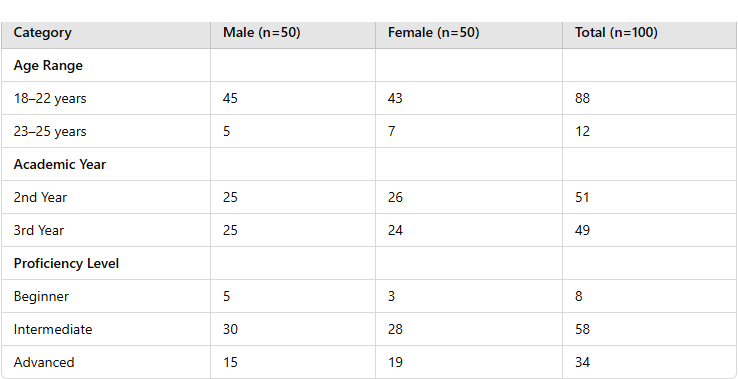
Age Distribution: The predominant age group of participants (85%) was between 18 and 22 years old, with a minority (15%) aged between 23 and 25 years.
Academic Level: All participants were undergraduate students, predominantly in their second or third year of study.
skill Level: According to self-assessment, 60% of students classified their English skills as intermediate, 30% as advanced, and 10% as beginner.
Table 1: Demographic Information of Survey Participants
This table summarizes the demographic information of the 100 survey participants, including gender, age range, and academic year.
4.1.2 Speaking Challenges
The survey identified some significant challenges encountered by both male and female students when speaking English. The primary challenges were as follows:
Pronunciation Challenges:
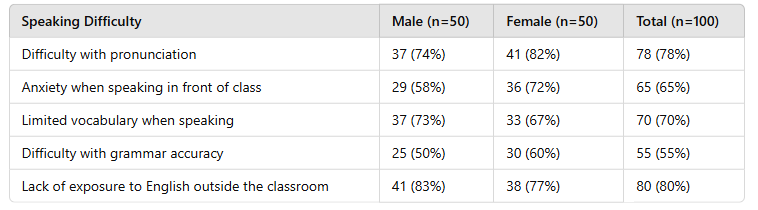
In total, 78% of students indicated difficulties with pronunciation, especially for specific English phonemes absent in Arabic.
Gender Comparison: Female students (82%) indicated marginally more incredible difficulty with pronunciation than male students (74%); however, the difference lacked statistical significance.
Table 2: Survey Results on Speaking Difficulties
This table provides the frequency of responses to questions regarding speaking difficulties, grouped by gender. Each item assesses a different speaking challenge.
Fluency and Anxiety:
In all, 65% of students indicated experiencing anxiety when required to speak in class. Numerous individuals said that this anxiety adversely affected their fluency and induced hesitation while speaking.
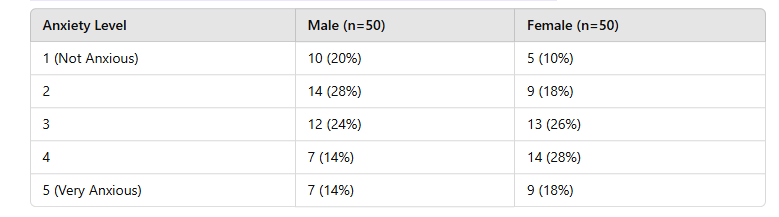
Gender Comparison: A more significant proportion of Female students (72%) reported experiencing anxiety compared to male students (58%), with the difference being statistically significant at the 0.05 level. Female students exhibited an elevated degree of self-consciousness while addressing their peers.
Table 3: Anxiety Levels and Gender Comparison
This table compares the anxiety levels of male and female students when speaking in English. The anxiety scale is based on a Likert scale (1 = Not Anxious, 5 = Very Anxious).
Lexicon and Syntax:
Seventy percent of students recognized restricted vocabulary as a major impediment to fluent speaking. Moreover, 55% indicated difficulties with grammatical precision, especially for verb tenses and sentence construction.
Gender Comparison: Male students (73%) saw more significant challenges with vocabulary than female students (67%), but female students (60%) encountered more difficulties with grammatical correctness than male students (50%).
Engagement with the English language:
80% of students reported insufficient opportunities to practice English beyond the classroom. Numerous students indicated a lack of interaction with native English speakers or participation in English-speaking activities in their daily routines.
Gender Comparison: A higher percentage of Male students (83%) reported minimal exposure to English outside the classroom compared to female students (77%).
4.1.3 Principal Conclusions from the Survey
Pronunciation, Fluency, and Anxiety: Both male and female students have considerable difficulties with pronunciation and fluency. Female students, however, often encounter elevated anxiety levels while addressing an audience, which may intensify their fluency difficulties.
Vocabulary and Grammar: Male students have more significant challenges with vocabulary, but female students encounter more difficulties with grammatical precision. This may indicate that male students prioritize communication above correctness, whereas female students emphasize precise speech.
Insufficient Exposure: Both genders indicate a deficiency in exposure to English beyond the classroom, which considerably impedes their speaking proficiency.
4.2 Interview Results
An aggregate of 20 students (10 male and 10 female) were questioned to acquire more details about how they deal with speaking challenges. The interviews addressed students’ impressions of the problems they confront, the significance gender plays in language learning, and solutions they utilize to enhance their speaking abilities.
4.2.1 Speaking Difficulties
Pronouncing words correctly: Numerous pupils experienced issues with some English sounds, notably the “th” sound and vowel sounds that do not exist in Arabic. Female students felt more self-conscious about their pronunciation, mainly when speaking in mixed-gender courses.
Fluency and Anxiety: Both male and female students reported that feeling anxious was a key hindrance to fluency. Many participants expressed fear of making errors in front of peers, which leads to reluctance to talk. Female students were more nervous about speaking in front of male peers, as they feared may impair their confidence.
Vocabulary: Many students, especially male students, claimed that a restricted lexicon impedes communication. Male learners also reported that they sometimes avoid using difficult terminology because they are worried about its authenticity.
syntax: Female students seemed more inclined to state that they concentrated on syntactic precision, no matter the sacrifice of fluency. Some female students claimed that their attention to syntax challenged them to generate proper phrases immediately.
Table 4: Summary of Gender-Based Differences in Speaking Difficulties
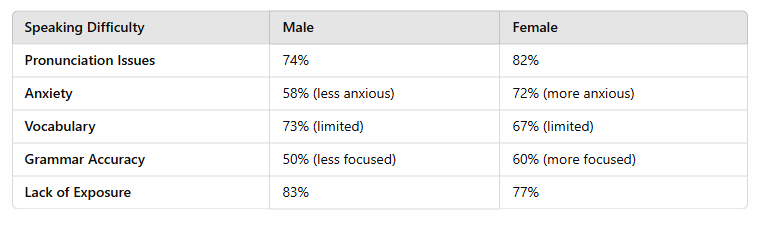 A summary table showing key differences in the speaking difficulties faced by male and female students:
4.2.2 Gender-Based Differences
Female students exhibited heightened nervousness and anxiety while speaking, especially in male-dominated settings. They said that the social standards of women in Iraq occasionally rendered them uneasy expressing themselves fully in the presence of male peers or teachers.
Conversely, Male students exhibited lower levels of anxiety but frequently encountered difficulties with fluency because of insufficient terminology. They indicated a preference for casual communication with peers; however, they expressed diminished confidence in classroom environments.
4.2.3 Coping Strategies
Female Students frequently indicated employing independent study techniques to enhance their ability to speak, including viewing movies in English and performing speech alone before a mirror. Several individuals indicated their involvement in additional English groups to mitigate their worry.
Male Students prioritized spontaneous conversational training with friends and classmates. Several male students indicated that they honed their ability to communicate by conversing with peers in English in addition to the learning setting.
Table 5: Coping Strategies Used by Male and Female Students
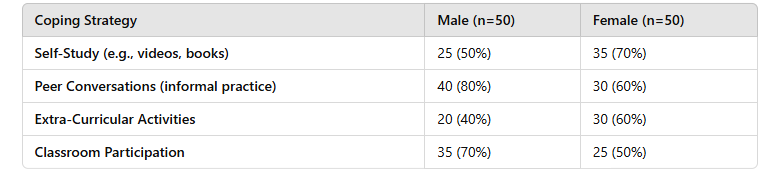 This table summarizes the coping strategies used by male and female students to improve their speaking competence.
4.3 Classroom Observations
The learning environment investigations yielded more information into the verbal behaviors of male and female pupils. The subsequent trends were noted:
Being involved: Female students tended to be more reticent in big group conversations, whereas male students were more outspoken and inclined to take chances in their speech. Nonetheless, female students demonstrated more involvement in smaller, gender-segregated groups.
Each gender displayed indications of anxiousness when required to speak in class. Female students had a greater propensity for tense behaviors, including pacing or evading gazes, whereas male students were more composed although occasionally showed hesitation.
Pronunciation Challenges: Both sexes had comparable difficulties with pronunciation, particularly with certain English sounds. Female students appeared to be closer to their articulation problems and were more inclined to solicit input from their instructor.
4.4 Discussion of Results
Iraqi EFL students at Al Iraqia University have many of the same difficulties when it comes to speaking English, according to the results of the questionnaire and the interviews conducted. These difficulties include nervousness, a restricted vocabulary, poor pronunciation, and the absence of knowledge.
Concerns with Pronunciation: These issues are in line with the research, which emphasizes that non-native speakers frequently have trouble pronouncing consonants that are not present in their original language (Al-Jarf, R., 2022). The survey also discovered that female students are likely to feel anxious because they are self-conscious about how they pronounce words.
Concerning Fluency and Anxiety, earlier studies have shown that female language learners are more likely to be self-critical and lack confidence in their speech (Horwitz et al., 1986). This finding is consistent with the fact that female students experience greater levels of anxiety.
Like in other studies on language acquisition, researchers noticed variations between the sexes in this study (Dewaele, 2002). In contrast to male students, who prioritise fluidity and often refrain from speaking when they lack language, female students are more inclined to experience anxiety and place a premium on precision.
One major problem is that students don’t have enough Exposure to the English language outside of school. Consistent with the results of DHARI, S. S. et al (2024), students of both sexes reported having few opportunities to use their English in authentic contexts.
According to this study’s findings, Iraqi English as a Foreign Language (EFL) students at Al Iraqia University face substantial obstacles to fluency in speaking. Though both sexes have challenges with pronunciation and fluency, female students often experience more anxiety, which can affect their total speaking abilities. Additionally, the research stresses the need for additional speaking chances, both in and out of the classroom, and for students to be exposed to English more often.
5. Conclusion and Recommendations
In this last section, review the investigation’s main points, discuss what they mean, and suggest ways EFL students at Al Iraqia University might improve their speaking. The chapter concludes by recommending potential avenues for further study in this area.
5.1 Key Findings Synopsis
With an emphasis on disparities between sexes, the present research aimed to evaluate the speech competency issues experienced by Iraqi EFL students at Al Iraqia University. numerous significant results were uncovered by the study’s survey, interviews, and lecture outcomes:
Problems with Pronunciation:
Students of both sexes expressed frustration with their English pronunciation, especially when it came to consonants that are not found in Arabic. The majority of Female students (82%) felt less comfortable whenever speaking because they were embarrassed about their pronunciation.
Fluency and Anxiety:
Students of both sexes found it difficult to talk clearly, with 65% of those who participated admitting that worry hindered their ability to communicate effectively. 72% of female students reported feeling anxious in classes with male and female pupils.
Vocabulary and Grammar:
Many of the students, particularly male students, expressed frustration with their lack of vocabulary and how it affected their communication skills. In contrast, Female students placed a greater emphasis on correct grammar usage, yet most of these students observed that this emphasis on syntax frequently resulted in reluctance and diminished fluency.
Insufficient English Proficiency:
Beyond their class, eighty percent of students said they didn’t have many chances to practice their English. This restriction was particularly apparent for male learners at 83%, whereas for female students, it reached 77%.
As It Relates to Gender:
Talking in front of classmates, especially when other male learners are around, made more women feel nervous and anxious than male pupils. The male students were less nervous but had more difficulty with the language arts and proficiency levels. Male students relied on unstructured conversational development with colleagues, whereas female students tended to concentrate on independent learning even though both sexes had comparable pronunciation challenges.
Methods for Dealing:
When it came to independent study strategies, female students were more inclined to use English films and practice speaking on their own. On the other hand, male students frequently sought out opportunities to practice public speaking during casual discussions with acquaintances and fellow students.
5.2 Possible Consequences for English as a Foreign Language Instruction
The results of this study have many significant consequences for English as a Foreign Language (EFL) instruction at Al Iraqia University. In light of these difficulties, the following strategies are proposed for enhancing public speaking skills:
More Time Spent Speaking:
Little exposure to the English language outside of the classroom was a significant obstacle to fluent speaking. To combat this, teachers can facilitate more in-class and extracurricular speaking opportunities for their pupils. Public speaking, group work, presentations, and debates might all fall under this category.
Through the design of In-class activities, teachers can aggressively encourage student engagement and reduce the fear of making errors. Students may benefit greatly from working in pairs or small groups, which provides a more comfortable setting in which to practice public speaking.
Dealing with Worry:
Many students, especially females, suffer from anxiety. To alleviate students’ fears and foster a positive classroom climate, educators should implement certain measures. Some examples of this kind of support include letting students know they may make errors without fear of reprimand and giving them constructive criticism.
If students feel nervous before speaking exercises, teachers should consider including relaxation techniques like deep breathing or mindfulness activities in the class
Enhancing Pronunciation:
Both sexes frequently experience problems with pronouncing words. If students have trouble pronouncing certain sounds, their teachers should tailor their pronunciation activities to help them with those particular sounds. To that end, this could employ interactive exercises, audio resources, and tongue twisters to assist students in working on their pronunciation.
Another strategy to promote a more cooperative learning atmosphere in group projects is to have students provide each other with comments on their pronunciation.
The Growth of One’s Vocabulary and Grammar:
The male students had a more challenging time with vocabulary than the female students, who were more concerned with correct grammar usage. This can be mitigated if educators balance their lesson plans between drills on accuracy and fluency. For instance, students may work on their fluency through exercises that promote spontaneous speaking, and they can work on their grammar and vocabulary correctness through supervised activities.
Speaking assignments should incorporate vocabulary-building activities like word games, flashcards, and exercises that are focused on context to assist students in increasing their vocabulary.
Methods that Take Gender into Account:
Recognizing and addressing gender inequalities in language acquisition is crucial. Particularly in mixed-gender classes, where female students may experience more self-consciousness, it may be helpful to establish a comfortable environment for them to talk. Educators have a responsibility to promote gender parity in the classroom and to help their female students gain confidence while presenting in front of an audience that includes both males and females.
Teachers should think about ways to help male students who are having trouble with fluency and vocabulary by giving them more chances to practice in less formal, peer-led situations.
Using Digital Tools and Internet-Based Materials:
Students’ limited exposure to the English language outside of school makes technological tools all the more critical for supplementing their speaking practice. Students may also gain further opportunities to engage in English listening and speaking activities outside of the classroom using online platforms, such as language exchange websites, podcasts, and video resources.
Another option would be to establish online speaking clubs or virtual classrooms where students may practice speaking English in a less formal context with either native speakers or other students.
5.3 Ideas for Further Study
This study has shed light on the challenges that Iraqi EFL students confront when it comes to speaking competence, but there are still many unanswered questions that might guide future studies in this area:
Examining Trends Over Time:
Researchers may follow students throughout their education to see how their speaking skills change over time. This would shed light on the elements that contribute to the maturation of oratory abilities.
Economic and Social Variables’ Influence:
What demographic variables, such as pupils’ access to resources, affect their speaking ability might potentially be a topic for future research. Students from more affluent families may have better opportunities to interact with native English speakers and get exposure to the language, which might improve their speaking skills.
Mastering Public Speaking and Online Education:
Given the increasing relevance of e-learning, future research can examine how well technology and platforms work to improve public speaking abilities. Possible areas of research interest include the efficacy of smartphone apps, language exchange programs, and online classes in assisting students with speech issues.
The Impact of Culture on Public Speaking:
Investigating how cultural factors influence language acquisition is another promising avenue for future studies. It would be beneficial for instructors to have a more thorough comprehension of how gender and social norms about speaking impact the enthusiasm and participation of pupils in speaking lessons.
5.4 Conclusion
Finally, this study has shown that Iraqi EFL students at Al Iraqia University have a number of significant obstacles while trying to become competent speakers. Some of these obstacles involve nervousness, a restricted vocabulary, poor fluency, poor pronunciation, and insufficient training in the English language. Although these challenges affect students of both sexes equally, research has shown that men and women deal with worry and stress differently. The results highlight the need for gender-inclusive pedagogical practices, increased communication opportunities, methods to alleviate stress, and enhancements to pronunciation and vocabulary. Teachers can aid their students in becoming more fluent speakers of English by following the strategies discussed in this chapter.
In sum, the findings of this study provide light on the challenges that Iraqi EFL students have while trying to communicate effectively and provide actionable advice for overcoming these obstacles.
6. References
Al Dilaimy, H. (2024). A Sociolinguistic Study of English Language Barriers and Communication. International Journal of Language and Literary Studies, 6(3), 120-136.
AlJuhani, E. (2023). Debating the Mixed Gender Classroom and Saudi Female Students Visibility in Coeducation. Theory & Practice in Language Studies (TPLS), 13(9).
AlJumaily, R. A. (2024). Investigating the Difficulties Encountered Iraqi EFL Learners in Pronouncing Multisyllabic English Words. International Journal of Linguistics, Literature & Translation, 7(9).
Aubrey, S., King, J., & Almukhaild, H. (2022). Language learner engagement during speaking tasks: A longitudinal study. RELC journal, 53(3), 519-533.
Brown, S., & Larson-Hall, J. (2012). Second language acquisition myths: Applying second language research to classroom teaching. University of Michigan Press ELT.
Chaima, M. Investigating Some Psychological Factors Hindering EFL Learners’ Speaking Skills. The Case of First Year LMD Students of English at Mohamed Kheider University of Biskra.
Dhari, S. S., Mohamad, H., Mohamed, A., & Khaleel, M. A. (2021). The impact of Arabic (L1) on Iraqi EFL undergraduates’ use of English prepositions at Al-Hikmah University College. Turkish Journal of Computer and Mathematics Education, 12(12), 2770-2782.
Dörnyei, Z. (2007). Research Methods in Applied Linguistics. Oxford University Press.
Grieve, R., Woodley, J., Hunt, S. E., & McKay, A. (2021). Student fears of oral presentations and public speaking in higher education: a qualitative survey. Journal of Further and Higher Education, 45(9), 1281-1293.
Khasawneh, M. A. S. (2024). Exploring the influence of gender variation on the use of language learning apps in foreign language skill improvement. Research Journal in Advanced Humanities. https://doi. org/10.58256/5pmpxd51.
Lee, J. S., Xie, Q., & Lee, K. (2024). Informal digital learning of English and L2 willingness to communicate: Roles of emotions, gender, and educational stage. Journal of Multilingual and Multicultural Development, 45(2), 596-612.
Nazim, M., Alzubi, A. A. F., & Fakih, A. H. (2024). EFL teachers’ student-centered pedagogy and assessment practices: challenges and solutions. Journal of Education and Learning (EduLearn), 18(1), 217-227.
Oktari, N. F. (2024). Investigating EFL Students’ Strategies to Overcome Barriers in Improving Speaking Skills through English Club (Doctoral dissertation, UIN Ar-Raniry Banda Aceh).
Özdemir, O., & Seçkin, H. Anxiety as a Foreign Language Learning Barrier: Perspectives of Lecturers and Freshmen on Speaking and Writing Skills in Higher Education Settings. Available at SSRN 5051729.
Rofi’i, A., & Herdiawan, R. D. (2024). The optimization of hybrid technology in synchronous and asynchronous speaking class. Journal of Information System, Technology and Engineering, 2(1), 142-152.
Sabti, A. A., Mansor, Y. T. M. B. T., Altikriti, M. Q., Abdalhussein, H. F., & Dhari, S. S. (2016). Gender differences and foreign language reading anxiety of high school learners in an Iraqi EFL context. International Journal of Applied Linguistics and English Literature, 5(5), 208-214.
 English
  Arabic