

A Critical Discourse Analysis of Ideology in some American and British Press in Relation to Palestinian Crisis
التحليل النقدي للخطاب الأيديولوجي في بعض الصحف الأمريكية والبريطانية في علاقتها بالأزمة الفلسطينية
Asst. Lect. Zainab Kareem Ghannam1
1 Ministry of Education, Iraa.
Zainabkareem632@gmail.com
DOI: https://doi.org/10.53796/hnsj611/45
Arabic Scientific Research Identifier: https://arsri.org/10000/611/45
Volume (6) Issue (11). Pages: 715 - 723
Received at: 2025-10-07 | Accepted at: 2025-10-15 | Published at: 2025-11-01
Abstract: This study conducts a critical discourse analysis (CDA) of ideological representation in selected American and British newspapers regarding the Palestinian crisis. It aims to uncover how ideology shapes news discourse and influences public perception through linguistic strategies. Drawing upon Van Dijk’s (1998, 2006) ideological square model, the study examines articles from The New York Times, The Washington Post, The Guardian, and The Daily Mirror, analyzing how each press constructs in-group and out-group identities through lexical and syntactic choices. The analysis reveals that both American and British newspapers employ ideologically motivated discourse structures, though to varying degrees. The American press exhibits stronger tendencies toward positive self-presentation (75%) and negative other-presentation (25%), emphasizing pro-Israeli perspectives. Conversely, the British press demonstrates a more balanced but still ideologically driven stance, with 25% positive self-presentation and 50% negative other-presentation, often portraying Palestinian suffering more visibly. These findings highlight that media discourse is far from neutral, reflecting underlying political and cultural biases embedded in Western reporting on Middle Eastern conflicts. The study contributes to the understanding of how ideological manipulation operates in global media narratives and offers valuable insights for linguists, discourse analysts, and media scholars interested in the intersection of language, power, and ideology.
Keywords: Critical discourse analysis, ideology, media discourse, Palestinian crisis, Van Dijk, American press, British press.
المستخلص: تتناول هذه الدراسة تحليلاً نقدياً للخطاب الأيديولوجي في عدد من الصحف الأمريكية والبريطانية فيما يتعلق بالأزمة الفلسطينية، بهدف الكشف عن كيفية توظيف الأيديولوجيا في تشكيل الخطاب الإعلامي وتأثيره في إدراك المتلقي. اعتمدت الدراسة نموذج فان دايك (1998، 2006) في تحليل "المربع الأيديولوجي" بوصفه إطاراً نظرياً لتحليل النصوص الصحفية المختارة من صحف نيويورك تايمز، وواشنطن بوست، وذا غارديان، وديلي ميرور. ركز التحليل على كيفية بناء الهويات الجماعية (نحن/هم) من خلال الاختيارات المعجمية والتركيبية في النصوص. أظهرت النتائج أن كلا من الصحافتين الأمريكية والبريطانية تمارسان خطاباً إعلامياً يحمل بعداً أيديولوجياً واضحاً، وإنْ بدرجات متفاوتة. إذ تبين أن الصحافة الأمريكية تميل إلى عرض ذاتها إيجابياً بنسبة (75%) مقابل عرض الآخر سلبياً بنسبة (25%)، بما يعكس ميلاً مؤيداً لإسرائيل، في حين أظهرت الصحافة البريطانية ميلاً أكثر توازناً مع استمرار حضور الأيديولوجيا، إذ بلغت نسبة العرض الذاتي الإيجابي (25%) والعرض السلبي للآخر (50%)، مع إبراز أوضح لمعاناة الفلسطينيين. تؤكد هذه النتائج أن الخطاب الإعلامي ليس محايداً، بل يعكس تحيزات ثقافية وسياسية كامنة في التغطية الغربية للصراع في الشرق الأوسط. وتُسهم الدراسة في تعميق الفهم للعلاقة بين اللغة والسلطة والأيديولوجيا في الخطاب الإعلامي العالمي، بما يفيد الباحثين في مجالات اللسانيات وتحليل الخطاب والإعلام السياسي.
الكلمات المفتاحية: التحليل النقدي للخطاب، الأيديولوجيا، الخطاب الإعلامي، الأزمة الفلسطينية، فان دايك، الصحافة الأمريكية، الصحافة البريطانية.
1.1 The Problem
The present study is in the field of critical discourse analysis (CDA, henceforth) about the American and British press in relation to the Palestinian crisis. Language adopted by media was influenced by ideology.
The impact of language is so powerful on the receiver both on psychological and behavioral levels. This power that language has, is seen heavily in press and media. These tools use language to impose their beliefs and thoughts on the receiver, especially if this receiver does not live the situation. That is why it is necessary to spot light on the Western press to have more knowledge about their way of handling the events and news in the Eastern world. Since news is delivered subjectively, there is a need to use a device for analysing the ideologies and attitudes of the press toward the Palestinian crisis.
The problem of the present study tries to shed light on the ideologies of American and British Press in relation to the Palestinian Crisis.
The present study tries to answer the following questions:
- What is meant by ideology?
- How ideology is manipulated in the discourse?
- Which group is more ideological than the other?
1.2 The Aims
In light of the preceding questions, the study aims at:
- Exploring the way the a. ideological square affects the articles of the American press.
1.3 The Hypotheses
It is hypothesized that:
- The American Newspapers consider Palestinians as out-group whereas Israel is in-group.
- The Ideology is more vivid in the British press than the American press
1.4 The procedure
In order to achieve the aims of the present study and prove its hypotheses, the following procedures will be followed:
- Presenting a theoretical account about ideology, American and British press. Analysing the data selected by adopting Van Dijk (2008)
- In the light of the results, conclusions and suggestions will be made.
1.5 The Limits
The present study is limited to Critical Discourse Analysis. The data of the present study is going to be selected from two newspapers. One of them is American and the other is British. The British newspaper is The Daily Mirror, the American one is The New York Times.
1.6 The Value
The present study is hoped to be of some value to students of linguistics, as well as those who are concerned with politics, media discourse analysts, and news analysts. It is also hoped that this study provokes the workers in the field of media to be more impartial and present more accurate and objective information.
Chapter Two
2.1 Ideology
Members of a group share social cognitions, which are the basis for the cognitive definition of ideology. The social component clarifies the types of groupings, interpersonal relationships, and institutional dynamics that contribute to the formation and propagation of ideologies. The ideological discourse dimension clarifies how ideologies impact our everyday texts and conversations, how we interpret ideological speech, and how discourse contributes to the spread of ideology across society. Van Dijk(4: 2012).
“Ideology” as an imprecise and contentious term The term ‘ideology’ is frequently employed in the social sciences, politics, and the media. Since the idea was developed at the end of the 18th century by French philosopher Destutt de Tracy, thousands of articles and books have been written about it. Destutt de Tracy opens his well-known book in this way, addressing young readers directly, claiming that renowned professors’ minds are already filled with “fixed ideas” that are exceedingly hard to modify. . Van Dijk(4: 2012)
Fairclough (1992: 87) claims that ideologies are “constructions of reality…which are built into various dimensions of the forms/meanings of discursive practices, and which contribute to the production, reproduction or transformation of relations of domination”. In others words, ideologies are ideas and attitudes in a form of language. They shape the reality being lived and contribute to the reproduction of domination.
Accordingly, Van Dijk (1998a:58) suggests ideological theory that furnishes better comprehending of the notion of ideology. He (ibid) combines its three core components that have been studied separately before. These components are (ibid: 58):
- Cognitively, ideology compromises of ideas in people’s minds, which are usually studied by cognitive psychologists.
- Societally, ideology also includes a group membership and value judgment, which are generally investigated by sociologists and social scientists.
- Linguistically, ideology is not an innate knowledge and, therefore, it needs to be learnt, acquired, or changed through written or spoken discourse.
Van Dijk (1995a: 21), nonetheless, does not depict ideology as “a system of ideas” as much as he(ibid) sees it as “specific basic frameworks of social cognition with specific social structures and specific cognitive and social functions”. Ideology, as proposed by Van Dijk (1995a: 21), is a set of mental beliefs about a certain phenomenon. It stands for the social opinions. It is usually concerned with the prejudiced mental models that reflects in the strategic use of language such as lexical choices at the semantic level.
Sometimes the term ‘ideology’ is negatively used and that the term ‘negative ideology’ has become central in social sciences and politics as “a system of false, misguided, or misleading beliefs” as opposite to truth of scientific knowledge. The negative use of the notion entails ‘polarisation’ between ‘us’ and ‘them’: “WE have true knowledge, THEY have ideologies”. As opposite to “negative ideology”. The term “positive ideology”‘ refers to ‘feminism’ and ‘anti-racism’. This “positive ideology” is a legal system that shows resistance against control and “inequality”. Such a system is called “anti-ideology” ,for instance “anti-racism” and “anti-feminism” (Van Dijk,2006d: 7).
Wodak (2015:4) views ‘ideology’ as the people’s view of world that compromised of the representation of mentality, attitudes, evaluations, opinions, and beliefs. Ideologies are considered as means of observing inequality of power relations in discourse. As such, ideologies has schema and this schema characterizes the ideologies of the same group (Van Dijk 2006:17):
Membership criteria: Who does (not) belong?
Typical activities: What do we do?
Overall aims: What do we want? Why do we do it?
Norms and values: What is good or bad for us?
Position: What are the relationships with others?
Resources: Who has access to our group resources?
Van Dijk’s(2006:7-8) definition of ideology is adopted for the present study:
“Ideologies are the fundamental beliefs of a group and its members..
‘Ideology’ as ‘false consciousness’ or ‘misguided beliefs’… ideologies not only make sense in order to understand the world (from the point of view of the group), but also as a basis for the social practices of group members… Often, ideologies thus emerge from group conflict and struggle, and they thus typically pitch Us against Them”
Van Dijk’s(2006:7-8) definition is chosen since it is comprehensive and serves the present study aiming at revealing the hidden ideologies behind the discourse of press.
2.2 Ideologies as social cognition
Ideologies have been defined in a variety of ways throughout the history of the social sciences, but they always have as their commonality the concepts or beliefs of social collectivities. Remarkably, the primary ‘mental’ aspect of ideologies has received far less research attention than their social and political purposes. In fact, thorough psychological studies of ideology are extremely uncommon compared to those in the social sciences, and when they do exist, they are largely limited to studies of political ideas.
In the same way that we do not have individual ideas or speak about individual tongues. Ideologies are therefore collective social beliefs rather than individual viewpoints. Moreover, rather than being about insignificant daily details like the color of our car or the brand of our computer, they frequently discuss significant social and political matters, that is, issues that are vital to a group and its existence. As the divergent views on abortion and euthanasia demonstrate, ideologies are about birth and reproduction, as well as life and death. Ecological ideologies make it clear that they are about people and their health in relation to the natural world. Class, income and resource redistribution, power and lack thereof, and socialist ideology are all central to their discourse. Van Dijk (4: 2012)
Chapter Three
Methodology
3.1 Ideological Square
Van Dijk (2006a: 42-44) states the fact that the Semantics, Style, and Syntax of the discourse are influenced by the ideologies of the speakers. So that the lexical choices are affected by the attitudes, and the ideological position that the speaker has about the group. The basis of ideology is the Us vs. Them principle. Consequently, ideologies control people and societies. The general strategy of ideology is that “Say positive things about Us, Say negative things about Them“. This principle of “positive self –presentation and negative other presentation” is the principle of ideological square that form the discourse. This principle is applied to the meaning level of discourse. Then is expanded to involve other discourse structure: “Do not say negative things about Us, Do not say positive things about them“. Then these four principles are modified in the following way:
- Emphasize/ Include Our good things or actions
- Emphasize/Include Their bad things or actions
- De-emphasize/Exclude Our bad things
- De-emphasize/ Exclude Their good things
Discourse structures at all levels could be analyzed using these ideas. They stand for the ideological quadrant. They concentrate on using the textual and spoken content. ( Van Dijk 2006a:8).
Van Dijk (20015:73) states that an ideological analysis of the discourse structure, which is closely linked to the perpetuation of power abuse, may be conducted by using the aforementioned strategies. These two approaches can be obtained by examining particular speech elements inside a given framework. For example, the usage of particular vocabulary words or sentence constructions that convey a particular meaning suggesting a favorable or negative assessment of Us or Them (ibid.). As Van Dijk (2006a: 44) says “discourse has many ways to emphasize or de-emphasize meanings, and as soon as these have an ideological basis”.
3.2 Data analysis
The data of the present study is selected from different American and British newspapers. The British newspapers are The Mirror and the Guardian. Whereas the American newspapers are the Washington Post and the New York Times. Different news is chosen which is related to the Palestinian crisis. The table below classify the articles in details:
|
Classification |
Press name |
Title |
No. |
|
British press |
The Gardian |
Violence from the Israeli settler movement has targeted Palestinians in the occupied West Bank with villages attacked by marauding gangs of men armed with torches and rifles, locals say |
1 |
|
British press |
The Gardian |
Israeli raiders ‘bring terror’ to Palestinians in occupied West Bank |
2 |
|
British press |
The Gardian |
Fanatical Hamas militants open fire on Israeli civilians as troops prepared for last push into Rafah One mum described living with her family in Sderot, an Israeli community less than a mile from Gaza, as ‘very frightening’ amid the regular fighting and explosions she hears |
3 |
|
British press |
The Gardian |
Children in Gaza underplaying their pain due to extent of trauma around them, say doctors |
4 |
|
American press |
The New York times |
The Stark Reality of Israel’s Fight in Gaza |
5 |
|
The Washington Post |
U.S. cites a litany of rights violations in Israel, Gaza and West Bank |
6 |
|
|
The Washington Post |
Six months of the Israel-Gaza war: A timeline of key moments |
7 |
3.3 The Model of the Study
The model of the present study is chosen according to Van Dijk’s(2006a) ideological square. The present study adopts Van Dijk (1998) for the ideological square analysis.
The Following figure represents the model of the study:
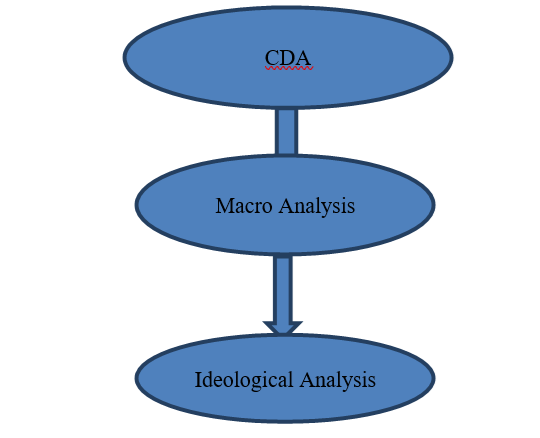
Figure (3-1) The Model of the Study
3.4 The Ideological Analysis
The ideological square of the positive self-presentation and the negative other presentation is applied by American newspapers. The in-group and the out-group make up the two polarized groups within the ideological square. The American and the British newspapers use the principles of the ideological square of the positive self-presentation and the negative-other presentation.
3.3 Data description
|
Classification |
Press name |
Title |
No. |
|
British press |
The Gardian |
Violence from the Israeli settler movement has targeted Palestinians in the occupied West Bank with villages attacked by marauding gangs of men armed with torches and rifles, locals say |
1 |
|
British press |
The Gardian |
Israeli raiders ‘bring terror’ to Palestinians in occupied West Bank |
2 |
|
British press |
The Mirror |
Fanatical Hamas militants open fire on Israeli civilians as troops prepared for last push into Rafah |
3 |
|
British press |
The Gardian |
Children in Gaza underplaying their pain due to extent of trauma around them, say doctors |
4 |
|
American press |
The New York times |
The Stark Reality of Israel’s Fight in Gaza |
5 |
|
The Woshington Post |
U.S. cites a litany of rights violations in Israel, Gaza and West Bank |
6 |
|
|
The Washington Post |
Six months of the Israel-Gaza war: A timeline of key moments |
7 |
Table (3-1) Data Description
3.4.1 British Press
Starting with the British articles, the present study is going to analyse the article according to Vandijk’s 2008 . The study is going to classify the ideological attitude that the press adopts when it deals with the two groups. The table below illustrates the percentages of the ideological square analysis.
|
Negative other presentation |
Positive self-presentation |
|
50 % |
25% |
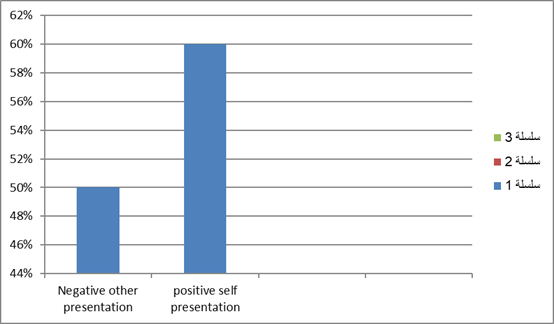
Figure(3-1) Ideology in British Press
The above-mentioned figure illustrates the percentage of Ideology of British press. The percentage is as follows: 25% of the total usage is for the positive we presentation. The British press uses the pronoun We/ I / Israel/ to refer to Israel as a positive presentation. It seems that the British press admits that civilians in the places that belong to Israel.
The aim of this study is to examine how the British press present themselves in political debate that is intended for media outlets.
Working within CDA as the general theoretical framework, Ideological analysis of an article for the British press in relation to the Palestinian crisis.
The division of the text into UK and Them places both the authors and the readers—the people who will be directly affected by the discussion—in the same category. The depiction of the few cognitive processes used does not reflect each other .The foundation of presenting We as a cohesive and dissident-free community is their shared history and perspective of the world.
As a result, the writers exclude information that might startle readers even though it isn’t explicitly mentioned that We have similar ideologies. Furthermore, by embracing the entire world—aside from Them—we make it impossible for anyone to disagree with our opinions. It is possible to conclude that the lack of “we think” entails maintaining Our unity in both confronting Them and defending universal democracy.
Thus, it is impossible to interpret “we stand for something different” in the British articles as referring to the divergent ideologies of the British press specifically, The Gardian is positively depicted, taking for granted that there are no indications of a power struggle for control among us, in the absence of what we consider to be what we stand for.
Words like Israel, We, I, The military force of Israel are repeated in the British discourse mainly. This refers to the positive self-presentation that the press adopt when it refers to Israel. Actually, this fact has been proved by the percentages in the above mentioned table.
The use of the pronoun we is used 25% while the pronoun they is used with percentage of 35%.
3.4.2 American Press
|
Negative other presentation |
Positive self-presentation |
|
25% |
75 % |
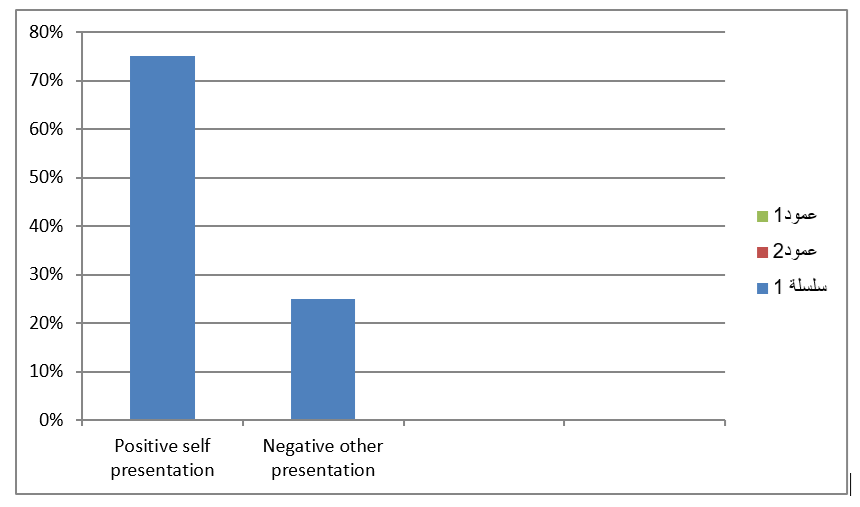
In the American press, it seems that the use of ideological discourse is widely concentrated on positive self-presentation as illustrated in the table. This reflects the fact that the American press intends to emphasise the negative and bad things of the out group. They shed light on the bad things, qualities, or information of the out group. For example, the Negative other presentation has been used with percentage of 25%.
Chapter Four
4.1 Conclusion
In the light of the preceding statistics, it is concluded that the manipulation of ideology is clear in both American and British press. For example, the percentage of the positive self-presentation in the British press is 25% whereas the percentage of the negative other presentation is 50%. In the same way, the use of ideology in American press is as follows: 75% is for the positive self-presentation and 25% is the percentage of the negative other presentation.
References
- Fairclough, N. (1995). Critical Discourse Analysis: The Critical Study of Language. London and New York: Longman.
- Van Dijk. (1995a). Discourse Analysis As Ideology Analysis. In C. Schӓffner and A. Wenden (Eds.), Language and Peace. Aldershot: Darmouth Publishing.
- Van Dijk.1998. IdeologyA Multidisciplinary Approach. London • Sage Publication. Van Dijk. (1993b). Editor’s foreword to Critical Discourse Analysis, Discourse and Society 4, 131-142.
- Van Dijk. (2006b). Ideology and Discourse Analysis. Journal of Political Ideologies, Vol.11,no.2, (pp. 115-140), London: Routledge.
- Van Dijk. (2015). Critical Discourse Analysis. A Case Study of International and National
- Wodak, R. (2015). The discourse of politics in action: Politics as usual (2nd ed.). Basingstoke, UK: Palgrave.
Web sources
- https://www.washingtonpost.com/national-security/2024/04/22/us-israel-gaza-human-rights/
- https://www.nytimes.com/2024/04/22/us/politics/israel-gaza-hamas-war.html
- https://www.theguardian.com/global-development/2024/apr/30/children-in-gaza-underplaying-their-pain-due-to-extent-of-trauma-around-them-say-doctors
- https://www.theguardian.com/commentisfree/2024/apr/30/us-investigation-gaza-mass-graves
- https://www.theguardian.com/world/live/2024/apr/30/middle-east-crisis-live-biden-urges-egypt-qatar-release-israeli-hostages-ceasefire-talks-hamas
- https://www.theguardian.com/global-development/2024/apr/30/children-in-gaza-underplaying-their-pain-due-to-extent-of-trauma-around-them-say-doctors
- https://www.mirror.co.uk/news/world-news/fanatical-hamas-militants-open-fire-32655848?int_source=mantis_rec&int_medium=web&int_campaign=more_like_this
- https://www.mirror.co.uk/news/world-news/israeli-raiders-bring-terror-palestinians-32699059
 English
  Arabic