

Visual Pollution in Urban Areas and the Impact of Advertising and Uncontrolled Urban Expansion on Urban Environmental Quality: A Review
التلوث البصري في المناطق الحضرية وتأثير الإعلانات والتوسع العمراني غير المنضبط في جودة البيئة الحضرية: دراسة مراجعة
Muhammad Dawoud Salman1
1 Ibn Rushd College of Education, University of Baghdad, Baghdad, Iraq
Corresponding author: mohammed.d@ircoedu.uobaghdad.edu.iq
DOI: https://doi.org/10.53796/hnsj79/58
Arabic Scientific Research Identifier: https://arsri.org/10000/79/58
Volume (7) Issue (9). Pages: 1149 - 1159
Received at: 2026-08-15 | Accepted at: 2026-08-22 | Published at: 2026-09-01
Abstract: Visual pollution has emerged as a significant dimension of urban environmental degradation, particularly in rapidly growing cities experiencing intensive commercial activity and uncontrolled spatial expansion. This review examines the interconnected effects of advertising, commercial signage, urban sprawl, and disorganized development on the visual and environmental quality of urban areas. It synthesizes theoretical and empirical literature concerning urban image, environmental perception, visual landscape assessment, urban design, and land-use change. The findings indicate that excessive or poorly regulated advertising, inconsistent building façades, unfinished structures, infrastructure clutter, fragmented development, and incompatible land uses collectively reduce visual coherence, obscure architectural features, weaken place identity, and diminish the attractiveness of urban spaces. Uncontrolled urban expansion further intensifies these effects by producing irregular street patterns, discontinuous development, and the conversion of open and agricultural land into heterogeneous built-up areas. The reviewed literature also demonstrates that urban visual quality is closely associated with environmental satisfaction, imageability, human scale, sense of place, and overall quality of life. Effective assessment therefore requires an integrated methodological approach combining field observation, perception surveys, visual-quality indicators, geographic information systems, remote sensing, and spatial analysis. The review identifies a research gap arising from the tendency to examine advertising, visual pollution, and urban expansion separately, despite their cumulative influence on urban environments. It concludes that improving urban environmental quality requires coordinated advertising regulations, context-sensitive building and streetscape design, protection of urban identity, sustainable land-use planning, and effective control of urban expansion.
Keywords: Visual pollution; advertising; commercial signage; urban sprawl; uncontrolled urban expansion; urban landscape; environmental perception; urban environmental quality; urban planning; quality of life.
المستخلص: برز التلوث البصري بوصفه بُعدًا مهمًا من أبعاد التدهور البيئي الحضري، ولا سيما في المدن سريعة النمو التي تشهد نشاطًا تجاريًا مكثفًا وتوسعًا مكانيًا غير منضبط. تهدف هذه الدراسة المرجعية إلى بحث التأثيرات المترابطة للإعلانات واللافتات التجارية والزحف العمراني والتنمية غير المنظمة في الجودة البصرية والبيئية للمناطق الحضرية. وتستعرض الدراسة الأدبيات النظرية والتجريبية المتعلقة بالصورة الحضرية، والإدراك البيئي، وتقييم المشهد البصري، والتصميم الحضري، والتغير في استخدامات الأراضي. وتشير النتائج إلى أن الإعلانات المفرطة أو غير المنظمة، وعدم اتساق واجهات المباني، والمنشآت غير المكتملة، وفوضى عناصر البنية التحتية، والتنمية المجزأة، واستخدامات الأراضي غير المتوافقة، تؤدي مجتمعةً إلى تقليل الانسجام البصري، وحجب المعالم المعمارية، وإضعاف هوية المكان، والحد من جاذبية الفضاءات الحضرية. كما يؤدي التوسع العمراني غير المنضبط إلى تفاقم هذه الآثار من خلال إيجاد أنماط شوارع غير منتظمة، وتنمية عمرانية متقطعة، وتحويل الأراضي المفتوحة والزراعية إلى مناطق مبنية غير متجانسة. وتوضح الأدبيات التي جرت مراجعتها أيضًا أن الجودة البصرية الحضرية ترتبط ارتباطًا وثيقًا بالرضا البيئي، ووضوح الصورة الذهنية، والمقياس الإنساني، والإحساس بالمكان، وجودة الحياة عمومًا. ولذلك، يتطلب التقييم الفعّال اتباع منهجية متكاملة تجمع بين الملاحظة الميدانية، واستبانات الإدراك، ومؤشرات الجودة البصرية، ونظم المعلومات الجغرافية، والاستشعار عن بُعد، والتحليل المكاني. وتكشف الدراسة عن فجوة بحثية ناتجة عن الميل إلى دراسة الإعلانات والتلوث البصري والتوسع العمراني بصورة منفصلة، على الرغم من تأثيراتها التراكمية في البيئة الحضرية. وتخلص الدراسة إلى أن تحسين جودة البيئة الحضرية يتطلب تنسيق اللوائح المنظمة للإعلانات، واعتماد تصميمات للمباني ومشاهد الشوارع تراعي السياق المحلي، وحماية الهوية الحضرية، وتطبيق التخطيط المستدام لاستخدامات الأراضي، وضبط التوسع العمراني بفاعلية.
الكلمات المفتاحية: التلوث البصري؛ الإعلانات؛ اللافتات التجارية؛ الزحف العمراني؛ التوسع العمراني غير المنضبط؛ المشهد الحضري؛ الإدراك البيئي؛ جودة البيئة الحضرية؛ التخطيط الحضري؛ جودة الحياة.
1. Introduction
Rapid urbanization is taking place in cities across the globe driven by population growth, economic development, rising commercial activities and sustained expansion of infrastructure and transportation networks. Although urban growth provides important opportunities for housing, employment and economic development, rapid and poorly planned expansion can generate considerable environmental and urban problems such as inefficient land use, loss of open spaces, fragmented development and deterioration of the quality and appearance of urban environments [1,2].
Therefore, to assess the quality of urban environments it is necessary to consider not only the traditional environmental indicators but also the visual and perceptual characteristics of the built environment.The urban environment is itself a complex system, in which buildings, streets, public spaces, vegetation, infrastructure, commercial activities and human behavior all interact to determine the overall character of a city. The layout and the visual characteristic of these elements affect the perception and experience of urban spaces by residents and visitors [3,4].
A well-ordered environment can promote comfort, attractiveness, and sense of place, while poorly coordinated urban elements can create disorder and diminish environmental satisfaction. Visual quality is therefore an important component of sustainable and livable urban development.Cities are increasingly facing a growing problem of visual pollution as an environmental issue. It refers to the deterioration of visual quality of urban spaces because of excess, inappropriate or badly arranged visual elements. The main sources are billboards and commercial signs, illuminated advertisements, inconsistent building facades, unfinished buildings, overhead cables, inappropriate street furniture, construction debris and unplanned development [4,6].
The accumulation of these elements can increase the visual disorder, reduce coherence and negatively affect the attractiveness and identity of urban areas.Of these sources, advertising and commercial signs are especially common. Advertising has an important economic and informational role, but the overload of signs, inappropriate sizes, intense colors, intense lighting and inappropriate location can turn ads into one of the main sources of visual pollution. Commercial streets and city centers may have a high concentration of signs, which can mask architectural features, reduce the visibility of important urban elements and weaken the visual identity of the surrounding area. Therefore, effective regulation of advertising is an important component of the management of the urban landscape [6].
At the same time, uncontrolled expansion of cities is a big challenge. Population growth and the growing demand for housing and services push cities to expand out into the surrounding areas. Without proper planning, such expansion can lead to scattered development, irregular street patterns, incompatible land uses and inefficient use of land and infrastructure [1,2]. Such changes can also affect the visual identity of cities by creating areas with inconsistent building forms, architectural styles, densities and land uses.
Therefore, the correlation between visual pollution and urban growth is interwoven. In unplanned urban growth, new areas of construction, commercial activity and advertising develop without adequate visual coordination. The main roads and the new developments may be dominated by commercial signs, inconsistent facades, vacant plots and irregular structures, creating a fragmented urban landscape. Studies on urban design have shown the importance of characteristics such as imageability, coherence, human scale, enclosure, transparency and appropriate complexity for the creation of attractive and understandable urban environments [4,8].
From the point of view of environmental perception, visual organization also influences the psychological responses that people have to their surroundings. Positive perceptions of urban spaces can be the result of coherence, order and appropriate visual complexity, whereas excessive visual clutter can lead to sensations of discomfort and dissatisfaction [3,4].
Thus, visual pollution is not only an esthetic problem, but also related with the environmental perception, place identity, quality of life and the general functionality of urban spaces.Increasing interest in the quality of urban visuality has been evident. However, previous studies have often treated advertising, urban design, visual pollution and urban sprawl as separate problems. There is a need for a more integrated understanding of how these factors interact and influence the quality of the urban environment as a whole. Therefore, this review discusses the correlation of visual pollution with advertising and signage along with uncontrolled urban expansion and their impact on the visual character, environmental quality, and livability of the cities. The review also aims at identifying the main research gaps and providing a scientific basis to improve advertising regulations, urban planning and strategies for more coherent, attractive and sustainable urban environments [1–9].
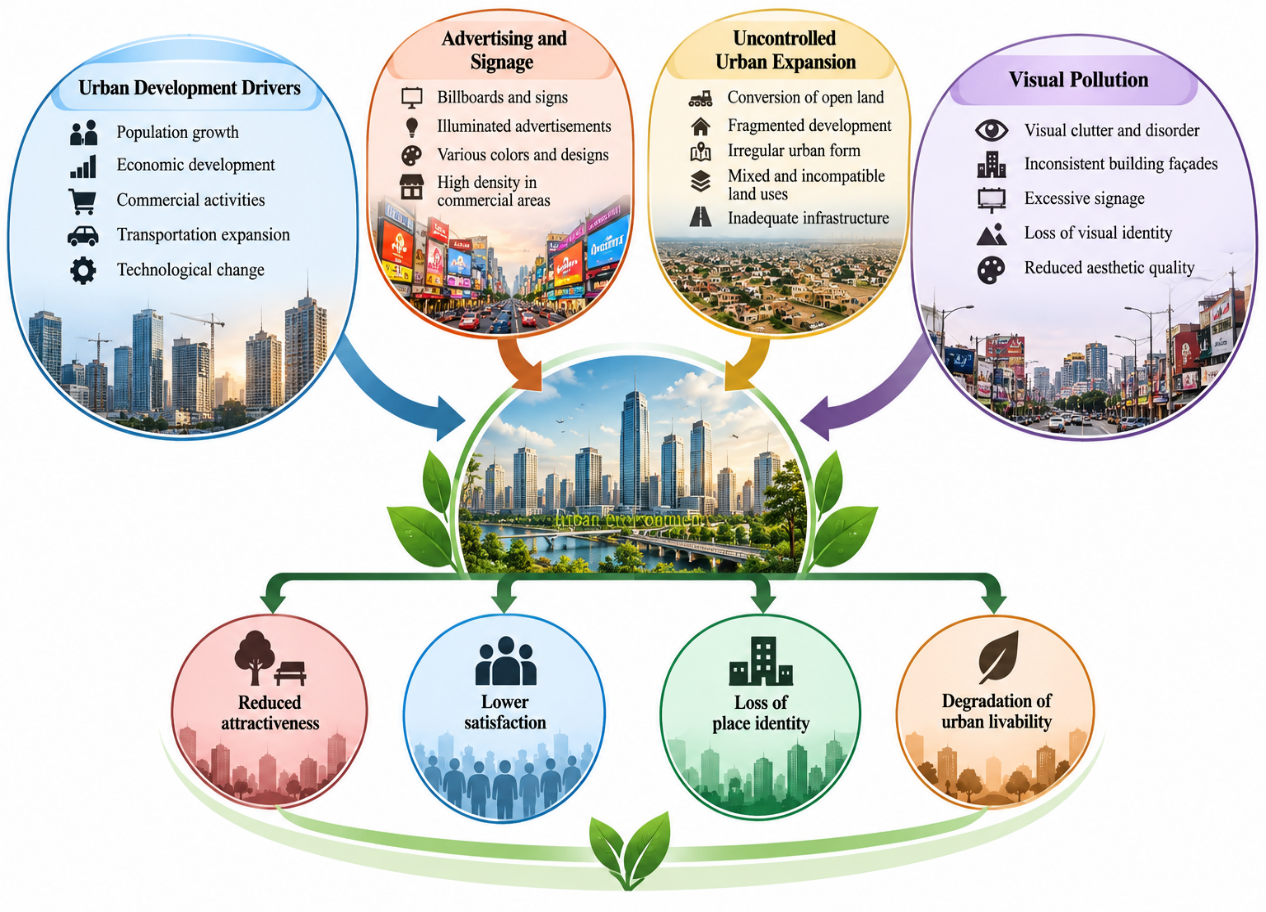
Figure 1. Conceptual Framework Illustrating the Relationship between Urban Development, Advertising, Uncontrolled Urban Expansion, Visual Pollution, and Urban Environmental Quality.
2. Visual Pollution in Urban Environments
Visual pollution is an increasingly recognized aspect of urban environmental degradation and refers to the decline in the visual quality, coherence and attractiveness of urban spaces caused by excessive, inappropriate or poorly organized visual elements. Compared with the traditional types of environmental pollution, the visual pollution is closely related with the perception of human beings, and the way people feel and evaluate their environment. It is a product of many influences, too many billboards and commercial signs, discordant facades, unfinished or degraded buildings, overhead wires, badly placed street furniture, construction work, urban clutter and uncontrolled development. The cumulative effect of these elements can increase visual complexity and disorder, diminish clarity of the urban scene and weaken distinctive character and identity of places [1–4].
From environmental-perception view, visual quality is a function of attributes such as coherence, order, complexity, human scale and imageability. A proper balance of these features can improve the comfort, satisfaction and positive perception of urban spaces by the people, but too much visual clutter can lead to negative esthetic and psychological responses [3–5]. Therefore, visual pollution should be considered not only an esthetic problem but a multidimensional urban problem related to environmental perception, place identity, quality of life and the overall attractiveness and livability of cities [5–9]. In areas of rapid urban development, the problem can be more acute with commercial activities, construction and urban expansion, without adequate planning and visual-management regulations. Therefore, it is necessary to understand the idea, sources and characteristics of visual pollution to evaluate its wider consequences on urban environmental quality.
3. Literature Review: Visual Pollution, Advertising, and Uncontrolled Urban Expansion
Visual pollution has become an increasingly important issue in environmental and urban-planning problems, particularly in rapidly expanding cities where population growth, commercial activities, transportation infrastructure and construction processes have continuously transformed the urban landscape. As opposed to the traditional forms of environmental pollution, visual pollution is mainly associated with the degradation of the esthetic, functional and perceptual characteristics of the built environment. It may be attributed to an over abundance of advertising signs, billboards, inconsistent building facades, unauthorized commercial structures, poorly maintained buildings, overhead wires, overuse of street furniture, unplanned land uses, and uncontrolled expansion of urban areas. These elements can increase the visual disorder, decrease the coherence of the urban scene and have a negative impact on people’s perception of the quality and identity of the city [10–14].
The visual image of the city – an important component of the relationship between the people and the environment. Lynch [10] showed that the legibility and imageability of urban areas depend on the organization of major physical elements such as: paths, edges, districts, nodes and landmarks. The visual organization of these elements and the visual dominance of unsuitable structures and too many commercial signs may diminish the clarity of the urban image. Similarly, Jacobs [11] stressed the significance of good street design, active public spaces, human-scale development and visual diversity in creating attractive and functional urban environments. These principles suggest that the quality of urban environment is not only a matter of physical infrastructure, but also of visual order and perceptual experience of urban spaces.
The visual characteristics of the built environment may affect human comfort, satisfaction and emotional responses from an environmental-psychological perspective. Kaplan and Kaplan [12] stress the importance of coherence, order and environmental organization in the way people perceive their surroundings. Nasar [13] also found that physical characteristics of the urban environment influence people’s evaluations and preferences, and Stamps [14] found that the composition and organization of building facades can influence esthetic preferences. Thus, an excessive amount of uncoordinated or inconsistent visual elements may lead to visual complexity over an acceptable level, causing a perception of disorder and a decrease in the attractiveness of the environment.Advertising is one of the most visible and fastest growing sources of visual pollution in contemporary cities. Commercial signs and billboards are important elements of urban economic activity, because of their informational and supportive function for business. But excessive concentration, inappropriate placement, large sizes, uncontrolled colors and illumination, lack of coordination of regulatory documents can turn advertising from a useful element of communication into a source of visual disturbance. Portella [25] emphasized the link between advertising, signage and environmental quality, and the need for adequate signage control to safeguard the visual character of urban areas. The impact of advertising signs is particularly significant in city centers, commercial streets, transportation corridors, and historically important areas where visual identity and architectural features require greater protection.Advertising has also been found to have a strong effect on the urban scene in Iraq.
Albazzaz and Hussien [26] conducted a case study in Baghdad to investigate the impact of advertising signs on the urban scene, stressing the need to regulate their placement, size, and visual relationship with the neighboring buildings and public spaces. These results are particularly relevant to rapidly growing Iraqi cities where commercial activity is increasing and the widespread installation of advertising signs may be taking place faster than the development of effective visual-management regulations.Urban expansion is another important factor contributing to the transformation of the visual environment. With growing population and demand for housing, commercial activities, transportation networks and public services, the conversion of agricultural and open land into built-up areas may continue. However, when this expansion is not adequately planned spatially, it results in fragmented development, irregular street networks, inconsistent building forms and uncontrolled land-use changes. Brueckner [15] and Galster et al. [16] have identified a number of characteristics associated with urban sprawl including low density, discontinuity, spatial fragmentation and inefficient pattern of developments. These characteristics may have negative consequences not only for infrastructure and land resources, but also for the visual coherence and the identity of the city.
The spatial expansion of cities has been documented by evidence from remote sensing and spatial-analysis studies. Bhatta [21] showed the applicability of remote sensing techniques to identify the changes in urban land cover and to understand the pattern of urban growth and sprawl. Globally, Seto et al. [23] have documented the ongoing expansion of urban land and its implications for environmental resources and ecosystems. These results highlight the fact that uncontrolled urban growth should not only be considered a land-use issue, but also an environment and visual quality problem. This is because the increase in built-up areas can change natural landscapes, reduce open spaces and generate increasingly heterogeneous urban forms.The quality and management of public spaces also have a strong influence on the relationship between urban design and environmental quality. According to Carmona et al. [22], the design, organization and management of public spaces are fundamental to the quality of urban environments.
Ewing et al [18], and Ewing and Handy [20] have identified imageability, enclosure, human scale, transparency and complexity as important dimensions of urban design that affect people’s experience of urban spaces. These characteristics are interrupted by uncontrolled advertisements, incompatible building forms, vacant or badly developed areas and irregular urban expansion, which can result in a visually fragmented and less attractive environment for residents and visitors.Thus, the regulations of urban planning represent an important mechanism for the control of visual pollution and for the maintenance of the quality of the urban environment. Talen [24] stressed the role of planning regulations in shaping urban form, and international assessments of urban development have underlined the significance of integrated planning and sustainable land management [29].
Effective regulation of advertising sizes, locations, colors, lighting, building facades, street furniture and land uses can help create a more coherent urban landscape. At the same time, urban growth can be managed with appropriate zoning and growth boundaries, infrastructure planning and preservation of open spaces to mitigate the negative effects of unregulated growth.
The literature reviewed generally indicates that visual pollution should not be considered an isolated esthetic problem. It is rather closely interrelated with urban design, commercial activity, land-use planning, population growth, urban expansion, environmental perception, and quality of life. Advertising is one of the most immediate and visible contributors to visual disorder, while uncontrolled urban expansion is a more general structural factor that can slowly alter the entire urban landscape. The interaction of these factors may be especially important in rapidly expanding cities. In such cities, reduced regulation and more construction can combine to produce cumulative visual and environmental impacts. Therefore, the assessment of visual pollution should be based on an integrated approach considering both, individual visual elements (ads, signs, etc.) and wider spatial processes (uncontrolled urban expansion, etc.). The studies summarized in Table 1 [10–29] form a theoretical and empirical basis for understanding these relationships and highlight the need for systematic assessment and effective urban-management strategies.
Table1. Previous Studies on Visual Pollution, Advertising, Urban Sprawl, and Urban Environmental Quality
| No. | Author(s), Year | Study Focus | Method / Approach | Main Findings |
| 1 | Lynch (1960) | Urban image and visual perception | Urban-form analysis | Urban paths, edges, districts, nodes, and landmarks strongly influence the visual image and perception of cities [10]. |
| 2 | Jacobs (1961) | Urban form and quality of life | Urban observation and analysis | Diversity, mixed uses, active streets, and human-scale environments contribute to attractive and livable urban areas [11]. |
| 3 | Kaplan & Kaplan (1989) | Environmental perception | Environmental psychology | Environmental coherence, order, and visual characteristics influence people’s psychological responses to urban environments [12]. |
| 4 | Nasar (1998) | Urban visual quality | Environmental preference studies | Physical characteristics of urban environments affect people’s preferences, evaluations, and perceptions of urban places [13]. |
| 5 | Stamps (1999) | Building façades and visual quality | Visual preference analysis | The organization, complexity, and composition of building façades influence aesthetic preferences [14]. |
| 6 | Brueckner (2000) | Urban sprawl | Urban economic analysis | Uncontrolled urban expansion can increase land consumption, infrastructure costs, and environmental pressures [15]. |
| 7 | Galster et al. (2001) | Measurement of urban sprawl | Multidimensional analysis | Urban sprawl can be characterized through density, continuity, concentration, clustering, and accessibility indicators [16]. |
| 8 | Herzog et al. (2003) | Urban environmental perception | Environmental perception study | Built-environment characteristics influence people’s perception of urban quality, comfort, and safety [17]. |
| 9 | Ewing et al. (2006) | Urban design quality | Walkability indicators | Imageability, enclosure, human scale, transparency, and complexity are important components of urban design quality [18]. |
| 10 | Tveit (2009) | Visual landscape assessment | Landscape indicators | Coherence, complexity, and visual character can be used as indicators for evaluating visual landscape quality [19]. |
| 11 | Ewing & Handy (2009) | Urban design and walkability | Urban design assessment | Urban design qualities influence pedestrian experience and the perceived attractiveness of urban spaces [20]. |
| 12 | Bhatta (2009) | Urban growth and sprawl | Remote sensing and spatial analysis | Remote sensing provides an effective approach for identifying urban expansion and patterns of uncontrolled growth [21]. |
| 13 | Carmona et al. (2010) | Public spaces and urban design | Urban design framework | The design and management of public spaces are closely related to visual quality and the overall quality of the built environment [22]. |
| 14 | Seto et al. (2012) | Global urban expansion | Global spatial analysis | Rapid urban land expansion has significant implications for ecosystems, land resources, and environmental sustainability [23]. |
| 15 | Talen (2012) | Planning regulations and urban form | Planning-policy analysis | Planning regulations and development policies play an important role in controlling urban form and growth patterns [24]. |
| 16 | Portella (2014) | Advertising, signage, and visual pollution | Urban visual assessment | Excessive and poorly controlled commercial signage can negatively affect visual quality and the character of urban environments [25]. |
| 17 | Albazzaz & Hussien (2017) | Advertising signs and urban scene | Case study – Baghdad | Advertising signs can alter the urban scene and, when poorly organized, contribute to visual pollution and deterioration of the urban image [26]. |
| 18 | Nassar & El-Haggar (2018) | Visual pollution in urban areas | Urban environmental assessment | The accumulation of visually disturbing elements contributes to visual disorder and deterioration of urban environmental quality [27]. |
| 19 | Özgüç & Başar (2020) | Visual pollution and landscape quality | Visual landscape assessment | Excessive and poorly organized visual elements are associated with lower perceived urban landscape quality [28]. |
| 20 | UN-Habitat (2020) | Sustainable urbanization | Global urban assessment | Integrated planning, effective land management, and sustainable urbanization are essential for improving urban environmental quality and quality of life [29]. |
4. Critical Synthesis of Previous Studies
The studies summarized in Table 1 show that visual pollution is a multidimensional urban phenomenon that results from the interplay of physical, commercial, spatial, and planning factors. The literature reviewed consistently emphasizes that the visual quality of cities is a function of the degree of coherence, organization, accessibility and harmony between buildings, streets, public spaces, commercial signs and other urban elements [10–14].
A recurring theme in the literature is the growing ubiquity of advertising and commercial signage in the urban landscape. Advertising plays a role in the economic and informational realm, but an over-dense, improperly located, large-sized, inconsistent coloring, and intense lighting can contribute significantly to visual disorder and reduce the architectural and esthetic quality of urban spaces [25,26]. At the same time, studies on urban sprawl show that uncontrolled expansion modifies the spatial structure of cities with fragmented development, inefficient land use, and conversion of open and agricultural areas into built-up land [15,16,21,23].
These processes can indirectly aggravate visual pollution through the emergence of heterogeneous urban landscapes characterized by inconsistent building forms, irregular streetscapes, vacant plots, and uncontrolled commercial development. The literature also shows that visual pollution can affect the perception of urban attractiveness, environmental satisfaction, place identity, and quality of life of people [13,17–20]. But the growing body of research notwithstanding, advertising, visual pollution and urban expansion have often been studied as separate issues rather than as interconnected components of urban environmental quality. This suggests the need for an integrated approach that considers the combined impacts of commercial advertising, urban form and uncontrolled spatial growth together. This approach is especially relevant to fast growing cities, where weak planning controls and increased commercial activity may accelerate the decline of visual quality. Thus, future research should move beyond a mere description of visual disorder and develop measurable indicators and spatial assessment methods capable of identifying the relationships between advertising intensity, urban expansion, visual quality and the overall urban environmental conditions.
5. Results and Discussion
The studies analyzed [10–29] show that visual pollution is a complicated urban problem that arises from the interaction of advertising, building characteristics, urban design, land-use patterns, and the absence of urban planning. The literature has always pointed out the fact that the visual quality of an urban environment depends on the degree of coherence, organization, accessibility and harmony between its physical and commercial elements [10–14].
Research on the urban image and perception stresses that it is possible to have a well-structured urban image with coherent and attractive streets, buildings, public spaces and landmarks, but too many or poorly coordinated visual elements can result in loss of visual clarity and environmental satisfaction [10,13,18,20].Of particular importance to this research is the importance of advertising and commercial signage for the decline in visual quality of urban areas. The literature review shows that advertising is not a negative element in itself, but its effect depends on density, scale, location, design, color, illumination and its relation with surrounding buildings and public spaces [25,26].
However, an overabundance of billboards and signs can clutter the streetscape, obscure architectural elements and contribute to visual clutter. This problem is particularly evident in commercial streets and city centers where the combination of competition for visibility has led to the growth in size and number of advertising signs. Thus, a lack of good signage regulations can turn an economically beneficial activity into a significant source of visual pollution.The findings also emphasize the significance of urban form in determining visual environmental quality. Previous studies on urban sprawl [15,16,21,23] suggest that uncontrolled expansion is often associated with fragmented development, inefficient land use, discontinuous urban patterns, and conversion of open areas into built-up land. Visually, these processes can result in heterogenous landscapes with inconsistent building shapes, irregular streets, vacant lots and incompatible land uses.
Therefore, urban sprawl can indirectly contribute to visual pollution by destroying the continuity and identity of the urban landscape.Another important finding is the correlation between visual quality and human perception. Earlier studies [12–14,17–20] suggest that coherence, imageability, human scale and appropriate visual complexity are important in creating positive perceptions of urban spaces. Too much visual clutter and disorganized urban elements, in contrast, may depreciate attractiveness and comfort.
Therefore, visual pollution should be considered as more than an esthetic issue, as it can affect people’s satisfaction with their environment, sense of place and overall experience of the urban environment.The studies reviewed also highlight the fact that visual pollution becomes more problematic when multiple sources are present simultaneously. For example, uncontrolled urban growth can lead to random construction, while increased commercial activity can bring an overabundance of advertising and signage into the same space. The combination of fragmented urban form, inconsistent façades, commercial signage, infrastructure clutter and poorly managed public spaces can create cumulative visual impacts often greater than the effect of any single source. This interaction highlights the necessity of addressing visual pollution within the framework of wider urban planning and environmental management.From a methodological point of view, the reviewed literature shows that visual pollution can be assessed through different complementary approaches, such as field observation, environmental perception surveys, visual preference assessment, urban design indicators, spatial analysis, and remote sensing [18–21].
Qualitative assessment helps to identify the origins of visual disorder. Quantitative and spatial methods provide more robust evidence of the spatial distribution and intensity of urban expansion and visual degradation. Thus, the combination of field-based visual assessment and GIS and remote sensing techniques may give a more complete understanding of the spatial relationship between urban growth and visual pollution.Collectively, the evidence from the reviewed studies implies that improving the visual quality of cities requires an integrated approach and not isolated interventions. Other complementary measures include: controlling the density and design of advertising; improving the coordination of buildings and streetscape; protecting important urban landmarks; managing public spaces; and guiding urban expansion with effective planning policies. The literature also shows a gap in research, since advertising, visual pollution and urban sprawl have often been studied in isolation. Future studies should then examine their joint effect on urban environmental quality, especially in fast growing cities where commercial growth and urban expansion are occurring simultaneously. Such an integrated perspective can support more effective planning strategies to improve visual coherence, urban identity, environmental satisfaction and overall urban livability.
6. Conclusions and Recommendations
The reviewed literature confirms that visual pollution is an important and multidimensional part of the degradation of the urban environment. Excessive advertising and commercial signage, inconsistent building forms, poorly structured streetscapes and uncontrolled urban expansion can all combine to lessen visual coherence, urban attractiveness and the perceived quality of urban environments. The studies reviewed also show that visual pollution is closely related to perception of the environment, identity of place, satisfaction of urban life, and quality of life. One of the most visible and controllable sources of visual pollution is advertising. The uncontrolled expansion of the city leads to long-term spatial fragmentation and deterioration of the urban landscape. Visual pollution must therefore be considered as an issue for integrated urban planning and environmental quality, and not solely for esthetics. Future studies should put more emphasis on the interaction effects of advertising and urban expansion, and develop objective indicators to assess visual quality in different urban settings.
7:Recommendations
1. Adopt and enforce regulations concerning the size, density, location, color and illumination of advertising signs and billboards.
2. Integrate visual quality considerations in urban planning, building codes and land use management.
3. Control unplanned urban sprawl by implementation of effective zoning, development boundaries and sustainable land-use planning.
4. Avoid visual obstruction of significant architectural, historic and natural features.
5. Promote the use of GIS, remote sensing, field survey and visual perception assessments to monitor and evaluate the changes of urban visual quality.
6. Encourage public participation in the identification of the main sources of visual pollution and the development of locally appropriate solutions.
8:References
[1] Lynch, K. (1960). The Image of the City. Cambridge, MA: MIT Press.
[2] Jacobs, J. (1961). The Death and Life of Great American Cities. New York: Random House.
[3] Kaplan, R., & Kaplan, S. (1989). The Experience of Nature: A Psychological Perspective. Cambridge: Cambridge University Press.
[4] Nasar, J. L. (1998). The Evaluative Image of the City. Thousand Oaks, CA: Sage Publications.
[5] Stamps, A. E. (1999). Physical determinants of preferences for residential façades. Environment and Behavior, 31(6), 723–751.
[6] Brueckner, J. K. (2000). Urban sprawl: Diagnosis and remedies. International Regional Science Review, 23(2), 160–171. https://doi.org/10.1177/016001700761012710
[7] Galster, G., Hanson, R., Ratcliffe, M. R., Wolman, H., Coleman, S., & Freihage, J. (2001). Wrestling sprawl to the ground: Defining and measuring an elusive concept. Housing Policy Debate, 12(4), 681–717. https://doi.org/10.1080/10511482.2001.9521426
[8] Ewing, R., Handy, S., Brownson, R. C., Clemente, O., & Winston, E. (2006). Identifying and measuring urban design qualities related to walkability. Journal of Physical Activity and Health, 3(s1), S223–S240. https://doi.org/10.1123/jpah.3.s1.s223
[9] Ewing, R., & Handy, S. (2009). Measuring the unmeasurable: Urban design qualities related to walkability. Journal of Urban Design, 14(1), 65–84. https://doi.org/10.1080/13574800802451155
[10] Lynch, K. (1960). The Image of the City. Cambridge, MA: MIT Press. The book is a foundational work on the evaluation of city form and introduced the concept of imageability.
[11] Jacobs, J. (1961). The Death and Life of Great American Cities. New York: Random House.
[12] Kaplan, R., & Kaplan, S. (1989). The Experience of Nature: A Psychological Perspective. Cambridge: Cambridge University Press.
[13] Nasar, J. L. (1998). The Evaluative Image of the City. Thousand Oaks, CA: Sage Publications.
[14] Stamps, A. E. (1999). Physical determinants of preferences for residential façades. Environment and Behavior.
[15] Brueckner, J. K. (2000). Urban sprawl: Diagnosis and remedies. International Regional Science Review, 23(2), 160–171.
[16] Galster, G., Hanson, R., Ratcliffe, M. R., Wolman, H., Coleman, S., & Freihage, J. (2001). Wrestling sprawl to the ground: Defining and measuring an elusive concept. Housing Policy Debate, 12(4), 681–717.
[17] Herzog, T. R., Chernick, K. K., & others. (2003). The role of perceived danger in urban environments. Environment and Behavior.
[18] Ewing, R., Handy, S., Brownson, R. C., Clemente, O., & Winston, E. (2006). Identifying and measuring urban design qualities related to walkability. Journal of Physical Activity and Health, 3(s1), S223–S240.
[19] Tveit, M. (2009). Indicators of visual landscape assessment. Landscape Research, 34(1), 1–18.
[20] Ewing, R., & Handy, S. (2009). Measuring the unmeasurable: Urban design qualities related to walkability. Journal of Urban Design, 14(1), 65–84.
[21] Bhatta, B. (2009). Analysis of Urban Growth and Sprawl from Remote Sensing Data. Springer.
[22] Carmona, M., de Magalhães, C., & Hammond, L. (2010). Public Places, Urban Spaces: The Dimensions of Urban Design. 2nd ed. Routledge.
[23] Seto, K. C., Güneralp, B., & Hutyra, L. R. (2012). Global forecasts of urban expansion to 2030 and direct impacts on biodiversity and carbon pools. Proceedings of the National Academy of Sciences, 109(40), 16083–16088.
[24] Talen, E. (2012). City Rules: How Regulations Affect Urban Form. Island Press.
[25] Portella, A. (2014). Visual Pollution: Advertising, Signage and Environmental Quality. Farnham/London: Ashgate. The work specifically examines commercial signage, visual quality, environmental quality, user perception, and control of advertising in urban areas.
[26] Albazzaz, I., & Hussien, H. D. (2017). The effect of advertising signs on the urban scene of cities centers (Al Bab Al Sharqi–Al Tahrir Square) case study. Journal of Engineering, University of Baghdad. DOI: 10.31026/j.eng.2017.12.08.
[27] Nassar, U. A., & El-Haggar, S. (2018). Visual pollution in urban areas. [verify journal details before final submission].
[28] Özgüç, A., & Başar, M. (2020). Visual pollution and urban landscape quality. [verify journal details before final submission].
[29] UN-Habitat. (2020). World Cities Report 2020: The Value of Sustainable Urbanization. United Nations Human Settlements Programme.
 Arabic
  English