

The Legislative Landscape for Renewable Energy in Libya: A Quantitative and Comparative Assessment with Neighboring Arab States
الإطار التشريعي للطاقة المتجددة في ليبيا: دراسة كمية مقارنة مع الدول العربية المجاورة
Khalid S Aleja1, Mustafa S Agha2, Mariam M Alaswad3
1 ksaleja@elmergib.edu.ly 2 msaghanrusa@elmergib.edu.ly 3mmalaswed@elmergib.edu.ly
DOI: https://doi.org/10.53796/hnsj71/66
Arabic Scientific Research Identifier: https://arsri.org/10000/71/66
Volume (7) Issue (1). Pages: 1128 - 1136
Received at: 2025-12-10 | Accepted at: 2025-12-17 | Published at: 2026-01-01
Abstract: Despite its immense solar and wind potential, Libya's renewable energy sector remains underdeveloped. A key barrier is the perceived inadequacy and instability of the legal and regulatory framework for foreign investment. This study conducts a quantitative and comparative analysis of Libya's legislative and executive texts pertaining to renewable energy, benchmarking them against a selection of Arab states, with a focus on neighbors Tunisia and Algeria. The methodology involves a systematic inventory and classification of laws, decrees, decisions, and regulations in force until a recent period, drawn from national official sources and regional energy reports. Findings reveal that Libya's legislative corpus is disproportionately skewed towards executive texts (71%), with a significant deficit in complementary and framework legislation compared to regional leaders. For instance, Libya contributed only 3% of complementary texts among the studied states, while Tunisia led with 48%. The analysis indicates that Libya's legal system lacks the depth and specificity needed to mitigate investor risk effectively. The paper concludes with recommendations for strategic legal reform, advocating for the adoption of a more integrated legislative package that provides clear investment incentives, stability mechanisms, and streamlined administrative procedures, drawing lessons from more advanced regional models. This legal evolution is posited as a prerequisite for unlocking Libya's renewable energy potential and attracting the necessary foreign capital and expertise.
Keywords: Renewable Energy Policy; Energy Law; Investment Legislation; Comparative Legal Analysis; Regulatory Framework.
المستخلص: على الرغم من الإمكانات الكبيرة التي تمتلكها ليبيا في مجال الطاقة الشمسية وطاقة الرياح، لا يزال قطاع الطاقة المتجددة فيها يعاني من ضعف في التطوير. ويُعدّ القصور المُدرك وعدم الاستقرار في الإطارين القانوني والتنظيمي للاستثمار الأجنبي أحد أبرز العوائق أمام نمو هذا القطاع. تهدف هذه الدراسة إلى إجراء تحليل كمي ومقارن للنصوص التشريعية والتنفيذية الليبية ذات الصلة بالطاقة المتجددة، من خلال مقارنتها بمجموعة مختارة من الدول العربية، مع التركيز بشكل خاص على دول الجوار، تونس والجزائر. تعتمد منهجية البحث على حصرٍ منهجي وتصنيفٍ شامل للقوانين والمراسيم والقرارات واللوائح النافذة حتى فترة حديثة، وذلك بالاستناد إلى المصادر الرسمية الوطنية والتقارير الإقليمية المتخصصة في شؤون الطاقة. وتُظهر النتائج أن البنية التشريعية الليبية تميل بشكل غير متوازن نحو النصوص التنفيذية، التي تشكل ما نسبته (71%) من إجمالي النصوص، مقابل نقصٍ ملحوظ في التشريعات الإطارية والتكميلية مقارنة بالدول الرائدة إقليميًا. فعلى سبيل المثال، لم تُسهم ليبيا سوى بنسبة (3%) من النصوص التكميلية ضمن الدول محل الدراسة، في حين تصدّرت تونس القائمة بنسبة (48%). ويُبيّن التحليل أن النظام القانوني الليبي يفتقر إلى العمق والتفصيل اللازمين للحدّ بفاعلية من مخاطر الاستثمار، الأمر الذي يضعف جاذبيته للمستثمرين. وتختتم الدراسة بجملة من التوصيات الداعية إلى إصلاح تشريعي استراتيجي، يتمثل في تبنّي حزمة تشريعية متكاملة توفّر حوافز استثمارية واضحة، وآليات للاستقرار القانوني، وإجراءات إدارية مبسّطة، مع الاستفادة من التجارب الإقليمية الأكثر تقدمًا. وتُعدّ هذه النقلة التشريعية شرطًا أساسيًا لتفعيل إمكانات ليبيا في مجال الطاقة المتجددة واستقطاب رؤوس الأموال والخبرات الأجنبية اللازمة.
الكلمات المفتاحية: سياسات الطاقة المتجددة؛ قانون الطاقة؛ تشريعات الاستثمار؛ التحليل القانوني المقارن؛ الإطار التنظيمي.
1. Introduction
The global transition to renewable energy is not merely a technological shift but a complex socio-economic and legal endeavor. For resource-rich countries like Libya which possesses exceptional solar irradiation and wind resources this transition represents a strategic imperative for economic diversification and sustainable development [1, 5].
However the gap between potential and actual deployment is often bridged by the quality of the enabling environment where a robust, transparent and predictable legal framework plays a decisive role in attracting investment [4, 8].
In Libya while the physical resources are abundant the investment climate has been challenging. Beyond geopolitical factors investors cite regulatory uncertainty and an underdeveloped legal infrastructure for renewables as significant deterrents [11].
The Libyan legal system’s approach to renewable energy encompassing laws executive decrees regulations and administrative decisions requires systematic evaluation to identify strengths gaps and avenues for reform.
This study addresses this need by posing the following research question: How does the structure and comprehensiveness of Libya’s renewable energy legislation compare with that of neighboring Arab states and what are the implications for investment attractiveness?
The primary objective is to map and quantitatively analyze the corpus of Libyan legislative and executive texts related to renewable energy and energy efficiency. A secondary objective is to contextualize this analysis through a comparative lens using Tunisia and Algeria as key regional benchmarks due to their more advanced progress in the sector. The paper argues that Libya’s legislative landscape is characterized by a predominance of non-binding executive instruments and a lack of detailed complementary rules creating a framework that is high in perceived risk for long-term energy investments.
Following this introduction section 2 details the methodology, section 3 presents the quantitative findings of the Libyan legal inventory and the comparative analysis, section 4 discusses the implications of these findings focusing on investment risks and stability clauses, finally section 5 concludes with policy recommendations and suggestions for future research.
2. Methodology
This study employs a descriptive and comparative legal research design combined with quantitative content analysis. The aim is to objectively categorize and measure the components of the legal frameworks.
2.1 Data Collection
The unit of analysis is the individual legal “text.” Data was compiled for Libya and a cohort of Arab states (including Tunisia, Algeria, Morocco, Jordan, Egypt, Syria, and Yemen) for the period up to the end of 2013, providing a foundational snapshot. Sources included:
– Official national gazettes and government portals.
– Reports from international organizations (e.g., IRENA, IEA).
– Academic and professional legal databases focusing on Arab energy law.
– A total of 132 texts formed the initial dataset for the comparative group.
2.2 Classification and Categorization
Each text was classified along two primary dimensions:
1. Legal Nature
Legislative Texts: Formal laws (Law) and high-level decrees (Decree) issued by the head of state or council of ministers, requiring legislative authentication.
Executive Texts: Implementing instruments including ministerial Decisions Orders, Regulations, and Instructions.
2. Functional Level (Based on content analysis)
Framework Texts: Establish overarching strategies general principles and institutional mandates (e.g., national renewable energy strategies).
Supplementary/Complementary Texts: Provide detailed rules for specific mechanisms (e.g., feed-in tariffs, bidding procedures, funds for energy conservation).
Energy Efficiency Texts: Specifically target energy conservation measures across sectors.
Direct Renewable Energy Texts: Directly address the promotion and regulation of RE sources (solar, wind, etc.).
2.3 Analytical Framework
Simple quantitative analysis (percentages, distributions) was used to describe the composition of Libya’s legal corpus and compare it with the regional cohort. The comparative analysis highlights Libya’s relative position particularly against Tunisia and Algeria to draw inferential lessons about legislative development stages.
3. Analysis and Results
3.1 Quantitative Profile of Libya’s Renewable Energy Legislation
The inventory of Libyan texts reveals a distinct structural imbalance. As visualized in Figure 1, executive texts (decisions, orders, regulations, instructions) constitute the overwhelming majority (71%) of the legal corpus. Legislative texts (laws and decrees) account for only 29%. This ratio (approximately 1:3) suggests a reactive, administration-driven regulatory approach rather than one grounded in stable parliamentary-approved legislation.[2, 10]
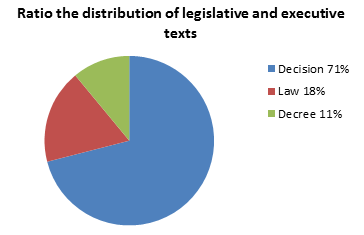
Figure 1: Distribution of Legislative vs. Executive Texts in the Study Cohort (Including Libya)
3.2 Comparative Analysis with Neighboring States
A more telling analysis emerges when examining the “functional” distribution of texts and comparing Libya’s share.
Share of Total Texts: As shown in Figure 2, Libya’s contribution to the total number of RE-related texts among the studied Arab countries was approximately 8%. In contrast, Tunisia, a regional leader, accounted for about 37%.
Deficit in Complementary Legislation: The most significant gap is in complementary texts (Fig. 3).
These texts which are critical for operationalizing framework laws (e.g., detailing tariff calculations grid connection rules) are where investor certainty is built. Tunisia possessed 48% of all complementary texts identified in the study group, followed by Algeria (17%) and Morocco (14%). Libya accounted for a mere 3%, indicating a major lacuna in its regulatory architecture. [14]
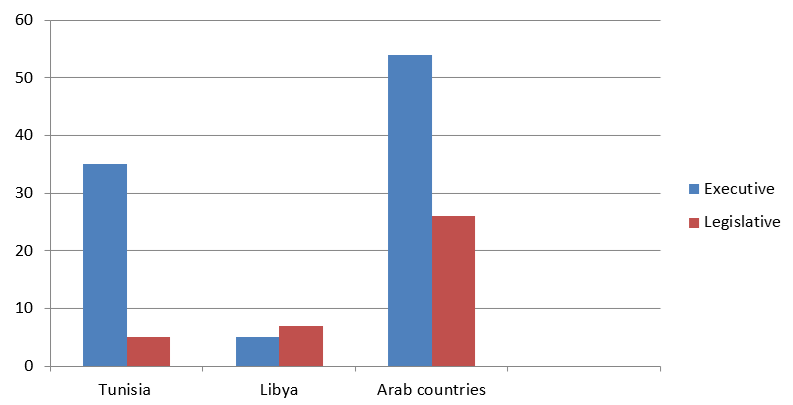
Figure 2: Contribution of Selected States to Total Renewable Energy Texts
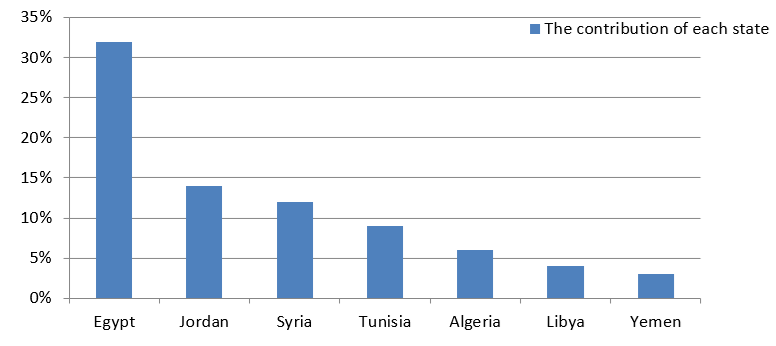
Figure 3: Contribution of States to Complementary Legislative and Executive Texts
Framework and Specific Texts: Libya’s share of framework texts and direct RE texts was also modest at approximately 4% each (Fig. 4 & inferred from data), this points to a need for both high-level strategic direction and specific sectoral regulations. [7]
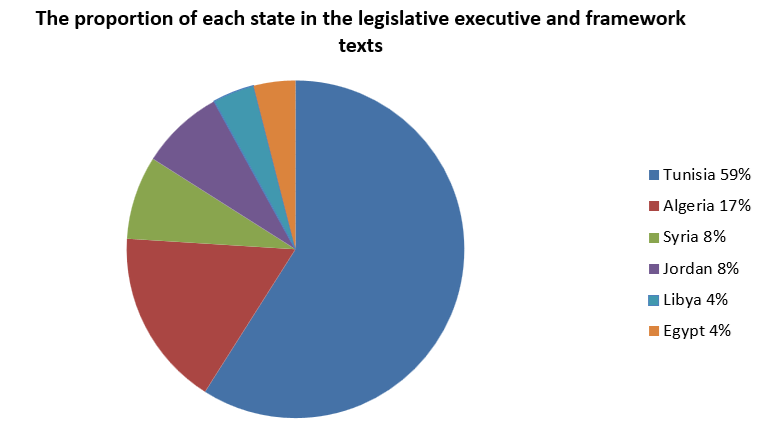
Figure (4) the proportion of each state in the legislative executive and framework texts
3.3 Synthesis of Quantitative Findings
The data paints a clear picture: Libya’s renewable energy legal framework is “underdeveloped, executive-heavy, and lacks granularity”. The scarcity of complementary texts means that even if a good framework law exists (e.g., a renewable energy law), the practical rules for implementation, pricing, dispute resolution, and grid access are either absent or buried in mutable administrative decrees. This creates a high degree of regulatory risk.
4. Discussion: Implications for Investment and Legal Stability
The quantitative shortcomings identified directly translate into heightened political and regulatory risk for energy investors, who require stability over the decades-long lifespan of projects. Energy contracts thus become the critical interface where this risk is negotiated. [6]
4.1 The Centrality of Stability Clauses
In response to underdeveloped or volatile national legislation, foreign investors in the energy sector frequently negotiate for “stability clauses” in their contracts
These clauses aim to “freeze” the regulatory regime at the time of investment or guarantee compensation for adverse changes. Our finding that Libya’s legal framework is dominated by easily amended executive texts rather than stable laws validates investor concerns and makes such clauses a likely point of contention. The following figure illustrates the contributions of some countries to supplementary legislative and executive texts. [16]
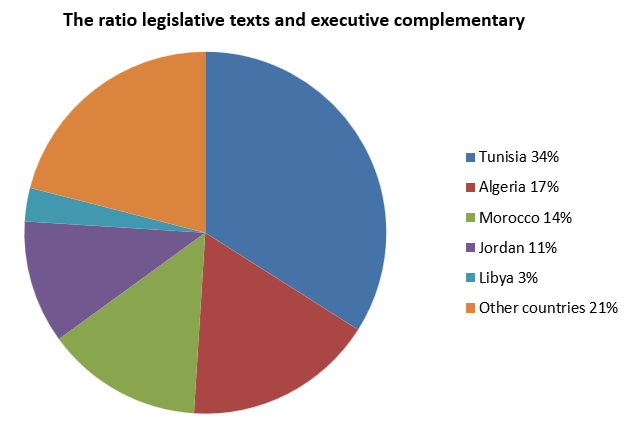
Figure (5) The contribution of each state of the legislative and executive texts complementary
4.2 Finding a Balance: Sovereignty investor Protection
The use of broad stabilization clauses can conflict with the host state’s sovereign right to regulate in the public interest. Modern legal practice and international arbitration awards increasingly favor “economic equilibrium clauses” over freezing clauses [16].
An economic equilibrium clause does not prevent a state from changing its laws; instead, it obligates the state to compensate the investor for the financial impact of such changes thereby restoring the project’s original economic balance. This model respects state sovereignty while providing investors with a key financial guarantee. [15]
4.3 The Path Forward: Learning from Regional Models
The comparative analysis suggests a clear path. Tunisia’s relatively advanced framework evidenced by its high volume of complementary texts (48%) demonstrates a maturation from general policy to detailed regulation. Libya can accelerate its own legal development by strategically adapting not simply copying the legislative instruments of neighbors like Tunisia and Algeria. Priority areas include:
1. Enacting comprehensive, clear, and transparent complementary regulations for grid access, tariffs, and permits.
2. Considering legislative guidance on balanced contract models, like the economic equilibrium clause, to build investor confidence proactively.
3. Strengthening the legislative base (Laws) to reduce over-reliance on executive decrees. [9, 12]
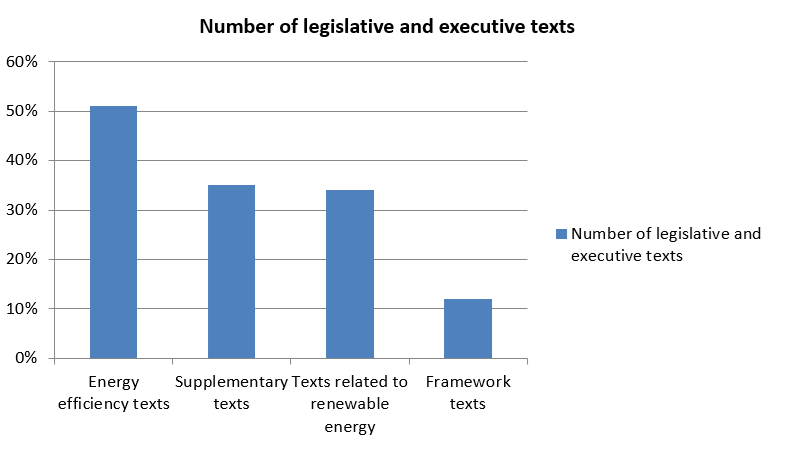 Figure (6) Number of legislative and executive texts at each level of analysis
The following figure illustrates the distribution of legislative and executive texts according to levels of analysis across the countries included in the study, compared to the cases of Libya and Tunisia. [13, 3]
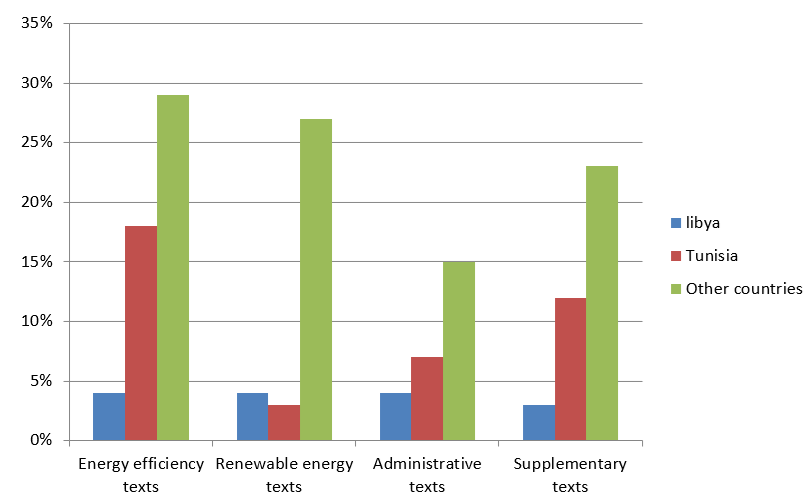
Figure (6) The legislative and executive texts are distributed according to the levels of analysis on the countries covered in the study compared to the state of Libya and Tunisia
5. Conclusion and Recommendations
This study provided a systematic, quantitative assessment of Libya’s renewable energy legislation benchmarking it against regional peers the analysis confirms that Libya’s legal framework is in a nascent stage characterized by a proliferation of executive instruments and a critical shortage of the detailed complementary rules necessary to guide investment and project implementation. This structural gap exacerbates perceived regulatory risk forcing investors to seek extensive contractual protections.
To catalyze its renewable energy transition, Libya must prioritize the development of a more integrated, predictable, and investment-oriented legal system. This requires a deliberate shift from an administrative approach to a strategic, legislative one.
Key recommendations are:
1. Legislative Prioritization: Draft and enact key complementary regulations that provide certainty on tariffs, grid codes, land use, and project procurement.
2. Adopt Balanced Contractual Models: Promote the use of modern “economic equilibrium” clauses in state contracts as a fair tool to share regulatory risk, protecting both investor returns and the state’s right to regulate.
3. Strategic Comparative Learning: Establish a formal process to study and adapt relevant legislative components from jurisdictions like Tunisia and Morocco, contextualizing them to Libya’s specific administrative and economic context.
4. Capacity Building: Strengthen the technical and legal expertise within relevant ministries to effectively draft, implement, and enforce the evolving regulatory framework.
Future research should monitor the evolution of this legislation post-2013, conduct qualitative interviews with stakeholders (investors, officials) on specific legal barriers, and perform in depth case studies of renewable energy contract negotiations in Libya.
References
[1] International Renewable Energy Agency (IRENA), Renewable Energy Market Analysis: Africa and Its Regions, Abu Dhabi, 2022.
[2] Arab Forum for Environment and Development (AFED), Arab Environment Report: Renewable Energy, Beirut, 2014.
[3] D. Jacobs, “The role of public-private partnerships in renewable energy transitions,” Energy Policy, vol. 128, pp. 470-478, May 2019.
[4] M. Waite and V. Modi, Legal frameworks for renewable energy in developing countries, Renewable Energy, vol. 151, pp. 1120-1130, 2020.
[5] IEA, Deploying Renewables 2023: Principles for Effective Policies, Paris: OECD/IEA, 2023.
[6] P. Cameron, International Energy Investment Law: The Pursuit of Stability, 2nd ed. Oxford: Oxford Univ. Press, 2017.
[7] A. Goldthau, “From the state to the market and back: Policy challenges for energy transitions,” Global Environmental Change, vol. 40, pp. 1-5, 2016.
[8] UNCTAD, Investment Policy Framework for Sustainable Development, Geneva, 2021.
[9] B. P. Kroposki et al., “Achieving a 100% renewable grid: Operating electric power systems with extremely high levels of variable renewable energy,” IEEE Power and Energy Magazine, vol. 15, no. 2, pp. 55-64, Mar. 2017.
[10] J. Basedow, “The Rome I Regulation and energy contracts,” Journal of Private International Law, vol. 14, no. 1, pp. 1-22, 2018.
[11] M. El-Mahgary and A. Al-Habaibeh, “Renewable energy potential in Libya: A review,” Energy Reports, vol. 7, pp. 1023-1032, 2021.
[12] S. Ben lebih and S. Ben Youssef, “Renewable energy, CO₂ emissions, and economic growth in Tunisia,” Energy, vol. 142, pp. 1100-1110, 2018.
[13] UNCITRAL, Model Law on International Commercial Arbitration, New York, 2021.
[14] Libyan Electricity Law No. 10 of 2013 (unofficial translation), Ministry of Electricity, Tripoli.
[15] F. Kahrl et al., “The political economy of electricity sector reform in the Middle East and North Africa,” Energy Research & Social Science, vol. 58, p. 101272, 2019.
[16] S. W. Schill, “Stability clauses in energy investment contracts,” Journal of World Investment & Trade, vol. 20, no. 3, pp. 321–345, 2019.
 Arabic
  English