
A Stylistic Study of Monotheism in Al-Imam Al-Hassan's (Peace Be Upon Him) Speeches
دراسة أسلوبية للتوحيد في خطب الإمام الحسن (عليه السلام)
Asst. Lect. Zahraa Kareem Ghannam1
1 University of Babylon, College of Management and Economics, Department of Accounting, Iraq.
Email: bsc.Zahraa.karim@uobabylon.edu.iq
DOI: https://doi.org/10.53796/hnsj611/46
Arabic Scientific Research Identifier: https://arsri.org/10000/611/46
Volume (6) Issue (11). Pages: 724 - 733
Received at: 2025-10-07 | Accepted at: 2025-10-15 | Published at: 2025-11-01
Abstract: This study offers a stylistic investigation of how monotheism (tawḥīd) is articulated in three selected sermons of Al-Imam Al-Hassan (peace be upon him). Drawing on Leech and Short’s (2007) stylistic framework, the research examines the deployment and pragmatic force of core devices—repetition, parallelism, antithesis, personification, allusion, and metaphor—in constructing and intensifying the theological message. The analysis shows that these sermons systematically foreground the transcendence and uniqueness of the Divine through patterned syntax and semantic contrast, with repetition functioning as the primary amplifier of key creedal propositions (44% of all identified devices), followed by parallelism (24%) and antithesis (11%). Personification, allusion (especially Qur’anic intertextuality), and metaphor serve supportive, sense-consolidating roles that render abstract concepts experientially vivid and doctrinally precise. Collectively, the findings validate the study’s hypotheses: Al-Imam Al-Hassan consistently harnesses stylistic resources to convey monotheism; repetition predominates over other devices; and parallelism and antithesis are widely employed to stabilize rhythm, heighten emphasis, and structure meaning. By evidencing how linguistic form and theological content co-operate, the study contributes to Arabic stylistics and religious discourse analysis, illuminating the rhetorical mechanisms through which monotheism is made cognitively salient and spiritually persuasive.
Keywords: monotheism; stylistics; Al-Imam Al-Hassan (peace be upon him); parallelism; repetition; antithesis; personification; allusion; metaphor.
المستخلص: تُقدِّم هذه الدراسة تحقيقًا أسلوبيًا في كيفية بلورة مفهوم التوحيد في ثلاث خُطب مختارة للإمام الحسن (عليه السلام). واعتمدت إطار ليتش وشورت (2007) في التحليل الأسلوبي لفحص توظيف الأدوات المحورية وقوتها التداولية—وهي التكرار، والتوازي، والتضاد، والتشخيص، والتلميح، والاستعارة—في بناء الرسالة العقدية وتكثيفها. وتُظهر النتائج أن هذه الخطب تُبرِز على نحوٍ منهجي تنزّه الذات الإلهية ووحدانيتها عبر انتظام البنية النحوية والتقابل الدلالي، مع قيام التكرار بدور المُضخِّم الرئيس للمقولات العقدية الأساسية (بنسبة 44% من مجمل الأدوات المحدَّدة)، يليه التوازي (24%) ثم التضاد (11%). وتؤدّي أدوات التشخيص والتلميح (لا سيّما التناصّ القرآني) والاستعارة أدوارًا مُسندة تُرسِّخ المعنى، فتجعل المفاهيم المجرّدة أكثر حيوية خبريةً ودقةً عقدية. وتُجمل النتائج صحة فروض الدراسة: إذ يوظّف الإمام الحسن بانتظام الموارد الأسلوبية لإيصال معنى التوحيد؛ ويتصدّر التكرار سائر الأدوات؛ كما يُستعمل التوازي والتضاد على نطاقٍ واسع لتثبيت الإيقاع وتعزيز التأكيد وبناء المعنى. ومن خلال إظهار تضافر الشكل اللغوي مع المحتوى العقدي، تُسهم الدراسة في حقل الأسلوبيات العربية وتحليل الخطاب الديني، مُضيئةً الآليات البلاغية التي تجعل التوحيد أكثر بروزًا معرفيًّا وأشدّ تأثيرًا روحانيًّا.
الكلمات المفتاحية: التوحيد؛ الأسلوبيات؛ الإمام الحسن (عليه السلام)؛ التوازي؛ التكرار؛ التضاد؛ التشخيص؛ التلميح؛ الاستعارة.
- Introduction
The belief in the One God aims to benefit the human beings in their relations with “others”, since God Himself is not affected in His All-mightiness by believing or disbelieving in Him. Next to the belief in the One God and the worship of Him alone come the consequences that this faith has for all human relations, starting with the family and going to all human beings whose lives, families and properties should be secure from any violation. (Osman, no p. 2007)
Ahl Al-Bayt’s (peace be upon them) contributions to human civilization are never limited to Muslims or their non-Muslim partners in Muslim countries. They are always offered to any student, scholar or beneficiary in the fields of physics and optics, chemistry, astronomy and observatories, anatomy, medicine and surgery, art and architecture, irrigation, agriculture and gardening, as well as philosophy, social and human studies, (ibid). Thus, they are the best figures to analyze and study their speeches. Al-Imam Al-Hassan (peace be upon him) is who tackles monotheism in his sermons. This study tries to answer the following questions:
- What is meant by monotheism?
- How does Al-Imam Al-Hassan (peace be upon him) addresses monotheism in his speeches?
- What are the stylistic devices that are used by Al-Imam Al-Hassan (peace be upon him) in his speeches.
It aims at:
- Identifying the meaning of monotheism.
- Showing how monotheism is addressed in Al-Imam Al-Hassan’s (peace be upon him) speeches.
- Presenting the main stylistic devices that are used by Al-Imam to give meaning to monotheism in a highly good way.
It is hypothesized that:
- Al-Imam Al-Hassan (peace be upon him) uses certain stylistic devices to deliver the sense of monotheism.
- Repetition is used by Al-Imam Al-Hassan (peace be upon him) more than any other devices.
- Parallelism and antithesis are widely used in Al-Imam Al-Hassan’s (peace be upon him) speeches.
The following steps are followed:
- Presenting a theoretical background about monotheism.
- Analyzing three speeches of Al-Imam Al-Hassan (peace be upon him) according to Leech and Short’s (2007) model.
The study is limited to deal with monotheism in a stylistic way in three speeches for Al-Imam Al-Hassan (peace be upon him) according to Leech and Short’s (2007) model since it is widely respected for its systematic approach to language, particularly in analyzing literary and religious texts.
The study is hoped to be valuable for those who seek the truth of Islam in general and the speeches of Al- Imam that tackle the topic monotheism in a stylistic way in specific.
- Monotheism
Monotheism is the basis of the invitation of all divine prophets and the end of every human path. The main thing that gives meaning to human life is the knowledge and faith in the one God. Imam Ali (peace be upon him) says: “The first religion is knowledge” (Nahj al-Balaghah / Sermon 1), the knowledge of God is the beginning of the religion. Therefore, this matter is very important to the extent that it has a great effect on human destiny and happiness. (Shiri et al. 2021)
Flesher (2016) said that the three religions of Judaism, Christianity and Islam agreed on the definition of monotheism, which is worshipping one God and deny the existence of other gods. The three religions urged to worship the same God. Though Judaism gave that god a name, “Yahweh,” while Christianity and Islam simply refer to him as “God” — in Arabic, Islam’s founding language, “Allah” means “The God.”
All monotheists believe that ‘One Lord’ who has created the whole human race as well as all forms of life and the entire universe; and all of creation is under His control, “the Lord of all being.” The belief in afterlife is not unique to monotheist traditions but, the Judgement Day, when individuals are held accountable for their deeds and are judged by God accordingly, is a central tenet of all three major monotheist traditions. (Osman, 2007)
Stark (2001:19) draws a crucial distinction between a person’s relationship with one god in monotheistic religions and their relationship with multiple gods in polytheistic religions, suggesting that competition between different divine entities contributes to shorten the interaction between the followers’ relationships and their gods. Polytheistic religions only support transient interactions because people look to the gods for precise, instant rewards and diversify their risks by doing business with several different vendors. Since there are no rational alternatives, an exclusive trade relationship is required if there is only one God. Dealing with a multitude of specialized gods when there is only one God with boundless power and reach is nonsensical. A lifelong, exclusive connection with One God is likewise a long-term commitment. People may no longer compare one God to another or conduct “God shopping.” This leads to incredibly powerful organizations with vast resources, which is consistent with a God of boundless concern and might.
- The Effect of Monotheism on Human Life
The term “monotheism” is not only a belief in one God, but also a decision to see the unity of all affirmative- beauty and truth, life and creativity. The moral effect of monotheism is to peruse God’s perfection to bring out in ourselves all the good and all the holiness that we can. (Langermann, 13:2011)
Monotheism has impact on human beings’ manners, ethics and eventually upon state of mind; a state of complete happiness. Thus, teaching heavenly religions distance a man from being miserable, as is the case with many who have no faith. On the contrary, when human beings follow Allah’s instructions, they will achieve good lives. Al-Sheha (2009) mentions some main aspects that must be existed in the monotheists:
“To love Allah and his messengers, defining the real goal in life, Allah commands us to forsake sinful acts, submitting to Allah, one should never deny blessings and achieve satisfaction, submitting to Allah, avoiding envy, avoiding miserliness, being patient, forgiving who wrongs you, retaining good thoughts and good companion”
4.The Model of the Analysis
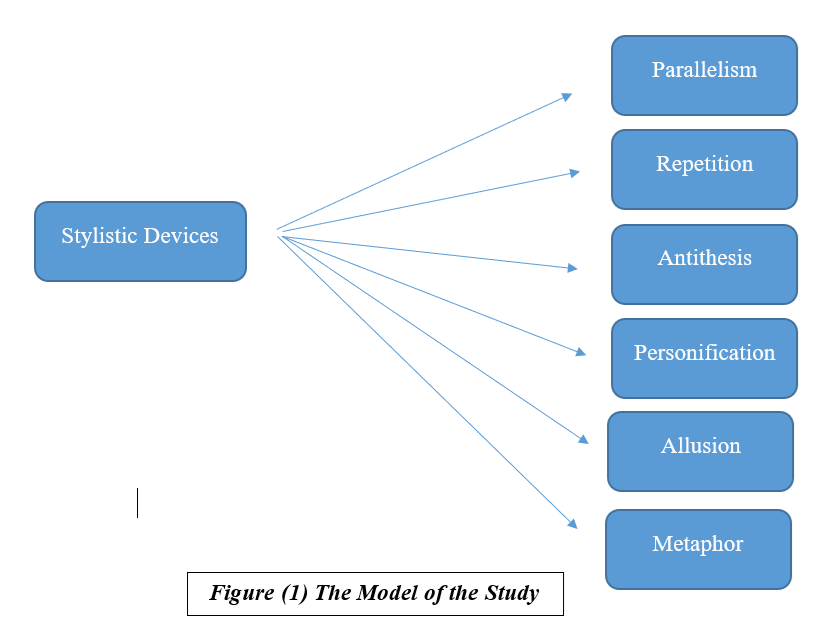
The data chosen will be analyzed according to Leech and Short’s (2007) model Style in Fiction: A Linguistic Introduction to English Fictional Prose. In this paper, a number of stylistic devices will be analyzed in three sermons by Al-Imam Al-Hassan (peace be upon him) talking about monotheism and how the divine nature is beyond the mind and cannot be understood by people. The devices that are analyzed are:
4.1 Parallelism
It is a syntactic stylistic device. It deals with the similar syntactical structures in neighboring phrases, clauses or sentences. Its main function is to increase the persuasion of the text and to reinforce the message in a clear way (Al-Ameedi and Al-A’ssam, 2018:87)
4.2 Repetition
It means the repetition of sounds, words, phrases, expressions, sentences or a whole clause. Its main purpose is to attract the attention of the hearers to an important idea or to emphasize it. (Manjavidze and Kemertelidze, 2013:8).
4.3 Antithesis
It is a stylistic device of contrast, it deals with two concepts or more that are contrasted in the concepts, image, position by common construction or internal meaning. The main role of antithesis is not only to put two concepts that are in principle contracting (antonyms) but also among concepts that are not contradicting each other individually but when they are put together, they become conflicting. Thus, this way of contrasting will cause a clear image in mind and sharpens the idea. (Ruzibaeva, 2019:150)
4.4 Personification
Personification is the transformation of animate actions or features to an entity that is inherently inanimate. The use of personification as a stylistic device is important for it is highly used in human dialogue. For generating personification there is no explicit syntactical structure to generate it as in using ‘like’ or ‘as’ in simile. (Keh et al. ,2022:1).
4.5 Allusion
Allusion is a stylistic device which implies reference to something or somebody. This reference alludes to historical, mythological, folklore, cultural, social and political phenomena, events and facts. This reference to a well-known literary work helps to contextualize the message which can lead to compress a great deal of significance to a phrase or sentence (Naciscione, 2021:302).
4.6 Metaphor
Metaphor is a special device of hyperbole since it is a persuasive strategy used in discourse. It helps the participants to change the abstract unfamiliar meaning into a concrete and familiar one (Van Dijk2006:77). Lakoff and Johnson(2003:4) suggest that metaphor is used in extraordinary language rather than in an ordinary one.
5. Analysis
In this section, three speeches for Al-Imam Al-Hassan (peace be upon him) will be analyzed stylistically:
5.1 The first speech:
)ٱلْـحَمْدُ لِلَّهِ ٱلْوَاحِدِ بِغَيْرِ تَشْبِيهٍ، وَٱلدَّائِمِ بِغَيْرِ تَكْوِينٍ، ٱلْقَائِمِ بِغَيْرِ كُلْفَةٍ، ٱلْخَالِقِ بِغَيْرِ مَنْصَبَةٍ، وَٱلْمَوْصُوفِ بِغَيْرِ غَايَةٍ، ٱلْمَعْرُوفِ بِغَيْرِ مَحْدُودٍ، ٱلْعَزِيزِ، لَمْ يَزَلْ قَدِيمًا فِي ٱلْقِدَمِ، رَدَعَتِ ٱلْقُلُوبُ لِهَيْبَتِهِ، وَذُهِلَتِ ٱلْعُقُولُ لِعِزَّتِهِ، وَخَضَعَتِ ٱلرِّقَابُ لِقُدْرَتِهِ، فَلَيْسَ يَخْطُرُ عَلَىٰ قَلْبِ بَشَرٍ مَبْلَغُ جَبَرُوتِهِ، وَلَا يَبْلُغُ ٱلنَّاسُ كُنْهَ جَلَالِهِ، وَلَا يُفْصِحُ ٱلْوَاصِفُونَ مِنْهُمْ لِكُنْهِ عَظَمَتِهِ، وَلَا تَبْلُغُهُ ٱلْعُلَمَاءُ بِأَلْبَابِهَا، وَلَا أَهْلُ ٱلتَّفَكُّرِ بِتَدَابِيرِ أُمُورِهَا، أَعْلَمُ خَلْقِهِ بِهِ ٱلَّذِي بِٱلْحَدِّ لَا يَصِفُهُ، يُدْرِكُ ٱلْأَبْصَارَ وَهُوَ ٱللَّطِيفُ ٱلْخَبِيرُ( المجلسي (h1403)
(Praise be to Allah, the One without likeness, the Everlasting without composition, the Existing without cost, the Creator without position, the Described without end, the Known without limit, the Almighty, who has always been ancient in time, the hearts are deterred by His majesty, the minds are stunned by His glory, and the necks are subdued by His power. The extent of His might is not in the heart of man, nor do people know the extent of His majesty, nor do those who describe His greatness, nor do the scholars reach Him with their intellects, nor do the people who think about the management of their affairs, the most knowledgeable of His creatures, who is the one who does not describe Him, who perceives the eyes and is the gentle and expert. … )([1])
The following stylistic devices are found in this speech:
- Parallelism
The similarity of syntactical structure in neighboring phrases or sentences leads to parallel constructions. In the above speech of Al-Imam there are parallel constructions:
(الحمد لله الواحد بغير تشبيه، والدائم بغير تكوين، القائم بغير كلفة، الخالق بغير منصبة، والموصوف بغير غاية، المعروف بغير محدود
The repetition of the phrase “بغير” shows the strong wording of Al-Imam Al-Hassan (peace be upon him) who starts his speech with forceful phrases to pay the attention of the hearers to the idea of his speech which is Allah is the One and Only God.
- Repetition
Repetition is widely used in Al-Imam Al-Hassan (peace be upon him) speech
بغير تشبيه، بغير تكوين، بغير كلفة، بغير منصبة، بغير غاية، بغير محدود
This anaphoric repetition which is a repetition of a word at the beginning of successive phrases is used to maintain the idea that Allah Almighty is beyond human characteristics.
Repetition of “ولا” in a series of clauses generates emphasis and power for the idea that no human —whether using his imagination, speech, knowledge, or reflection—can understand the essence of the Divine. This way of writing evokes awe and submission
- Antithesis
This device mainly deals with contrast between words or ideas:
الواحد بغير تشبيه ، والدائم بغير تكوين
The use of the word “one” to maintain the idea of oneness the hearer expects there is a comparison but Al-Imam directly follows it without similarity ” بغير تشبيه”. The same thing with the other part of the phrase, “the Eternal” immediately followed by without formation ” بغير تكوين” . The aim behind the use of this technique is to manifest Allah uniqueness that human brain cannot recognize or comprehend the divine self.
Personification
This device means giving human features to non-human things. In the line:
ردعت القلوب لهيبته ، وذهلت العقول لعزّته ، وخضعت الرقاب لقدرته
The verbs: ردعت)) restrained, (ذهلت)stupefied and(خضعت) bowed, all these verbs are given to describe hearts, minds and necks respectively. This description is used to add to these parts the sense of fear, which is related to human beings, of God Almighty, the One and Only Creator of this universe, to whose majesty everything submits. Thus, the use of personification reinforces the idea of monotheism in the Imam’s speech.
- Allusion
Al-Imam Al-Hassan (peace be upon him) uses allusion in the line:
أعلم خلقه به الذي بالحدّ لا يصفه ، يُدرك الأبصار وهو اللطيف الخبير
which is a reference to the following Quranic text
“لَا تُدْرِكُهُ الْأَبْصَارُ وَهُوَ يُدْرِكُ الْأَبْصَارَ وَهُوَ اللَّطِيفُ الْخَبِيرُ”(سورة الأنعام:103)
He uses this device to enrich the meaning of monotheism in his speech and the Quranic verse is the best way to prove it.
-
- The second speech:
ٱلْـحَمْدُ لِلَّهِ ٱلَّذِي لَمْ يَكُنْ لَهُ أَوَّلٌ مَعْلُومٌ، وَلَا آخِرٌ مُتَنَاهٍ، وَلَا قَبْلٌ مُدْرَكٌ، وَلَا بَعْدٌ مَحْدُودٌ، وَلَا أَمَدٌ مُبْتَغًى، وَلَا شَخْصٌ فَيَتَجَزَّأَ، وَلَا ٱخْتِلَافُ صِفَةٍ فَيَتَنَاهَى، فَلَا تُدْرِكُ ٱلْعُقُولُ وَأَوْهَامُهَا، وَلَا ٱلْفِكَرُ وَخَطَرَاتُهَا، وَلَا ٱلْأَلْبَابُ وَأَذْهَانُهَا صِفَتَهُ، فَتَقُولَ: مَتَىٰ؟ وَلَا: بُدْءٌ مِمَّ؟ وَلَا: ظَاهِرٌ عَلَىٰ مَا؟ وَلَا: بَاطِنٌ فِيمَا؟ وَلَا: تَارِكٌ فَهَلَّا؟ خَلَقَ ٱلْخَلْقَ فَكَانَ بَدِيئًا بَدِيعًا، ٱبْتَدَأَ مَا ٱبْتَدَعَ، وَٱبْتَدَعَ مَا ٱبْتَدَأَ، وَفَعَلَ مَا أَرَادَ، وَأَرَادَ مَا ٱسْتَزَادَ، ذَٰلِكُمُ ٱللَّهُ رَبُّ ٱلْعَالَمِينَ. الصدوق (45:1401h)
Praise be to God, who has no known beginning nor finite last, nor a before that can be perceived nor a limited after, nor a pure duration nor a person that can be divided, nor a different description that can be finite, so that the minds and their imaginations, nor the thoughts and their thoughts, nor the hearts and minds can comprehend His description, so that they say: When? N’ or did He begin from what, nor is He apparent over what, nor is He hidden in what, nor can He leave it. So why did He not create creation and be a Originator, Innovator? He began what He innovated, and innovated what He began, and did what He willed, and willed what He asked for more. That is God, Lord of the worlds([2])
- Parallelism
، ابتدأ ما ابتدع، وابتدع ما ابتدأ،
In this line Al-Imam Al-Hassan (peace be upon him) uses this device to emphasize the uniqueness and unity of the innovation way Allah is creating the creatures.
، فَلَا تُدْرِكُ ٱلْعُقُولُ وَأَوْهَامُهَا، وَلَا ٱلْفِكَرُ وَخَطَرَاتُهَا، وَلَا ٱلْأَلْبَابُ وَأَذْهَانُهَا
This line has also many parallel structures which refer to the high level of wording that Al-Imam use in order to deliver his message to the different social levels, attracting their attention by repeating the same device in the speech.
- Repetition:
ولا آخر …، ولا قبل … ولا بعد …، ولا أمد … ولا شخص …، ولا اختلاف …
Then Al-Imam Al-Hassan (peace be upon him) makes use of repetition in many parts in this part in numerating the unlimited characteristics of Allah that is beyond the mind of human.
Also, the repetition of the adjective بديئا بديعا” is to create paradoxical sense in the speech.
- Antithesis:
لم يكن له أول معلوم ولا آخر متناه، ولا قبل مدرك ولا بعد محدود
Al-Imam Al-Hassan (peace be upon him) starts his sermon by using this device of antithesis to pay the attention of the hearers to the idea that Allah is the One before everything and after everything and there is no limits for His existence and power.
- Personification
“فلا تدرك العقول وأوهامها، ولا الفكر وخطراتها، ولا الألباب وأذهانها صفته”
Al-Imam Al-Hassan (peace be upon him) says that if minds or hearts have the power of imagination, reasoning or delusion just as human beings, they will fail to understand what Allah is.
- Allusion
The last phrase in last line is taken from the Holy Quran
)ذلكم الله رب العالمين) )سورة الانعام:102)
Al-Imam Al-Hassan (peace be upon him) ends his speech by a verse from the Quran to show to people that Ahal Al-Bayt(PBUT) are associated with Quran and they follow every single detail in this Holy Book as Prophit Mohammad (Peace be upon him and his family) describes them in many speeches that they do not separate, i,e. Holy Quran and Ahal Al-Bayt(PBUT).
- Metaphor
، خلق الخلق فكان بديئا بديعا،
The adjectives: (بديئا)initiator and (بديعا)innovator metaphorically describe Allah Almighty when creating all the creatures no one can ever do this neither before nor after Him, so He is ” بديئا بديعا “
5.3 The Third speech
لْـحَمْدُ لِلَّهِ ٱلَّذِي كَانَ فِي أَوَّلِيَّتِهِ، وَحْدَانِيًّا فِي أَزَلِيَّتِهِ، مُتَعَظِّمًا بِٱلْهَيْبَةِ، مُتَكَبِّرًا بِكِبْرِيَائِهِ وَجَبَرُوتِهِ، ٱبْتَدَأَ مَا ٱبْتَدَعَ، وَأَنْشَأَ مَا خَلَقَ عَلَىٰ غَيْرِ مِثَالٍ كَانَ سَبَقَ مِمَّا خَلَقَ، رَبُّنَا ٱللَّطِيفُ بِلُطْفِ رُبُوبِيَّتِهِ، وَبِعِلْمِ خَبَرِهِ فَتَقَ، وَبِأَحْكَامِ قُدْرَتِهِ خَلَقَ جَمِيعَ مَا خَلَقَ، فَلَا مُبَدِّلَ لِخَلْقِهِ، وَلَا مُغَيِّرَ لِصُنْعِهِ، وَلَا مُعَقِّبَ لِحُكْمِهِ، وَلَا رَادَّ لِأَمْرِهِ، وَلَا مُسْتَرَاحَ عَنْ دَعْوَتِهِ.
خَلَقَ، وَلَا زَوَالَ لِمُلْكِهِ، وَلَا ٱنْقِطَاعَ لِمُدَّتِهِ، فَوْقَ كُلِّ شَيْءٍ عَلَا، وَمِنْ كُلِّ شَيْءٍ دَنَا، فَتَجَلَّىٰ لِخَلْقِهِ مِنْ غَيْرِ أَنْ يُرَىٰ، وَهُوَ بِٱلْمَنْظَرِ ٱلْأَعْلَىٰ ٱحْتَجَبَ بِنُورِهِ، وَسَمَا فِي عُلُوِّهِ، فَٱسْتَتَرَ عَنْ خَلْقِهِ، وَبَعَثَ إِلَيْهِمْ شَهِيدًا عَلَيْهِمْ، وَبَعَثَ فِيهِمُ ٱلنَّبِيِّينَ مُبَشِّرِينَ وَمُنْذِرِينَ، لِيَهْلِكَ مَنْ هَلَكَ عَنْ بَيِّنَةٍ، وَيَحْيَىٰ مَنْ حَيَّ عَنْ بَيِّنَةٍ، وَلِيَعْقِلَ ٱلْعِبَادُ عَنْ رَبِّهِمْ مَا جَهِلُوهُ، فَيَعْرِفُوهُ بِرُبُوبِيَّتِهِ بَعْدَ مَا أَنْكَرُوهُ. الموسوي (مج1)
.Praise be to God, Who was in His primacy, One in His eternity, glorious in His awe, and proud in His majesty and might. He began what He innovated and brought into being what He created without any previous example of what He created. Our Lord, the Kind, with the kindness of His Lordship, and with the knowledge of His information He split, and with the decrees of His power He created all that He created. There is no changer of His creation nor alterer of His making, nor follower of His judgment nor repeller of His command nor rest from His call. He created, and His kingdom does not cease nor does His duration cease above all things He is exalted and from all things He is near. So He revealed Himself to His creation without being seen, and in the highest vision He veiled Himself with His light, and He was named in His exaltation, so He was concealed from His creation. He sent to them a witness over them and sent among them prophets as bearers of good tidings and warners, so that whoever perishes may perish with clear evidence, and whoever lives may live with clear evidence, and so that the servants may understand about their Lord what they did not know, so that they may know Him with His Lordship after they denied Him. ([3])
- Parallelism
، فلا مبدل لخلقه ولا مغير لصنعه، ولا معقب لحكمه، ولا راد لأمره، ولا مستراح عن دعوته،
This use of balanced clauses reinforces the features of Almighty Allah that no one can change his creation nor decision. The use of this device has a powerful effect on the mind of the hearers because of its fluent constructions so that it strengthens the idea of monotheism.
- Repetition
ولا..، ولا.. لأ..، ولا ..
Al-Imam Al-Hassan (peace be upon him) uses the same device in nearly all his devices which is the repetition of the preposition of “ولا”. Al-Imam does so to intensify the meanings he wants to deliver to the hearers and establish a rhythmic, emphatic flow.
مُتَكَبِّرًا بِكِبْرِيَائِهِ.. ٱللَّطِيفُ بِلُطْفِ.. خَلَقَ جَمِيعَ مَا خَلَقَ، فَلَا مُبَدِّلَ لِخَلْقِهِ
Al-Imam Al-Hassan (peace be upon him) repeats all these phrases to remind people of the attributes of Almighty Allah in addition to the attribute of monotheism. Almighty is the Most Majestic(مُتَكَبِّرًا), the Most Kind(ٱللَّطِيفُ), and the Creator(الخالق), and no one can have a single attribute of these divine attributes.
- Antithesis
فوق كل شئ علا، ومن كل شئ دنى، فتجلى لخلقه من غير أن يكون يرى
Al-Imam Al-Hassan (peace be upon him) employs contrasted adjectives which show that Allah Almighty is above everything(فوق كل شئ علا) but at the same time He is very near(ومن كل شئ دنى). Similarly, Almighty Allah is clear for His creatures but He is invisible. Al-Imam Al-Hassan (peace be upon him) does so to reinforce the idea of monotheism for people at that time.
Allusion
Al-Imam Al-Hassan (peace be upon him) uses allusion from the Quranic verse in the line:
(البقرة 213)”كَانَ النَّاسُ أُمَّةً وَاحِدَةً فَبَعَثَ اللَّهُ النَّبِيِّينَ مُبَشِّرِينَ وَمُنْذِرِينَ “
This is a reference to the main purpose of all prophets which is warning oppressors from the torment of Hell and at the same time telling believers about Heaven.
- Metaphor
ربنا اللطيف..
Al-Imam Al-Hassan (peace be upon him) uses metaphor to remind the people of characteristics that are found in Almighty Allah in addition to be the One and the Only worshipping God.
|
Stylistic Device |
First speech |
Second speech |
Third speech |
total |
frequency |
|
Parallelism |
11 |
3 |
5 |
19 |
24 |
|
Repetition |
2 |
14 |
19 |
35 |
44 |
|
Antithesis |
2 |
3 |
4 |
9 |
11 |
|
Personification |
3 |
3 |
0 |
6 |
8 |
|
Allusion |
2 |
1 |
1 |
4 |
5 |
|
Metaphor |
0 |
1 |
6 |
7 |
9 |
|
Total |
20 |
25 |
32 |
80 |
100 |
Table (1): The Stylistic Devices in Al-Imam Al-Hassan’s (peace be upon him) Speaches
Conclusions
Through the analysis, it is concluded that Al-Imam Al-Hassan (peace be upon him) tackles monotheism in almost every speech to make people remember the main massage that prophet Mohammed (Peace be upon him and his family) calls for. The first hypothesis which reads as: “Al-Imam Al-Hassan (peace be upon him) uses stylistic devices to deliver the sense of monotheism” is valid since Al-Imam uses a number of stylistic devices such as personification, parallelism, repetition, antithesis, allusion and metaphor. therefore, the total percentage of the whole use of these devices is (80). The second hypothesis which reads as ” Repetition is used by Al-Imam Al-Hassan (peace be upon him) more than any other devices” is valid subsequently. Al-Imam Al-Hassan (peace be upon him) uses it in the three speeches that are taken as data for this study with a percentage 44% as a total. So are parallelism and antithesis. Thus, the third hypothesis is also valid since the percentages read as 24% and 11% respectively.
References
القران الكريم
Al-Ameedi, R. T. K. and Al-A’ssan, S.A. 2018. Retribution in Biblical Texts: A Stylistic Analysis. International Journal of English Linguistics; Vol.8, No. 4. (P.87)
Al-Sheha, A. 2009. The Key to Happiness. Keval,A. ; Karimi, U. ; Amin, U. ; Zainab, U. ; Sarah, A. (eds)
https://d1.islamhouse.com/data/en/ih_books/single/en_The_Key_to_Happiness.pdf
Flesher,P. 2016. UW Religion Today: The Three Monotheistic Religions: Children of One Father. University of Wyoming. https://www.uwyo.edu/news/2016/09/uw-religion-today-the-three-monotheistic-religions-children-of-one-father.html
Lakoff, G., and Johnson, M. 2003. Metaphors We Live by. (2nd ed.) University of Chicago Press.
Langermann, T. 2011. Introduction to Monotheism and Ethics. Bar llan university: Brill. https://www.researchgate.net/publication/304079913_Introduction_to_Monotheism_and_Ethics
Leech, G. N. and Short, M. (2007). Style in Fiction: A Linguistic Introduction to English Fictional Prose. London: Person Education Ltd.
Manjavidze, T. and Kemerttelidze, N. 2013. Stylistic Repetition, Its Peculiarities and Types in Modern English. Tbilisi:Grigol Robakidze University.
Naciscione,A. 2021. The Stylistic Pattern of Allusion: A Cognitive Approach. Latvian Academy of Culture, Latvia. Vol.9 http://www.culturecrossroads.lv/
Osman, F. 2007. Monotheists and the `Other` An Islamic perspective in an era of religious pluralism Institute for the Study of Islam in the Contemporary World. Los Angeles: California. https://www.islamicity.org/3049/monotheists-and-the-other-an-islamic-perspective-in-an-era-of-religious-pluralism/
Ruzibaeva;N. 2019.Peculiarities of the Antithesis in the Literary Text. European Journal of Research and reflection in Educational Science. Vol.7. No11. https://www.researchgate.net/publication/344512883_PECULIARITIES_OF_THE_ANTITHESIS_IN_THE_LITERARY_TEXT
Sedrick Scott Keh,S.; Lu,K; Gangal, V; and Feng, S; 2022. Pineapple: Personifying Inanimate Entities by Acquiring Parallel Personification data for Learning Enhanced generation. Carnegie Mellon University, University of Waterloo, Stanford University, University of Pittsburg
Shiri, A; Ahvar, M; Ghandehari, M. 2021. Principles and Methods of Teaching Monotheism Based on the Holy Quran and Ahl al-Bayt (as) Teachings. Journal of Research in Teaching. 2021, Autumn, No3, V:9.
Stark, R. 2001. One True God: Historical Consequences of Monotheism. Princeton,NJ: Princeton University Press.
Van Dijk, T. A. (2006). Ideology and Discourse: A Multidisciplinary Introduction. Pompeu Fabra University, Barcelona.
المصادر العربية:
الشريف الرضي. 2001. نهج البلاغة (تحقيق صبحي الصالح ط.4). بيروت: دار الكتاب العربي.
الصدوق، محمد بن علي بن الحسين.(1402) التوحيد. قم: جماعة المدرسين في الحوزة العلمية.
المجلسي، محمد باقر . 1403.بحار الانوار الجامعة لدرر اخبار الائمة الاطهار.(تحقيق محمد باقر البهبودي ط.2 مج 1-110).بيروت: مؤسسه الوفاء.
الموسوي، مصطفى. (سنه غير مذكورة). الروائع المختارة من خطب الامام الحسن (عليه السلام) .(ط 1 مج1 ) . القاهرة: دار و مطبعه الهلال.
 Arabic
  English