
Assessment of Natural Alpha-Emitting Radionuclides in Prenatal Vitamins and Dietary Supplements Commonly Used by Pregnant Women
تقييم النويدات المشعة الطبيعية الباعثة لجسيمات ألفا في فيتامينات ما قبل الولادة والمكملات الغذائية الشائعة الاستخدام لدى النساء الحوامل
Fatima Abbas Shaker1
1 Department of Vision Screening Techniques, College of Health and Medical Techniques, Al-Furat Al-Awsat Technical University, An-Najaf, Iraq
Email: fatima.abbas@atu.edu.iq
DOI: https://doi.org/10.53796/hnsj77/44
Arabic Scientific Research Identifier: https://arsri.org/10000/77/44
Volume (7) Issue (7). Pages: 778 - 786
Received at: 2026-06-15 | Accepted at: 2026-06-20 | Published at: 2026-07-01
Abstract: Natural radionuclides may be found in medicinal and nutritional goods owing to their geological and biological sources. The evaluation of the radiological safety of prenatal vitamins and nutritional supplements, commonly ingested during pregnancy, is crucial for the health of both the mother and the fetus. The current study sought to ascertain the levels of naturally occurring alpha-emitting radionuclides, specifically 222Rn (radon-222), 226Ra (radium-226), 238U (uranium-238), 218Po (polonium-218), and 214Po (polonium-214), in selected prenatal vitamins and dietary supplements frequently utilized by pregnant women in Iraq. Measurements were conducted utilizing the CN-85 solid-state nuclear track detector.The results indicated that the concentrations of ^222Rn in the air above the samples varied from 22.887 to 142.224 Bq/m³, with a mean value of 59.396 Bq/m³. The mean specific activity of 222Rn, 226Ra, and 238U were determined to be 2.840 Bq/kg, 173.938 mBq/kg, and 2.830 Bq/kg, respectively. The average concentrations of 218Po and 214Po were 15.926 Bq/m³ and 6.716 Bq/m³, respectively. The observed radioactive amounts varied among the analyzed samples, likely due to discrepancies in raw material sources, mineral makeup, and manufacturing procedures.The acquired values were below the internationally established thresholds set by the World Health Organization (WHO), the International Commission on Radiological Protection (ICRP), and the United Nations Scientific Committee on the Effects of Atomic Radiation (UNSCEAR). The examined prenatal vitamins and dietary supplements do not provide a substantial radiological risk and are deemed safe for regular use by pregnant women. Ongoing surveillance of naturally occurring radioactive elements in dietary supplements is advised to guarantee product quality and safeguard public health.
Keywords: Alpha emitters, prenatal vitamins, dietary supplements, pregnant women, radon, uranium, radium, CN-85 detector, natural radioactivity.
المستخلص: قد توجد النويدات المشعة الطبيعية في المنتجات الدوائية والغذائية نتيجةً لمصادرها الجيولوجية والبيولوجية. ويُعد تقييم السلامة الإشعاعية لفيتامينات ما قبل الولادة والمكملات الغذائية، التي تُستهلك عادةً خلال فترة الحمل، أمرًا بالغ الأهمية لصحة كلٍّ من الأم والجنين. هدفت الدراسة الحالية إلى تحديد مستويات النويدات المشعة الطبيعية الباعثة لجسيمات ألفا، ولا سيما الرادون-222 (222Rn)، والراديوم-226 (226Ra)، واليورانيوم-238 (238U)، والبولونيوم-218 (218Po)، والبولونيوم-214 (214Po)، في عينات مختارة من فيتامينات ما قبل الولادة والمكملات الغذائية التي تستخدمها النساء الحوامل بصورة شائعة في العراق. وقد أُجريت القياسات باستخدام كاشف الأثر النووي الصلب من نوع CN-85. أظهرت النتائج أن تراكيز غاز الرادون-222 (222Rn) في الهواء فوق العينات تراوحت بين 22.887 و142.224 بيكريل/م³، بمتوسط بلغ 59.396 بيكريل/م³. كما بلغ متوسط النشاط النوعي لكلٍّ من الرادون-222، والراديوم-226، واليورانيوم-238 نحو 2.840 بيكريل/كغ، و173.938 ملي بيكريل/كغ، و2.830 بيكريل/كغ، على التوالي. وبلغ متوسط تركيز البولونيوم-218 والبولونيوم-214 نحو 15.926 بيكريل/م³ و6.716 بيكريل/م³، على التوالي. وقد تباينت المستويات الإشعاعية المرصودة بين العينات التي خضعت للتحليل، ويُرجح أن يعود ذلك إلى الاختلافات في مصادر المواد الخام، والتركيب المعدني، وعمليات التصنيع. كانت القيم التي جرى الحصول عليها أقل من الحدود المقررة دوليًا من قبل منظمة الصحة العالمية (WHO)، واللجنة الدولية للوقاية من الإشعاع (ICRP)، ولجنة الأمم المتحدة العلمية المعنية بآثار الإشعاع الذري (UNSCEAR). وبناءً على ذلك، لا تمثل فيتامينات ما قبل الولادة والمكملات الغذائية التي جرى فحصها خطرًا إشعاعيًا كبيرًا، وتُعد آمنة للاستخدام المنتظم من قبل النساء الحوامل. ومع ذلك، يُوصى بالمراقبة المستمرة للعناصر المشعة الطبيعية في المكملات الغذائية لضمان جودة المنتجات وحماية الصحة العامة.
الكلمات المفتاحية: باعثات ألفا، فيتامينات ما قبل الولادة، المكملات الغذائية، النساء الحوامل، الرادون، اليورانيوم، الراديوم، كاشف CN-85، النشاط الإشعاعي الطبيعي.
1. Introduction
Natural and artificial radionuclides are ubiquitous in the environment and may enter into the human body through inhalation, ingestion or dermal contact. Such radionuclides emit ionizing radiation that interacts with biological tissue and damages molecules and cells. Long-term exposure to ionising radiation can be detrimental to human health as it can cause genetic changes, tissue damage and the development of cancer. The severity of these effects depends on the type of radiation, duration of exposure, concentration of radionuclides and sensitivity of individuals [1].
An alpha particle consists of two protons and two neutrons bound together tightly and is emitted from the nuclei of some radioactive elements in radioactive decay. Alpha particles have low penetrating ability and can be stopped by a sheet of paper or the outer layer of human skin. But they are very dangerous if alpha-emitting radionuclides are ingested or inhaled. In these cases, alpha particles deposit their energy over very short distances, generating dense ionization which can inflict severe damage on nearby biological cells and DNA molecules [2].
Hence, the internal exposure to alpha-emitting radionuclides is considered to be one of the most important radiological health hazards.Among the naturally occurring alpha-emitting radionuclides, uranium-238 (238U), radium-226 (226Ra), radon-222 (222Rn) and their decay products, e.g. polonium-218 (218Po) and polonium-214 (214Po) are of special interest due to their potential contribution to internal radiation doses [3].
These radionuclides may enter the food chain from soil and water to agricultural produce and raw materials used by the pharmaceutical and nutraceutical industries. Thus, trace amounts of natural radioactivity can be found in dietary supplements and vitamin products for human use [4].
Pregnant women are a particularly sensitive population group since the exposure of the mother to radionuclides may affect both the mother and the developing fetus. Prenatal vitamins and dietary supplements are commonly used in pregnancy to promote fetal development and maternal well-being. These products often contain minerals and natural ingredients from geologic and biologic sources that may contain naturally occurring radioactive materials (NORMs). Therefore, the measurement of the radioactivity of such products is necessary to guarantee their safety and to evaluate possible radiological risks related to long time consumption [5].
The evaluation of environmental radioactivity and its transfer into foodstuffs, pharmaceuticals and dietary supplements has become an important field of research in medical physics and radiation protection. The increased awareness of radiation health effects has led researchers worldwide to study radionuclide concentrations in a broad range of consumer products. Several studies have reported the presence of alpha-emitting radionuclides in medicinal plants, pharmaceutical products, food supplements and herbal preparations, thus signifying the need for continuous radiological monitoring and risk assessment [6–9].
Therefore, the present study aims to determine the concentrations of 222Rn, 226Ra, 238U, 218Po and 214Po in selected prenatal vitamins and dietary supplements commonly used by pregnant women using the CN-85 detector. Also, the study evaluates the corresponding radiological health risk parameters such as the Annual Average Internal Effective Dose (AAIED) and the Risk Excess Cancer Factor for Pregnant Mothers Products (RECFPMP) due to exposure to 222Rn, 226Ra and 238U in the studied samples.
2. Experimental Procedures
2.1. Prenatal Vitamins and Dietary Supplement Samples (Collection and Preparation)
Fifteen samples of prenatal vitamins and dietary supplements commonly used by pregnant women were collected from different pharmacies and health stores in the Iraqi market during November and December 2025. The samples selected were multivitamin preparations, folic acid supplements, iron supplements, calcium supplements and prenatal nutritional formulations. Table 1 presents the names, sample codes, manufacturers and countries of origin of the samples..
Table 1. Name, code, manufacturer, and country of origin of prenatal vitamin and dietary supplement samples
| No. | Sample Name | Sample Code | Manufacturer | Country |
| 1 | Elevit Pronatal | P1 | Bayer | Germany |
| 2 | Pregnacare Original | P2 | Vitabiotics | United Kingdom |
| 3 | Fefol Vit | P3 | Abbott | Australia |
| 4 | Materna | P4 | Nestlé Health Science | Switzerland |
| 5 | Centrum Materna | P5 | Haleon | Canada |
| 6 | Prenatal DHA | P6 | Nature Made | USA |
| 7 | Pregnacare Plus Omega-3 | P7 | Vitabiotics | United Kingdom |
| 8 | Feroglobin B12 | P8 | Vitabiotics | United Kingdom |
| 9 | Osteocare | P9 | Vitabiotics | United Kingdom |
| 10 | Calcium-D3 | P10 | Jamjoom Pharma | Saudi Arabia |
| 11 | Folic Acid 5 mg | P11 | SDI | Iraq |
| 12 | Iron Plus Folic Acid | P12 | Pioneer | Iraq |
| 13 | Multi Prenatal | P13 | Jamieson | Canada |
| 14 | Prenatal Complete | P14 | GNC | USA |
After collection the samples were transported to the Advanced Nuclear Physics Laboratory, Faculty of Science, University of Kufa. Each sample was given a unique identification code and stored in clean plastic containers prior to radiological preparation. The samples examined were in the form of tablets, capsules and powder. Tablets and capsules were ground and homogenized in a clean laboratory mortar to produce a fine powder with uniform particle size.The powdered samples were dried at room temperature to remove moisture and to ensure the stability of the sample during the measure. The samples were weighed on a very sensitive digital balance with an accuracy of ±0.01 g. Each powdered sample (approx. 20 g, corresponding to a thickness of about 2 cm) was placed into a cylindrical plastic container (diameter 5 cm, height 7 cm). Then a CN-85 solid state nuclear track detector was tightly mounted on the top of each container. The containers were hermetically sealed to prevent radon leakage and stored under laboratory conditions during the exposure period.
2.2. Measurement Technique
An integrated passive dosimetry technique was used to measure concentrations of alpha-emitting radionuclides in prenatal vitamin and dietary supplement samples. The measurements were carried out with (1×1) cm2 CN-85 solid state nuclear track detectors. The detectors were left in contact with the samples for a period of 90 days to allow the build-up of alpha-particle tracks from the decay of naturally occurring radionuclides.The CN-85 detector is a cellulose nitrate detector with a thickness of 12 μm and chemical composition C 6 H 8 O 9 N 2 . It is produced by Kodak, France and it is widely used for the detection of alpha particles in the energy range of about 0.5-8 MeV and for the measurement of radon concentrations in different environmental and pharmaceutical samples [10].The detectors were chemically etched in sodium hydroxide (NaOH) solution in a water bath (Type HH-420, made in Germany) after the exposure period. The optimal etching condition was 2.5 N NaOH, 60 °C and 90 min [11]. This process disclosed the latent tracks of alpha particles produced by irradiation.The etching of the detectors was analyzed with an optical microscope at 400× magnification to find the track density [12]. The measured track densities were used to determine concentrations of 222Rn, 226Ra, 238U, 218Po and 214Po in the samples investigated. Furthermore, radiological health risk parameters of exposure to these radionuclides were assessed for prenatal vitamin and dietary supplements products commonly consumed by pregnant women.
2.3. Alpha Emitter Calculations
Alpha emitters such as 222Rn (C, CRn, and CRns in airspace of tube, within the sample, and specific activity within the sample), 226Ra (CRawithin the sample), and uranium concentrations CU, as well as (POW) and (POS) for radon daughters on chamber walls and chamber face, respectively were calculated according to equations from (1) to (6), respectively [13-17]:
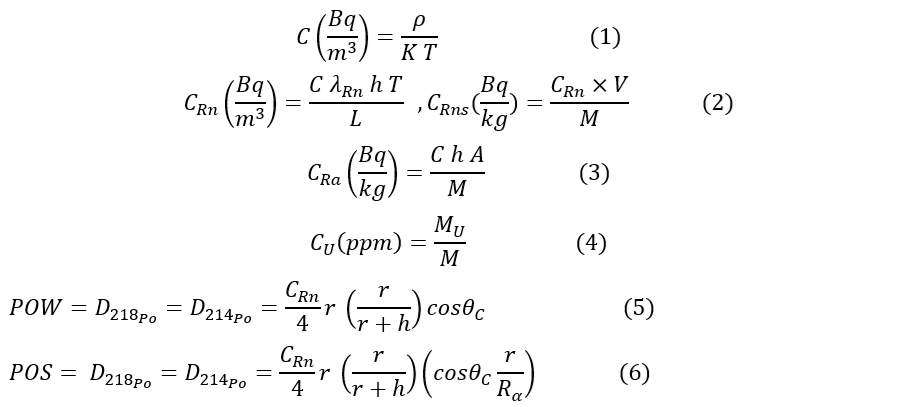
where ρ, k, t, λRn, L, A, V, M, r, θC, and R is density of the track, calibration factor (0.28±0.043Track.cm-2 /Bq.m-3.day), time exposure (90 days), decay constant, thickness of the powder sample, surface area of the powder sample, volume of the container, and weight of powder sample, radius of the container, the value of the critical angle of CN-85 detector, and the value of the range of α-particle in air, respectively. [15,18]
3. Results and Discussion
Table 2 shows the concentrations of 222Rn, 226Ra and 238U measured in prenatal vitamins and dietary supplements commonly used by pregnant women. The obtained values show differences in radionuclide concentrations among the investigated samples, which can be explained by differences in raw materials, manufacturing processes, mineral composition, and geographical origin of the ingredients used in the production of these supplements.The data in Table 2 and Figure 1 show that the radon activity concentration in the air space above the samples (C) ranged from 22.887 Bq/m^3 to 142.224 Bq/m^3 with an average value of 59.396 Bq/m^3. The concentration of radon in the sample containers (C_Rn) varied from 934.116 Bq/m3 to 5804.864 Bq/m3 with an average value of 2424.254 Bq/m3. Similarly. The specific activity of radon (C_Rns) varied between 1.057 Bq/kg and 6.202 Bq/kg with the mean value of 2.840 Bq/kg.The specific activity of 226Ra ranged from 64.730 mBq/kg to 379.905 mBq/kg with an average value of 173.938 mBq/kg. Moreover, the concentration of uranium (238U) was ranged from 0.085 ppm to 0.500 ppm with an average value of 0.229 ppm, while the specific activity of uranium was ranged from 1.053 Bq/kg to 6.180 Bq/kg with an average value of 2.830 Bq/kg.The differences in radionuclide concentrations observed in the investigated prenatal supplements can be explained by the differences in mineral and botanical sources applied during the manufacturing. Many prenatal vitamins include calcium, iron, magnesium, zinc and other minerals from natural geological deposits. These raw materials may contain traces of naturally occurring uranium, radium, radon and their decay products. Other factors affecting the transfer of naturally occurring radioactive materials (NORMs) into dietary supplements include environmental conditions, soil composition, fertilizer application and methods of industrial processing.The measured radon concentrations in all studied samples of prenatal vitamins and dietary supplements were below the action level recommended by the International Commission on Radiological Protection (ICRP), i.e., 200 Bq/m3 [19]. Similarly, the average values were lower than the reference level of 100 Bq/m3 in indoor air recommended by World Health Organization (WHO) [20]. Therefore, the products under investigation do not pose a relevant radiological risk as regards radon exposure.Similarly, the measured values of 226 Ra were far below the world average permissible level of 30 Bq/kg as provided by UNSCEAR [21]. Also, the concentrations of uranium were much lower than the recommended global average value of 2.8 ppm reported by UNSCEAR [21]. These findings suggest that the analyzed prenatal vitamins and dietary supplements contain low concentrations of natural radionuclides and can be considered radiologically safe for human consumption
Table (2): Results of 222Rn, 226Ra, and 238U in Prenatal Vitamins and Dietary Supplements
| No. | Code | C (Bq/m³) | C_Rn (Bq/m³) | C_Rns (Bq/kg) | C_Ra (mBq/kg) | C_U (ppm) | C_US (Bq/kg) |
| 1 | P1 | 24.521 | 1000.839 | 1.203 | 73.689 | 0.097 | 1.199 |
| 2 | P2 | 32.695 | 1334.452 | 1.426 | 87.335 | 0.115 | 1.421 |
| 3 | P3 | 29.426 | 1201.006 | 1.777 | 108.832 | 0.143 | 1.770 |
| 4 | P4 | 71.929 | 2935.793 | 3.321 | 203.438 | 0.268 | 3.310 |
| 5 | P5 | 142.224 | 5804.864 | 6.202 | 379.905 | 0.500 | 6.180 |
| 6 | P6 | 98.085 | 4003.355 | 3.850 | 235.803 | 0.311 | 3.836 |
| 7 | P7 | 39.234 | 1601.342 | 1.621 | 99.286 | 0.131 | 1.615 |
| 8 | P8 | 50.677 | 2068.400 | 2.486 | 152.290 | 0.201 | 2.477 |
| 9 | P9 | 40.869 | 1668.064 | 2.468 | 151.156 | 0.199 | 2.459 |
| 10 | P10 | 93.181 | 3803.187 | 6.095 | 373.355 | 0.492 | 6.074 |
| 11 | P11 | 58.851 | 2402.013 | 2.887 | 176.853 | 0.233 | 2.877 |
| 12 | P12 | 42.504 | 1734.787 | 1.854 | 113.535 | 0.150 | 1.847 |
| 13 | P13 | 91.546 | 3736.464 | 3.782 | 231.666 | 0.305 | 3.769 |
| 14 | P14 | 22.887 | 934.116 | 1.057 | 64.730 | 0.085 | 1.053 |
| 15 | P15 | 52.312 | 2135.122 | 2.566 | 157.202 | 0.207 | 2.557 |
| Average | 59.396 | 59.396 | 59.396 | 59.396 | 59.396 | 59.396 | |
Figure 1: Radon concentration in the air space above prenatal vitamin and dietary supplement samples. 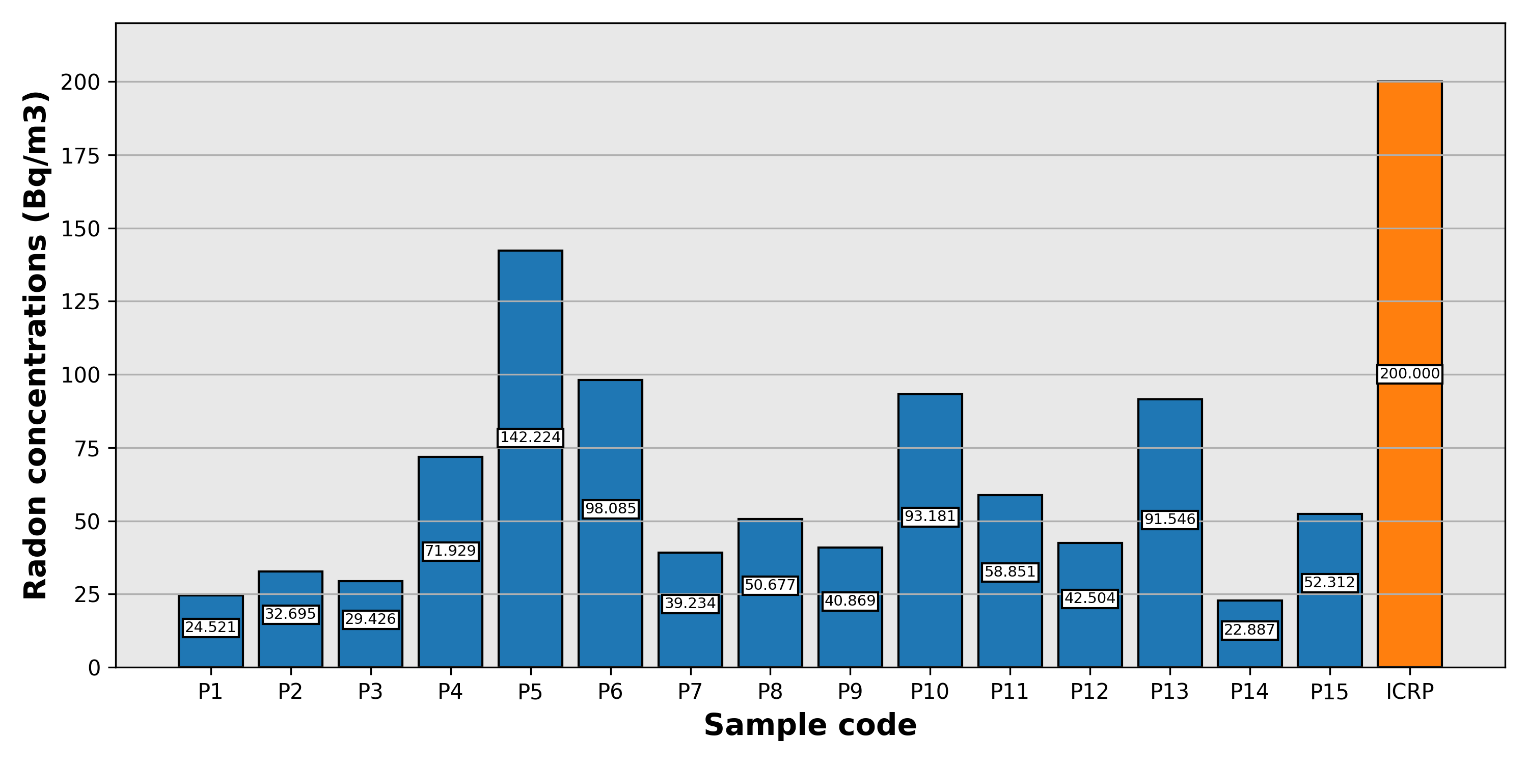
Figure 2 presents the histogram distribution of 222Rn concentrations in the investigated samples. Most of the measured values were concentrated within the range of 20–150 Bq/m³, indicating a relatively homogeneous distribution and the absence of extreme radionuclide contamination among the analyzed products.
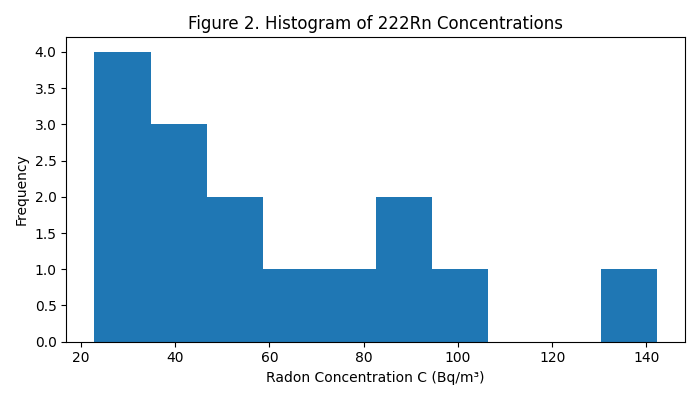 Figure 2. Histogram of 222Rn concentrations in prenatal vitamin and dietary supplement samples.
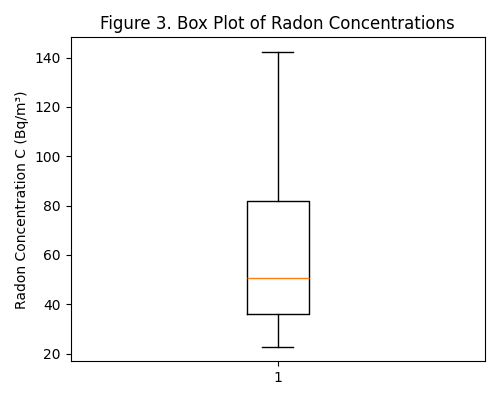
The box plot shown in Figure 3 illustrates the distribution, central tendency, variability, and possible outliers of radon concentrations. The results indicate an approximately normal distribution with moderate variability among the investigated samples.
The concentrations of 218Po and 214Po are presented in Table 3. The average values of 218Po and 214Po were found to be 15.926 Bq/m³ and 6.716 Bq/m³, respectively. These values remain within acceptable radiological limits and are consistent with the low concentrations observed for radon and uranium in the investigated samples.
Table (3): Results of Polonium (218Po and 214Po) in Prenatal Vitamins and Dietary Supplements
| No. | Code | 218Po (Bq/m³) | 214Po (Bq/m³) |
| 1 | P1 | 6.575 | 2.773 |
| 2 | P2 | 8.767 | 3.697 |
| 3 | P3 | 7.890 | 3.327 |
| 4 | P4 | 19.287 | 8.133 |
| 5 | P5 | 38.137 | 16.082 |
| 6 | P6 | 26.301 | 11.091 |
| 7 | P7 | 10.520 | 4.436 |
| 8 | P8 | 13.589 | 5.730 |
| 9 | P9 | 10.959 | 4.621 |
| 10 | P10 | 24.986 | 10.536 |
| 11 | P11 | 15.781 | 6.655 |
| 12 | P12 | 11.397 | 4.806 |
| 13 | P13 | 24.548 | 10.351 |
| 14 | P14 | 6.137 | 2.588 |
| 15 | P15 | 14.027 | 5.915 |
| Average | 15.926 | 6.716 | |
4. Conclusions
The results obtained in this study indicated that the measured ^222Rn concentrations in the prenatal vitamins and dietary supplements studied were within the permissible limits recommended by the World Health Organization (WHO) and the International Commission on Radiological Protection (ICRP). In addition, the concentrations of 226Ra and 238U measured in all the samples analyzed were below the worldwide recommended limits reported by UNSCEAR.In addition, the concentrations of radon progeny, represented by 218Po and 214Po, were within acceptable radiological levels. The estimated radiological health risk parameters for the investigated alpha-emitting radionuclides were very low and within the internationally accepted safety limits.
5. References
[1] Gupta, T. (2013). Radiation, Ionization, and Detection in Nuclear Medicine. In: Basic Physics and Radiation Safety in Nuclear Medicine. Springer, Heidelberg, pp. 451–494.
[2] United Nations Scientific Committee on the Effects of Atomic Radiation (UNSCEAR). (2000). Sources and Effects of Ionizing Radiation. UNSCEAR 2000 Report to the General Assembly, United Nations, New York.
[3] United Nations Scientific Committee on the Effects of Atomic Radiation (UNSCEAR). (2008). Sources and Effects of Ionizing Radiation. UNSCEAR 2008 Report, United Nations, New York.
[4] World Health Organization (WHO). (2009). WHO Handbook on Indoor Radon: A Public Health Perspective. World Health Organization, Geneva.
[5] Tirmarche, M., Harrison, J.D., Laurier, D., Paquet, F., Blanchardon, E., & Marsh, J.W. (2010). Lung Cancer Risk from Radon and Progeny and Statement on Radon. ICRP Publication 115, Annals of the ICRP, 40(1), 1–64.
[6] International Commission on Radiological Protection (ICRP). (2007). The 2007 Recommendations of the International Commission on Radiological Protection. ICRP Publication 103. Annals of the ICRP, 37(2–4).
[7] International Atomic Energy Agency (IAEA). (2014). Radiation Protection and Safety of Radiation Sources: International Basic Safety Standards. General Safety Requirements Part 3 (GSR Part 3), Vienna.
[8] Al-Omari, S. (2015). Radioactivity Measurement of 222Rn, 226Ra and 238U in Pharmaceuticals and Evaluation of Cancer Risk. International Journal of Low Radiation, 10(1), 61–73.
[9] Oufni, L., Manaut, N., Taj, S., & Manaut, B. (2013). Determination of Radon and Thoron Concentrations in Different Parts of Some Plants Used in Traditional Medicine Using Nuclear Track Detectors. American Journal of Environmental Protection, 1(2), 34–40.
[10] Atteah, Y.M., & Mohsen, I.K. (2012). Measurement of Radon-222 Exhalation Rate in Different Kinds of Tablet Medicine Samples by CR-39 Detectors. Journal of Kerbala University, 10(2), 221–227.
[11] Grzywa-Celińska, A., Krusiński, A., Mazur, J., Szewczyk, K., & Kozak, K. (2020). Radon—The Element of Risk. The Impact of Radon Exposure on Human Health. Toxics, 8(4), 120.
[12] Ibrahim, A.A., Hashim, A.K., & Abojassim, A.A. (2021). Measurement of Radon-222 Concentrations in Selected Soil Samples in Al-Mothafeen Area (Kerbala, Iraq) by Using the CN-85 Detector. Polish Journal of Soil Science, 54(2), 139–153.
[13] Hashim, A.K., Mezher, H.A., Kadhim, S.H., & Abojassim, A.A. (2021). Annual Average Internal Dose Based on Alpha Emitters in Milk Samples. Journal of Physics: Conference Series, 1829, 012027.
[14] Alhous, S.F., Kadhim, S.A., Alkufi, A.A., & Kadhim, B.A. (2020). Measuring the Level of Radioactive Contamination of Selected Samples of Sugar and Salt Available in Local Markets in Najaf Governorate/Iraq. IOP Conference Series: Materials Science and Engineering, 928, 072097.
[15] Poty, S., Francesconi, L.C., McDevitt, M.R., Morris, M.J., & Lewis, J.S. (2018). α-Emitters for Radiotherapy: From Basic Radiochemistry to Clinical Studies—Part 1. Journal of Nuclear Medicine, 59(6), 878–884.
[16] International Commission on Radiological Protection (ICRP). (2010). Lung Cancer Risk from Radon and Progeny and Statement on Radon. ICRP Publication 115, Annals of the ICRP, 40(1), 1–64.
[17] United States Environmental Protection Agency (EPA). (2016). A Citizen’s Guide to Radon: The Guide to Protecting Yourself and Your Family from Radon. EPA 402/K-12/002.
[18] Abojassim, A. A., Hady, H. N., & Kareem, A. H. A. (2016). Radon Levels in Different Types of Plants with Medicinal Properties. Madridge Journal of Food Technology, 1(1), 18–21.
[19] Mohammed, H. A. U., Hussain, H. S., & Abojassim, A. A. (2022). Radon and Radon Progeny Concentrations Detection for Human Serum Samples in Kerbala Governorate. AIP Conference Proceedings, 2386(1), 020004.
[20] Poty, S., Francesconi, L. C., McDevitt, M. R., Morris, M. J., & Lewis, J. S. (2018). α-Emitters for Radiotherapy: From Basic Radiochemistry to Clinical Studies—Part 1. Journal of Nuclear Medicine, 59(6), 878–884.
[21] Trujillo-Nolasco, M., Morales-Avila, E., Cruz-Nova, P., Katti, K. V., & Ocampo-García, B. (2021). Nanoradiopharmaceuticals Based on Alpha Emitters: Recent Developments for Medical Applications. Pharmaceutics, 13(8), 1123.
 Arabic
  English