

Internet of Things (IoT) and Artificial Intelligence (AI) Based Smart Cities Management: A Review Study
إدارة المدن الذكية القائمة على إنترنت الأشياء (IoT) والذكاء الاصطناعي (AI):دراسة مراجعة
Saleemah Najm Abdullah1, Ali Saad Assaad2*
1 DR, Department of Insurance Techniques, Al-Furat Al-Awsat Technical University,, Iraq. E-mail: dw.slema@atu.edu.iq
2 DR, Department of Management, Faculty of Administrative Sciences and Economics, University of Isfahan, Iran. E-mail: alisaadassaad1989@
DOI: https://doi.org/10.53796/hnsj71/45
Arabic Scientific Research Identifier: https://arsri.org/10000/71/45
Volume (7) Issue (1). Pages: 725 - 738
Received at: 2025-12-10 | Accepted at: 2025-12-17 | Published at: 2026-01-01
Abstract: With how technology and metering have improved so quickly, smart cities can used a wide range of disconnected (IoT) and artificial intelligence (AI) devices with greater sophistication than ever before. The use of Artificial Intelligence (AI) as an integrated part of IoT technology regarding smart city safety and security represents a major step forward in urban safety and surveillance. The capacity of cities to detect, prevent, and react to security incidents in real-time can be improved with the help of AI-powered analytics integrated with IoT sensor networks. This research intends to provide a systematic study of the concepts of smart cities, focusing on the motivates and practical executions. Primarily, it focuses on the IoT and AI technologies driving smart city initiatives, discussing their necessary elements and defining their major attributes. Besides, it points to the significant challenges faced in the development of such urban centers.
Keywords: Internet of Things, Smart Cities, Artificial Intelligence, Smart Home.
المستخلص: مع التطور السريع في التكنولوجيا وأنظمة القياس، أصبحت المدن الذكية قادرة على استخدام مجموعة واسعة من أجهزة إنترنت الأشياء (IoT) والذكاء الاصطناعي (AI) المنفصلة بدرجة من التطور تفوق ما كان عليه الحال في السابق. ويُعدّ توظيف الذكاء الاصطناعي كجزء متكامل من تقنيات إنترنت الأشياء في مجال سلامة وأمن المدن الذكية خطوة نوعية متقدمة في تعزيز الأمن الحضري وأنظمة المراقبة. إذ تسهم التحليلات المدعومة بالذكاء الاصطناعي، والمندمجة مع شبكات مستشعرات إنترنت الأشياء، في تحسين قدرة المدن على الكشف عن الحوادث الأمنية والوقاية منها والاستجابة لها في الوقت الحقيقي. وتهدف هذه الدراسة إلى تقديم بحث منهجي حول مفاهيم المدن الذكية، مع التركيز على الدوافع والتطبيقات العملية. كما تركز بصورة أساسية على تقنيات إنترنت الأشياء والذكاء الاصطناعي التي تقود مبادرات المدن الذكية، من خلال مناقشة مكوناتها الأساسية وتحديد خصائصها الرئيسة. وإلى جانب ذلك، تسلط الدراسة الضوء على التحديات الجوهرية التي تواجه تطوير هذا النوع من المراكز الحضرية.
الكلمات المفتاحية: إنترنت الأشياء، المدن الذكية، الذكاء الاصطناعي، المنزل الذكي.
Introduction
The urgent need to provide infrastructure and services to urban residents has been fueled by a spike in population density in city centers (Wolniak and Stecuła, 2024). This geo has substantially increased the number of digital devices including sensors, actuators, smartphones, etc. This also marks the demand IoT and AI technologies. The devices can connect and communicate with each other over the internet which increases their potential impact (Camacho et al, 2024).
A multitude of autonomous systems linked by self-regulating networks makes up an Internet of Things (IoT) framework (Jagatheesaperumal et al., 2024). Generally, IoT is technology that incorporates physical objects that are pervasive, dispersed, and that have low processing and storage capabilities (Omrany et al., 2024). Its core focus is the enhancement of the smart cities and the infrastructures supporting the cities in terms of reliability, performance, and security (Wang et al., 2024). AI, on the contrary, improves the effect of the decision made by the systems through its ability to assess complexities and huge volumes of information in record time with remarkable accuracy to reveal insights and patterns that are otherwise invisible to people (Herath & Mittal, 2022; Alahi et al., 2023). Decision made are supposed to be supported by data and in this case, AI helps drive the organization to the intended destination with the least number of mistakes possible and the most desired results (Assaad et al., 2024, Bibri et al., 2023). Hence, this article gives an in-depth analysis of various smart city projects that make use of AI and IoT technologies.
Global advancements have encouraged the creation of smart cities that use cutting-edge technologies. These cities use smart technologies such as the surveillance cameras and sensors used for city monitoring and vehicle traffic management systems. Along with other sources, sensors used in the IoT regions can be used to collect geo-location data, which can be employed for the tracking of vehicles, bicycles, etc. Complex systems of artificial intelligence synthesize existing datasets with complex, layered algorithms to discover patterns in the information. Each cycle of data processing where the system interacts with the datasets results in the modification of the artificial intelligence system which fine tunes the data systems in the process (Hammoumi, Maanan & Rhinane, 2024.) Many administrative functions use Looming Technology to improve functions related with Air and Noise Pollution, Congestion, and Surveillance Systems. Moreover, Artificial Intelligence (AI) is of tremendous help to administrative professionals by supporting in task optimization, efficiency, and productivity. AI’s goals are to augment, not replace. It is a powerful tool in easing administrative burdens and propelling career advancement (Chen, Sivaparthipan & Muthu, 2022; Belli et al., 2020 Concerning the Internet. It dynamically connects billions of people. The next phase of the Internet’s evolution will make it possible to establish more intricate interactions between objects (Janssen et al., 2019). In 2011 the number of inter-connected devices was considerably more than the number of people using the Internet (Ketu & Mishra, 2022). Today, artificial intelligent tools like ChatGPT demonstrate how AI can be harnessed to fundamentally alter our approaches to data analytics and administrative management (Zhang, Manogaran & Muthu, 2020). IoT and AI technologies are poised to transform a multitude of spheres in life organized under the smart city concept: health, security, and transportation. In addition to this, they might actively participate at the country level advocating on policies involving energy savings, reduction of pollution and so on. They also enable remote monitoring and critical infrastructure management (Jovari 2024, Rahaman & Bhakt Vaishali 2023). In this regard also, the integration of Internet of Things (IoT) and Artificial Intelligence (AI) will improve the effectiveness, lowering the cost, and increasing the security of operations in various fields by taking energy conservation, economic factors, and reliability into account (Abd Aziz, Abdullah & Sofyan 2023). IoT and AI-based interrelations are shown in the Figure 1.
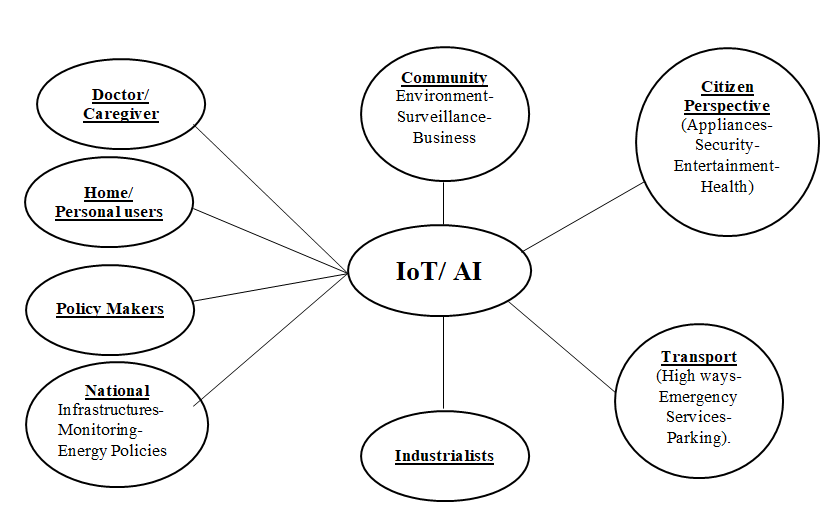
Fig1: IoT and AI-based interconnections
IoT for Smart Cities
The Internet of Things (IoT) is an extensive network system that uses standard communication formats and is intrinsically connected to the internet. More precisely, the Internet of Things (IoT) is defined by the ability to capture, read, and comprehend diverse entities within the domain of their presence and, more importantly, the power to act on their environment. This is predicated on the progress of diverse devices and means of communication (Syed et al, 2021). IoT systems comprise of diverse categories of smart electronics including the cellular phone and items less regarded as electronics including food, smart homes, infrastructure, public utilities, monuments, and even bindeez, which can all cohesively operate to serve a single purpose. One of the most pivotal aspects of the Internet of Things (IoT) is the influence on the clients’ lives. In the next section, we will discuss the various IoT developments and their implications (Assaad et al, 2024; Majeed et al, 2021).
1. Addressing: the internet possess the ability to facilitate meaningful relationships among people and foster interconnectivity among devices and things developing intelligent surroundings. Being able to uniquely identify objects is important for the proper and optimal functioning of IoT systems. This is mostly the case because proper and unique addressing of the limitless range of devices is crucial for proper management of the devices over the Internet (Bedi et al., 2022). Unique identification is important but devices with other attributes such as reliability, scale, and resolution come forth as primary needs to be considered for creating a proper addressing scheme (Yu et al., 2022).
2. Wireless Sensor Network: WSNs provide useful information and can be helpful in numerous areas, including but not limited to, the medical field, government, environmental science, and the monitoring of earthquakes. Moreover, WSNs can be combined with RFID technology to collect additional data on the location, movement, and temperature of an object (Yu et al. 2022).
3. Radio-Frequency Identification (RFID): These systems, comprising readers and tags, are fundamental to the framework of the Internet of Things (IoT). When applied to an object, this technology enables the automation of identification, which allows each object to be given a unique digital identity. This automation allows the object to be integrated into a network, which can be linked to other digital data and services (John et al. 2022).
4. Middleware: One of the most crucial points of data collection, chatting, and processing is the application of middleware, which is the primary software layer that connects various devices, network edges, and the different software systems to the application layer. The aim of middleware is to consolidate and simplify the functions and communications of the relevant systems (John et al. 2022; Majeed et al. 2021).
AI for Smart Cities
The combination of AI and smart cities come with a variety of benefits with regards to productivity, safety and overall well-being of the people within the city (Ramu et al. 2022). In urban settings, cross leveraging blades of machine learning and other emerging AI technologies is conservatively transformational and operationally impactful with a low burden on the environment. Moreover, AI smart radiant systems’ digital front ends to services are altering the way public services are provided and there is a new form of interaction and active involvement of people (Khanh et al. 2023).
1. Using Big Data: The use of big data with the Internet of Things (IoT) enables cities to achieve their urban development objectives. The data collected helps the city understand its pulse. With the city analytics design data, city officials can capture and analyze large volumes of data (Wu et al., 2024). The powerful use of big data helps municipalities identify and analyze risk factors to improve response policing. The big data also assists forecasting and planning for urbanizations. These approaches identify and analyze emerging issues of citizen interests, problems, and needs. In addition, timely data helps improve response and recovery efforts for disasters like hurricanes and earthquakes (Allam & Dhunny, 2019).
2. Tackling Environmental Issues: In our efforts towards preventing climate change, we see that there is a need for every future city to incorporate practices for effective and sustainable waste management. The increasing concentration of greenhouse gases, marine debris and litter in our towns has spawned a new concept, “smart cities” (Camacho et al. 2024, Allam and Dhunny 2019). The designs for energy-efficient buildings, coupled with renewable energy sources, air-quality monitoring systems and similar innovations, are leading this charge. If cities deploy air-quality sensors in convenient urban positions, they will be able to collect essential pollution level data, identify why certain areas have lower levels of air (Mark and Anya, 2018), and even determine the spatial positions of pollution sources. This is a key development in the practice of air pollution control in highly urbanized areas. AI is central to the emerging domain of e-mobility, which automates the management of strategic charging for electric vehicles in equilibrium with the pulsations of city life. The ever-increasing capability of machine learning to pluck facts from fiction has sharpened the instrument of public safety in the hands of defenders, facilitating deeper analytical processes on violent events (Yigitcanlar et al 2020, Chatterjee, Kar, and Gupta 2018).
IoT Applications for Smart Cities
IoT connects a variety of devices through the internet, bringing them together for enhanced interaction. To enable this connectivity, sensors can be deployed in various locations to gather and analyze data, ultimately improving functionality and efficiency (Ghaffarianhoseini, 2024). Figure 2 illustrates the key applications of IoT in smart cities. The core concepts pertaining to this subject are elaborated upon as follows.
A)- Smart Parking Lots: By facilitating intelligent monitoring, we can track the arrival and departure of various vehicles in different parking zones throughout the city. Therefore, smart parking areas should be designed to accommodate the volume of cars in each specific location (Wang et al., 2024). Furthermore, new parking facilities should be established in areas with a greater concentration of vehicles. Similarly, data from these smart parking facilities can enhance the daily experiences of both vehicle owners and parking lot operators in a smart city context (Chen et al., 2022).
B)- Environmental Pollution: A city cannot truly be regarded as vibrant if its residents are struggling. Therefore, an insightful city should monitor environmental pollution and keep its citizens informed, especially those with health concerns (Syed et al., 2021).
C)- Vehicular Traffic: Information on vehicle movement is one of the most critical resources in a modern smart city. By leveraging this data and employing appropriate analysis techniques, both citizens and government agencies can gain significant advantages. Additionally, residents can utilize vehicle movement information to estimate their arrival times at various destinations (Bauer, Sanchez & Song, 2021).
D) – Smart Homes: Smart homes can be enhanced by leveraging the data generated by various sensors. For instance, innovative demand response capabilities can be integrated, allowing for real-time monitoring of pollution levels. This way, users can be alerted if pollution exceeds acceptable thresholds (Bellini, Nesi & Pantaleo, 2022).
E)- Surveillance Systems: in a smart city, ensuring the safety of its residents is a top priority. Therefore, it is essential for the entire urban environment to be under constant surveillance. However, analyzing this data and detecting criminal activity presents significant challenges (Whaiduzzaman et al., 2022).
F) – Weather and Water Systems: climate and water management systems can utilize various sensors to gather essential data, such as temperature, rainfall, wind speed, and atmospheric pressure. This information can significantly enhance the efficiency of smart cities (Englund et al., 2021; Ketu & Mishra, 2022).
AI Applications for Smart Cities
Artificial intelligence and machine learning algorithms have become essential components across various industries, playing a vital role in the development of smart cities (Bedi et al., 2022). The integration of AI-driven intelligent machines, enhanced by machine learning, establishes a cyber-physical environment that encompasses traffic sensors, industrial control systems, surveillance cameras, environmental sensors, smart meters, and more (Wolniak & Stecuła , 2024; Mark & Anya, 2019).
Analyzing the data collected from these advanced machines enables predictive analysis and informed decision-making, which are critical for effective smart city planning. By efficiently processing vast quantities of data with speed and precision, AI enables city officials to uncover patterns and trends that inform smarter resource management decisions for the urban environment.
There are five AI applications that can be supremely beneficial at five vital AI in a Smart City:
A) – Solving City-wide parking issues using AI based technologies: with the surge in population clustering in Cities, the street traffic has massively increased and finding a parking space has become increasingly difficult. In commercially dense neighborhoods, parking zones are being utilized to their full capacity. City officials are struggling to adjust pricing dynamically based on demand, which hampers their efforts to enhance revenue from parking facilities (Wolniak & Stecuła, 2024). Parking zones in commercially dense areas observe more demand with higher parking charges during rush hours; however, nearby parking zones are not fully utilized to balance the traffic even if the parking charge is lower (Herath et al., 2022). In this context, artificial intelligence offers an effective solution by forecasting demand for parking spaces across various city zones and adjusting the availability of those spaces accordingly (Braun et al., 2019). Utilizing AI to predict parking lot occupancy can guarantee that ample parking is accessible in high-demand areas, thereby minimizing the time individuals spend searching for a spot. This enhanced capability allows for a clearer understanding of demand trends throughout different times of the year, whether during festivals or regular periods (Sarker, 2022).
B)- Efficient Transport Management with AI based applications: with urban populations on the rise, cities are facing significant challenges such as severe traffic congestion and inadequate management of public transportation systems and resources. The growing need for enhanced mobility and road safety has prompted developing nations to undertake substantial upgrades to their infrastructure, particularly focusing on modernizing transportation systems (Zoumpoulis et al., 2024). AI can be harnessed by authorities to integrate various functions within the transportation department, including the scheduling and planning of public transit, fleet operations, workforce management, and addressing citizen complaints. This integration allows for improved planning and execution of transportation activities, enabling officials to oversee performance more effectively (Al Sharif & Pokharel, 2022). An AI-driven Passenger Management System can provide commuters with timely updates through smart devices across different modes of transport, delivering real-time information on road incidents, delays, and vehicle malfunctions. This facilitates informed decision-making for traffic management when developing transportation routes and schedules, thereby alleviating urban congestion (Hammoumi, Maanan & Rhinane, 2024). Furthermore, AI can analyze past and current transportation usage trends, assisting city planners in pinpointing the most frequented routes and peak travel times. This valuable insight can optimize scheduling, pricing strategies, and the allocation of transport resources, ensuring an adequate number of vehicles are available to meet passenger demand. Moreover, AI technology can continuously monitor transport system performance in real-time, offering forecasts and identifying potential issues before they arise through intuitive dashboards. These capabilities help the city authorities predict the number of passengers expected and fare collection for each bus stop to manage and schedule the buses as per the demand, saving on fuel costs and travel time. This can help to reduce delays and improve the overall reliability of transport services (Yigitcanlar et al., 2020; Allam & Dhunny, 2019).
C) – Efficiently disposing and Managing Solid Waste: The gathering, processing, transportation, and disposal of solid waste, especially which produced in urban areas, has emerged as a growing challenge for both governments and residents. For local authorities, the mismanagement of waste collection and disposal has long posed significant difficulties. Factors such as operating in isolation, a lack of effective coordination with waste collectors, and inefficient use of resources are at the heart of the issue (Pan & Zhang, 2023). AI can be used to analyze data on waste generation patterns in different areas of the city by providing predictive ‘bin fill’ alerts helping city officials to identify areas where waste collection needs to be initialized. This information can be leveraged to enhance the scheduling and allocation of waste collection resources, ensuring that the process is carried out efficiently (Zhou & Kankanhalli, 2021). Furthermore, artificial intelligence can be utilized to determine the most effective routes for garbage collection, taking into account the position of each bin. This approach allows the collection crew to follow the optimal path for waste disposal. Real-time monitoring of waste collection systems through dashboards is instrumental in detecting potential issues before they arise. This capability is crucial for city officials, as it aids in minimizing waste buildup and elevating the overall cleanliness of urban areas (Garg & Namitan, 2024). Moreover, insights on the type of waste generated can help city authorities to plan for segregation units that can enhance the processing time and provides avenue for revenue generation via creation of Biofuels, Composts, etc. from organic waste (Alahi et al., 2023).
D) – Making Cities and Communities safer using AI based applications: with rapid urbanization, incidents of crimes have drastically increased. It is vital to identify the crime hotspots in the city based on historical patterns of crime and help law enforcement agencies. Modern data solutions possess the ability to gather substantial amounts of information from diverse sources instantly. Through the integration of cameras, sensors, and citizen feedback, advanced technology captures data from a broad spectrum of inputs, spanning urban areas that are continually expanding in both size and population. This has resulted in the accumulation of substantial data concerning daily criminal activities (Zhou & Kankanhalli, 2021). An AI-integrated surveillance system can effectively identify patterns of criminal behavior and potential threats, aiding in the implementation of safety measures. The use of facial recognition-enabled CCTV cameras has significantly enhanced public safety in urban environments. The introduction of AI security cameras has revolutionized the speed of response during threatening situations. However, to develop a genuinely effective and intelligent system, local agencies must have the capability to convert this extensive data into actionable insights. A recommendation engine allocates the patrol vehicles to crime prone areas based on the resources and skills analysis. Challenges like improper location marking of incidents/crime, presence of personal data like name, gender, age, etc. which is removed to avoid biasing in the model, Identifying the incident types which follows the pattern to pass to model (Jagatheesaperumal et al., 2024; Wang et al., 2024).
E) – AI based Utilities and Metering solutions: Utilities manage extensive data to effectively run their energy, water, or gas sectors. Cities encounter significant difficulties in analyzing these substantial data sets, often facing issues of time inefficiency. Additionally, the safety protocols for workers operating equipment in potentially dangerous environments are not routinely monitored. Budget overruns and schedule delays contribute to the overall inefficacy experienced within the energy and utility sector (Bano et al., 2020). Compounding these challenges are factors like weather-related setbacks, limited resources, and regulatory constraints imposed by government bodies. Utilities such as energy, water, and oil & gas are progressively turning to artificial intelligence for profound data insights that enhance both operational and strategic decision-making processes. AI technologies in the utilities sector facilitate efficient power distribution, optimize scheduling for energy and water delivery, predict consumer usage patterns, and boost overall operational effectiveness (Jaramillo-Alcazar, Govea & Villegas, 2023).
AI has the potential to enhance the efficiency of various devices within power plants, sewage treatment plants (STP), and water treatment plants (WTP), ultimately leading to a decrease in operational expenditure (OPEX) for utilities. By leveraging AI, utility companies can accurately predict supply and demand dynamics in real-time, allowing for improved economic dispatch strategies. Furthermore, AI enables power providers to fine-tune generation efficiency through real-time adjustments across their systems (Wolniak & Stecuła, 2024). In the realm of metering, AI applications include fault detection, predictive maintenance, operational enhancements, and the identification of energy theft. Addressing fault detection has become increasingly important for field personnel, as it helps minimize significant meter losses and unearths potential theft incidents. The positive impact of this AI application is twofold: it reduces meter downtime and ensures that consumers have access to a dependable and uninterrupted supply of water or energy. Additionally, the workforce can be streamlined using machine learning and big data technologies, which facilitate quicker processing of extensive datasets. This capability allows for informed decision-making and actionable insights to be derived in real-time (Chakraborty et al., 2024; John et al., 2022).
How AI and IoT boost smart city public security?
The integration of Artificial Intelligence (AI) and the Internet of Things (IoT) has the potential to enhance decision-making processes, optimize urban management, and minimize environmental footprints. By leveraging IoT, smart cities can provide advantages like improved public transportation and lower energy usage (Lv et al., 2021). However, despite these considerable benefits, the development of smart cities presents certain challenges, including the necessity for significant financial investment in technological infrastructure and the growing issue of electronic waste. It is crucial to guarantee that smart city technologies are designed with clear, predetermined objectives that prioritize delivering meaningful advantages to urban residents (Kankanhalli, Charalabidis & Mellouli, 2019).
A) – Robotic and drone integration: In the realm of physical security, the integration of IoT and AI technologies not only alleviates the workload of security staff but also opens the door for AI-driven security robots to take over some roles traditionally held by human law enforcement. These advanced robotic units, outfitted with sophisticated sensors and cameras, are capable of patrolling the streets of smart cities, identifying potential dangers, and even deterring criminal activity simply by being present (Lv et a., 2021; Khanh et al., 2023). They are particularly effective in fundamental security functions such as managing crowds and conducting search missions, frequently surpassing human officers in performance. In the meantime, human security staff are ready to act, stepping in only when situations become more intense. Furthermore, drones can be utilized for monitoring public areas, notifying nearby security teams of any potential threats to safety (Singh et al., 2020).
B) – Threat detection: Threat detection is an advanced process that leverages artificial intelligence algorithms and Internet of Things (IoT) sensor networks to oversee urban settings for possible dangers and weaknesses. This technology empowers smart cities to recognize various threats ranging from criminal acts and natural calamities to infrastructure breakdowns either in real-time or by anticipating them before they happen. AI/ IoT algorithms are capable of identifying patterns that suggest potential threats by examining data from various sources such as surveillance cameras, environmental sensors, traffic monitoring systems, and social media feeds (Singh et al., 2020). These algorithms can spot unusual behaviors, abnormal environmental conditions, or deviations from standard norms, which may indicate the presence of a threat. When a potential threat is identified, automated alert systems can promptly inform the appropriate authorities or security teams, allowing for a quick and effective response. Furthermore, AI-driven systems can enhance resource allocation and response strategies, ensuring a rapid and coordinated approach to minimize the threat’s impact (Laufs, Borrion & Bradford, 2020).
C)- Crowd management: Ensuring the safety of public spaces, such as bustling streets, shopping districts, and transit centers, necessitates careful observation of large gatherings to detect possible security risks. It can be challenging security staff to monitor the behavior of every individual in densely populated areas. Spotting potential dangers, like individuals carrying explosives or weapons, presents a notable difficulty. In a smart city environment, security teams can leverage a range of IoT sensors to keep an eye out for suspicious and potentially hazardous items (Singh et al., 2020; Khanh et al., 2023). For instance, advanced scanning devices are capable of identifying objects based on their materials and shapes, even when they are hidden from view. Additionally, real-time AI analysis of the scanned images assists in assessing whether these items represent a security threat. In addition, crowd monitoring technologies driven by IoT and AI are capable of observing pedestrian movement in vital locations such as footbridges (Singh et al., 2020). These systems help ensure that occupancy levels on bridges remain within safe limits, thereby improving public safety. When footbridges reach capacity, IoT solutions send alerts to both the public and relevant authorities, enabling timely interventions to manage the crowd effectively (Laufs, Borrion & Bradford, 2020).
D) – Video surveillance: The integration of video surveillance within the realms of artificial intelligence and the Internet of Things (IoT) plays a crucial role in enhancing the security of smart cities (Ghaffarianhoseini, 2024). This system utilizes cameras endowed with sophisticated features, including facial recognition, object detection, and behavioral analysis. By linking these cameras to an IoT network, they facilitate the real-time monitoring and analysis of video footage collected from multiple locations across the city. Artificial intelligence algorithms examine video recordings to recognize and identify possible security risks, including suspicious activities, unauthorized entries, or criminal conduct (Alahi et al., 2023). By utilizing AI-powered video surveillance, smart cities significantly bolster their capability to efficiently detect and respond to security incidents, ultimately enhancing public safety and overall security measures (Englund et al., 2021).
E) – Access systems controlling: The Internet of Things (IoT) and artificial intelligence (AI) play a crucial role in managing access to highly secure locations, including airports, financial institutions, and government buildings. IoT-enabled security gateways ensure that only authorized individuals can enter these premises, while supplementary security measures, such as biometric scanning, provide an extra layer of protection for sensitive zones within these facilities (Yang et al., 2023). The implementation of IoT-driven ticketing systems can significantly boost safety measures. By incorporating radio-frequency identification (RFID) technology into tickets, it becomes possible to enhance security protocols, simplify scanning procedures, and improve both reliability and user-friendliness. Alternatively, tickets can be kept digitally on smartphones, allowing for seamless interaction with airport security systems. This ensures that only authorized individuals are granted access, thereby allowing security staff to focus on more urgent concerns (Tasgaonkar, Garg & Garg, 2024).
F)- Facial recognition: in the context of smart city security, facial recognition technology integrates artificial intelligence and the Internet of Things (IoT) to enhance safety measures (Yu et al., 2022). This sophisticated system employs advanced algorithms to analyze and recognize individuals’ facial features from images captured by surveillance cameras strategically placed across the city. These cameras are linked to an IoT network, facilitating real-time monitoring and detailed analysis of video footage (Ramu et al., 2022). Artificial intelligence examines facial characteristics, including the dimensions and contours of the eyes, nose, and mouth, to generate distinct facial profiles for every person. These profiles are subsequently matched against a database of recognized individuals or watch lists, enabling the detection and identification of potential security risks or individuals of interest (Chatterjee, Kar & Gupta, 2018). Facial recognition technology holds significant potential for enhancing security measures in smart cities. It can be employed to identify known criminals or suspects, monitor crowd behavior, detect unauthorized entry into restricted zones, and improve public safety at events and gatherings. Nonetheless, issues related to privacy and ethical implications pose considerable challenges that must be thoughtfully addressed (Bano, Ud Din & Al-Huqail, 2020).
Challenges of AI and IoT application in the smart cities
The incorporation of AI and IoT in smart cities offers a wealth of advantages; however, it also presents several challenges that must be tackled to guarantee effective implementation and sustainable success.
1-Data Privacy and Security: AI systems depend on sensitive information, which not only makes them vulnerable to cyber-attacks but also brings to light significant ethical concerns regarding data utilization. Thus, protecting personal and business data is critical for trust and compliance (Nguyen, Nawara & Kashef, 2024).
2- High Implementation Costs: Creating artificial intelligence necessitates substantial investment in infrastructure, highly skilled teams, and advanced hardware. High costs can prevent smaller businesses or governments from adopting AI (Tasgaonkar et al., 2024).
3- Lack of Skilled Workforce: There is a shortage of experts in machine learning, data science, and engineering, slowing AI adoption. Hence, Without skilled professionals, AI projects often stall or fail (Nguyen, Nawara & Kashef, 2024).
4- Bias and Fairness Issues: AI/ IoT can reflect the biases present in its training data, resulting in unjust or detrimental outcomes in sectors such as recruitment or law enforcement. Bias has the potential to negatively impact individuals and diminish confidence in AI systems. It is essential to prioritize fairness in order to achieve an ethical integration of these technologies (Tasgaonkar et al., 2024).
5- Interoperability with Existing Systems: Numerous companies rely on outdated systems that struggle to connect with contemporary AI technologies. For AI systems to operate effectively in practical settings, smooth integration is crucial (Zhou & Kankanhalli, 2021).
6- Scalability: Enhancing AI systems to accommodate larger datasets and tackle more tasks that are intricate. Insufficient scalability hinders the effective growth of AI applications (Tasgaonkar et al., 2024).
7- Ethical Considerations: The decisions made by autonomous AI systems bring forth significant issues regarding accountability and transparency, particularly in critical contexts. To foster trust and ensure that AI-driven decisions align with societal values, it is essential to prioritize transparency (Nguyen, Nawara & Kashef, 2024).
8- Resistance to Change: Employees and stakeholders frequently express concerns that AI may take over jobs or disrupt established workflows. This resistance can hinder the adoption of AI technologies, necessitating considerable efforts in change management and education (Nguyen, Nawara & Kashef, 2024).
9- Regulatory and Legal Barriers: The constantly changing regulations in sectors such as healthcare, finance, and security render compliance with the use of artificial intelligence both intricate and expensive. It is crucial to establish clear legal frameworks to prevent misuse and to ensure effective governance of AI systems (Belli et al., 2020).
10- Data Quality and Accessibility: Artificial Intelligence systems depend on clear and organized data; however, numerous organizations face challenges due to subpar data quality or restricted access. The absence of high-quality data can lead to AI outputs that are either inaccurate or unproductive (Zhou & Kankanhalli, 2021).
11- Sensor networks: Sensor systems are among the most critical technologies that enable the Internet of Things (IoT). They have the potential to transform our world by allowing for the measurement, analysis, and interpretation of environmental indicators. Recent advancements in technology have enhanced the efficiency and user-friendliness of wireless sensing applications on a large scale (Belli et al., 2020). Moreover, smartphones are equipped with a wide range of sensors, which facilitate numerous mobile applications across various IoT domains. Consequently, the primary challenge lies in managing the vast amounts of data generated by these sensors, especially concerning energy consumption, network limitations, and other uncertainties (Zhou & Kankanhalli, 2021).
Conclusion
The incorporation of artificial intelligence (AI) and the Internet of Things (IoT) into smart city security represents a significant leap forward in enhancing urban safety and surveillance. By utilizing AI-powered analytics alongside IoT sensor networks, cities can improve their capacity to identify, thwart, and react to security threats as they happen. With innovations such as sophisticated video monitoring, facial recognition, IoT-enhanced access control, and crowd management systems, these technologies provide a holistic strategy for safeguarding public safety and security. This study examined the intricate relationships between IoT and AI frameworks, as well as the driving factors behind their utilization. Additionally, it highlighted various applications associated with both IoT and AI technologies. Furthermore, it provided a comprehensive explanation of how AI and IoT enhance public safety in smart cities. Ultimately, we explored the challenges associated with the integration of AI and IoT technologies. We emphasized the critical importance of addressing privacy issues and ethical implications during the deployment of these innovations. With ongoing advancements and a commitment to responsible practices, AI and IoT hold the promise to revolutionize smart cities, creating safer and more resilient urban spaces for all residents and visitors alike. One of the most intriguing future trends lies in the combination of IoT platforms with various autonomous and intelligent systems, which enables intelligent and comprehensive applications. Additionally, developing a framework to address fundamental challenges, such as safeguarding citizens’ privacy rights, remains an area of significant interest. Indeed, the full potential of IoT, equipped with smart systems and sensors, should be harnessed to protect the rights of urban dwellers in smart cities.
References
- Abd Aziz, F. S., Abdullah, K. H., Harith, S. H., & Sofyan, D. (2022). Trends and evolution of road user behaviour research: A bibliometric review. International Journal of Information Science and Management (IJISM), 20(3), 69-93.
- Al Sharif, R., & Pokharel, S. (2022). Smart city dimensions and associated risks: Review of literature. Sustainable cities and society, 77(11), 103-135.
- Alahi, M. E. E., Sukkuea, A., Tina, F. W., Nag, A., Kurdthongmee, W., Suwannarat, K., & Mukhopadhyay, S. C. (2023). Integration of IoT-enabled technologies and artificial intelligence (AI) for smart city scenario: recent advancements and future trends. Sensors, 23(11), 5206.
- Anthony Jnr, B. (2025). Sustainable mobility governance in smart cities for urban policy development–a scoping review and conceptual model. Smart and sustainable built environment, 14(3), 649-671.
- Assaad, A. S., & Sadek Kanaan, S. (2025, June). Supply chain integration based on big data, Internet of Things, marketing intelligence and knowledge sharing. Study SNOWA company in Iran. In Supply Chain Forum: An International Journal (pp. 1-17). Taylor & Francis.
- Assaad, A. S., Sanayei, A., & Mohammad Shafiee, M. (2024). The Impact of the Internet of Things, Customer Relationship Management, Customer Experience Management, and Marketing Intelligence on Achieving Sustained Competitive Advantage (case study: Snowa Company). International Journal of Information Science and Management (IJISM), 22(4), 267-286.
- ASSAAD, A., Sanayei, A. L. I., & Mohammad Shafiee, M. (2024). The Impact of Inbound Marketing Strategy and Relationship Marketing on Brand Loyalty with the Mediating Role of Customer Engagement and Brand Trust: The Case of Melat Bank in Isfahan. Journal of Strategic Management Studies, 15(59).
- Bedi, P., Goyal, S. B., Rajawat, A. S., Shaw, R. N., & Ghosh, A. (2022). Application of AI/IoT for smart renewable energy management in smart cities. AI and IoT for smart city applications, 11(3), 115-138.
- Bellini, P., Nesi, P., & Pantaleo, G. (2022). IoT-enabled smart cities: A review of concepts, frameworks and key technologies. Applied Sciences, 12(3), 1607.
- Bibri, S. E., Alexandre, A., Sharifi, A., & Krogstie, J. (2023). Environmentally sustainable smart cities and their converging AI, IoT, and big data technologies and solutions: an integrated approach to an extensive literature review. Energy Informatics, 6(1), 9-18.
- Camacho, J. D. J., Aguirre, B., Ponce, P., Anthony, B., & Molina, A. (2024). Leveraging Artificial Intelligence to Bolster the Energy Sector in Smart Cities: A Literature Review. Energies, 17(2), 353.
- Chakraborty, A., Banerjee, J. S., Bhadra, R., Dutta, A., Ganguly, S., Das, D., … & Saha, G. (2024). A framework of intelligent mental health monitoring in smart cities and societies. IETE Journal of Research, 70(2), 1328-1341.
- Chen, Z., Sivaparthipan, C. B., & Muthu, B. (2022). IoT based smart and intelligent smart city energy optimization. Sustainable Energy Technologies and Assessments, 49(11), 101-117.
- Hammoumi, L., Maanan, M., & Rhinane, H. (2024). Characterizing Smart Cities Based on Artificial Intelligence. Smart Cities, 7(3), 1330-1345.
- Herath, H. M. K. K. M. B., & Mittal, M. (2022). Adoption of artificial intelligence in smart cities: A comprehensive review. International Journal of Information Management Data Insights, 2(1), 100-112.
- Ismagilova, E., Hughes, L., Dwivedi, Y. K., & Raman, K. R. (2019). Smart cities: Advances in research—An information systems perspective. International journal of information management, 47, 88-100.
- Jagatheesaperumal, S. K., Bibri, S. E., Huang, J., Rajapandian, J., & Parthiban, B. (2024). Artificial intelligence of things for smart cities: advanced solutions for enhancing transportation safety. Computational Urban Science, 4(1), 10-21.
- Janssen, M., Luthra, S., Mangla, S., Rana, N. P., & Dwivedi, Y. K. (2019). Challenges for adopting and implementing IoT in smart cities: An integrated MICMAC-ISM approach. Internet Research, 29(6), 1589-1616.
- Jaramillo-Alcazar, A., Govea, J., & Villegas-Ch, W. (2023). Advances in the optimization of vehicular traffic in smart cities: Integration of blockchain and computer vision for sustainable mobility. Sustainability, 15(22), 15736.
- John, J., Varkey, M. S., Podder, R. S., Sensarma, N., Selvi, M., Santhosh Kumar, S. V. N., & Kannan, A. (2022). Smart prediction and monitoring of waste disposal system using IoT and cloud for IoT based smart cities. Wireless Personal Communications, 122(1), 243-275.
- Kanaan, S. S., Zreqa, W., Mhanna, B., Assaad, A. S., & Ali, H. The impact of artificial intelligence on supply chain visibility and decision-making.
- Ketu, S., & Mishra, P. K. (2022). A contemporary survey on IoT based smart cities: architecture, applications, and open issues. Wireless Personal Communications, 125(3), 2319-2367.
- Khanh, Q. V., Nguyen, V. H., Minh, Q. N., Van, A. D., Le Anh, N., & Chehri, A. (2023). An efficient edge computing management mechanism for sustainable smart cities. Sustainable Computing: Informatics and Systems, 38(11), 100-118.
- Kumar, H., Gupta, A., Singh, R., & Sayal, A. (2025). Toward sustainable social change: strategic approaches to smart city development in developing nations. Frontiers in Sustainable Cities, 7, 1592534.
- Laufs, J., Borrion, H., & Bradford, B. (2020). Security and the smart city: A systematic review. Sustainable cities and society, 55(20), 102-123.
- Lv, Z., Qiao, L., Kumar Singh, A., & Wang, Q. (2021). AI-empowered IoT security for smart cities. ACM Transactions on Internet Technology, 21(4), 1-21.
- Majeed, U., Khan, L. U., Yaqoob, I., Kazmi, S. A., Salah, K., & Hong, C. S. (2021). Blockchain for IoT-based smart cities: Recent advances, requirements, and future challenges. Journal of Network and Computer Applications, 181(24), 103-117.
- Mark, R., & Anya, G. (2019). Ethics of using smart city AI and big data: The case of four large European cities. The ORBIT Journal, 2(2), 1-36.
- Nguyen, H., Nawara, D., & Kashef, R. (2024). Connecting the indispensable roles of iot and artificial intelligence in smart cities: a survey. Journal of Information and Intelligence, 11(5), 65-81.
- Omrany, H., Al-Obaidi, K. M., Hossain, M., Alduais, N. A., Al-Duais, H. S., & Ghaffarianhoseini, A. (2024). IoT-enabled smart cities: a hybrid systematic analysis of key research areas, challenges, and recommendations for future direction. Discover Cities, 1(1), 2-14.
- Pan, Y., & Zhang, L. (2023). Integrating BIM and AI for smart construction management: Current status and future directions. Archives of Computational Methods in Engineering, 30(2), 1081-1110.
- Rahaman, M. S., & Bhakt Vaishali, U. (2023). Cloud Computing in Context with Library and Information Science (LIS): A Scientometric Analysis and Knowledge Mapping. International Journal of Information Science and Management (IJISM), 21(4), 67-82.
- Ramu, S. P., Boopalan, P., Pham, Q. V., Maddikunta, P. K. R., Huynh-The, T., Alazab, M., … & Gadekallu, T. R. (2022). Federated learning enabled digital twins for smart cities: Concepts, recent advances, and future directions. Sustainable Cities and Society, 79 (4), 103-116.
- Sarker, I. H. (2022). Smart City Data Science: Towards data-driven smart cities with open research issues. Internet of Things, 19, 100-115.
- Sharma, S., Thirumalaisamy, M., Balusamy, B., & Chilamkurti, N. (Eds.). (2025). Artificial Intelligence and IoT for Cyber Security Solutions in Smart Cities. CRC Press.
- Tasgaonkar, P. P., Garg, R. D., & Garg, P. K. (2024). An IoT-based framework of vehicle accident detection for Smart City. IETE Journal of Research, 70(5), 4744-4757.
- van den Broek, T., & van Veenstra, A. F. (2018). Governance of big data collaborations: How to balance regulatory compliance and disruptive innovation. Technological Forecasting and Social Change, 129, 330-338.
- Wang, B., Dabbaghjamanesh, M., Kavousi-Fard, A., & Yue, Y. (2024). AI-enhanced multi-stage learning-to-learning approach for secure smart cities load management in IoT networks. Ad Hoc Networks, 164(21), 103-126.
- Whaiduzzaman, M., Barros, A., Chanda, M., Barman, S., Sultana, T., Rahman, M. S., … & Fidge, C. (2022). A review of emerging technologies for IoT-based smart cities. Sensors, 22(23), 9271.
- Wolniak, R., & Stecuła, K. (2024). Artificial Intelligence in Smart Cities—Applications, Barriers, and Future Directions: A Review. Smart Cities, 7(3), 1346-1389.
- Wu, P., Zhang, Z., Peng, X., & Wang, R. (2024). Deep learning solutions for smart city challenges in urban development. Scientific Reports, 14(1), 5176.
- Yang, B., Tang, J., Dong, X., Li, S., Gu, R., & Hao, J. (2023). Power inspection design by Internet of Things and RFID technology in smart city. Microprocessors and microsystems, 96 (31), 104-125.
- Yu, Z., Song, L., Jiang, L., & Khold Sharafi, O. (2022). Systematic literature review on the security challenges of blockchain in IoT-based smart cities. Kybernetes, 51(1), 323-347.
 Arabic
  English