
Women’s Contribution to Translation Studies: Gender-based Differences in Translation Works
إسهامات المرأة في دراسات الترجمة: الاختلافات القائمة على النوع الاجتماعي في أعمال الترجمة
Abdul-Ilah Niama As-Saadi1
1 PhD of Applied Linguistics, Translation and Interpreting, Al-Iraqia University, Iraq.
Email: abdul-ilah.as-saadi@aliraqia.edu.iq
DOI: https://doi.org/10.53796/hnsj610/31
Arabic Scientific Research Identifier: https://arsri.org/10000/610/31
Volume (6) Issue (10). Pages: 498 - 512
Received at: 2025-09-07 | Accepted at: 2025-09-15 | Published at: 2025-10-01
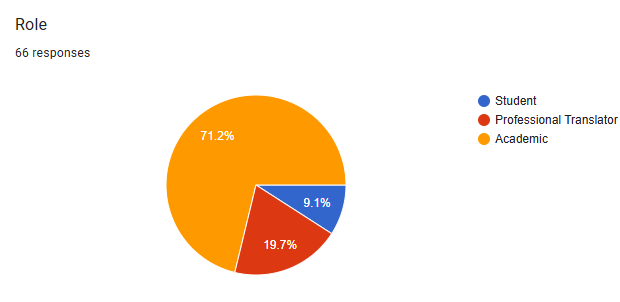
Abstract: This study examines women’s contributions to translation studies and the extent to which gender shapes translation practices, visibility, and scholarly recognition. Building on feminist translation theory (e.g., Simon; von Flotow; Godard), it traces historical and theoretical trajectories from Quebec to Arab contexts and outlines core strategies—supplementing, prefacing/footnoting, and the contested “hijacking”—that foreground translator agency. Empirically, a quantitative survey (n = 66; academics 71.2%, professional translators 19.7%, students 9.1%) using 5-point Likert items assessed perceptions of women’s impact, stylistic differences, training, and mentorship. Results indicate broad agreement that women have significantly advanced translation studies, though recognition remains uneven. Respondents commonly perceive stylistic differences between male and female translators, attributing them more to socialization than innate ability. Opinions on mentorship availability are mixed, yet there is strong endorsement for integrating gender awareness into translator education and ethics, and high interest in related workshops. While many participants have not personally been influenced by a female translator or scholar, a clear majority believe gender diversity enhances the field. The study argues that translation should not be dominated by any gender and calls for inclusive curricula, expanded mentorship, and sustained cross-cultural research on gendered translation strategies—particularly within Arab and Iraqi contexts—to strengthen equity, translator visibility, and the quality of translational outcomes.
Keywords: translation studies; feminist translation; gender; translator visibility; strategies; authorship; interdisciplinarity.
المستخلص: تفحص هذه الدراسة إسهامات المرأة في دراسات الترجمة ومدى تأثير النوع الاجتماعي في ممارسات الترجمة ومرئية المترجم والاعتراف الأكاديمي. وانطلاقًا من نظرية الترجمة النسوية (سيمون، فون فلوتو، غودار)، تتتبّع الدراسة المسارات التاريخية والنظرية من كيبيك إلى السياقات العربية، وتعرض استراتيجيات أساسية—هي الاستبدال/الاستكمال، والتمهيد والتذييل، و«الاختطاف» المثير للجدل—التي تُبرز فاعلية المترجم/ة. تجريبيًا، استخدمت الدراسة مسحًا كميًا (ن=66؛ أكاديميون 71.2%، مترجمون مهنيون 19.7%، طلاب 9.1%) بمقياس ليكرت من خمس درجات لتقدير تصورات التأثير، والفروق الأسلوبية، والتدريب، والإرشاد المهني. أظهرت النتائج اتفاقًا واسعًا على أن النساء أسهمن بشكل ملحوظ في تطور دراسات الترجمة، مع بقاء الاعتراف غير متكافئ. ويرى المشاركون فروقًا أسلوبية بين المترجمين الذكور والإناث تُنسب في الغالب إلى التنشئة الاجتماعية لا إلى القدرات الفطرية. وتتباين الآراء بشأن توفر فرص الإرشاد، مع تأييد قوي لإدماج الوعي بالنوع الاجتماعي في تعليم المترجمين وأخلاقيات الممارسة، واهتمام مرتفع بالورش ذات الصلة. وبينما لم يتأثر كثير من المشاركين مباشرةً بمترجمات أو باحثات، يرى غالبية واضحة أن التنوع الجندري يُثري الحقل. وتخلص الدراسة إلى رفض هيمنة أي جنس على الترجمة، وتدعو إلى مناهج شاملة، وتوسيع الإرشاد، وبحوث عابرة للثقافات حول الاستراتيجيات الجندرية—لا سيما في السياقات العربية والعراقية—تعزيزًا للإنصاف ومرئية المترجم وجودة المخرجات الترجمية.
الكلمات المفتاحية: دراسات الترجمة؛ الترجمة النسوية؛ الاستراتيجيات الترجمية؛ النوع الاجتماعي؛ مرئية/حضور المترجم؛ التأليف؛ التداخلية/البينية المعرفية
1. Introduction
Women write and translate just as men do after the rise of feminist translation theory that provided a new insight for translation studies. They also contend and fail just as men do. When their work will no longer need to be carefully considered separately from that of men, they will truly have achieved equal opportunity though there is no end to this discrimination has yet been imminent. Looking at the history of literatures from the perspective of translation, we cannot close an eye to the role of women translators. Women’s influence in any literature has been obvious but simultaneously their contribution was, and in many cases still is overlooked and their names are often unmentioned.
Conferences have been and are being organised all over the world and even in Canada, where many scholars agree that exciting feminist strategies have been used and resulted in important studies in feminist translation, particularly when Luise von Flotow has edited a new book of essays on Translating Women. Women’s challenging relationship with language has come into sight as a central preoccupation of the feminist translation. Women’s translation lay the foundation of its image in issues of identity and difference.
Feminist writers such as Chamberlain 1988; Godard 1990; Lotbiniere-Harwood 1991; Simon 1996; von Flotow 1997 have determined the connection between translation and woman. They think that gender conflict is the essence of the combat for power and supremacy of men over women. Feminist campaigns have been the cornerstone to bring about major changes in the path of feminists’ rights, particularly in the West. The statement of feminist was not established out until the end of 19th century.
The feminist movement began in America during the 1970s, posing a deep influence on the academic as well as art development. The spread of the feminist thought has helped the development of language and the integration of thought and language. However, translation studies have become essential in studying culture. Subsequently, the issue of the expression of the gender in translation came to surface.
The notion of feminist awareness is associated with the time when the concern for women’s role emerged in the earlier ages. And during 1970s, a number of scholars and translators showed interest in the feminism and translation studies. They conducted studies that led to a great influence on the original concept of translation. It is of particular interest that two major books on translation – “Gender in Translation: Cultural Identity and the Politics of Transmission (1996)”, by Sherry Simon; and “Translation and Gender: Translating in the ‘Era of Feminism (1997)”, by Luise von Flotow – have definitely put the concept of women translation in motion. A long list of publications, which investigate steadily more aspects, has followed.
Simon (1996: 8) put the gender of translation comprehensively. She indicates that translation is not just related to linguistic issues in a narrow sense, but instead, the range of issues related to gender should also be concerned. As the character of women had always been demoted for the most part of human history, and even until the present time, women should have defied for much more rights than they did in the past as women’s role is still highly overshadowed by men’s dominant position in society due to social norms. For the translator, the choice of language is made in accordance with social norms and expectations, and the translation process inevitably works through and reflects the translator’s ideology.
-
- Globalisation and the internationalisation of translation
Many differences could be seen when a translation is performed by a female translator or a male translator. In some circumstances, the male translators may ignore the female characters in the books paying less attention in translating some specific phrases or sentences. In a highly globalized world, it is still appropriate to ask whether a discussion between academics working in the field of gender and language and in that of gender and translation has yet taken place; and if so, how fruitful these interdisciplinary debates have been. Thus, not all academic work done in these two fields originate from a feminist standpoint (Mills and Mullany 2011:2).
Within the scope of the globalisation and the internationalisation of translation, it can be asserted that ‘we all live in “translated” worlds’ (Simon 1996:135). Language and translation definitely are tools for justifying the status quo or for impairing it; tools for gender domination or liberation. Not all scholarly work done in the fields of language and translation originates from a feminist standpoint (Mills and Mullany 2011:2).
1.2. Socio-cultural and historical factors
Socio-cultural and historical factors absolutely have an effect on women’s translation studies since translated works can influence and be influenced by gender and beliefs. As Minas (2000:4-5) puts it, gender describes the biological socially-constructed aspects of femininity and masculinity differences which are different.
One of the study’s objectives is to lay the stress on women translator’s subjectivity and her roles and to show that translation studies are not to be categorised according to the gender of the performer whether it is a male or a female. The other purpose is to reveal and repair the identity of feminist translation that has been distorted by the supremacy of men. The third and the last objective is to bring up a thorny issue that has not been thoroughly investigated by researches.
The aim of women’s movement is the support of women’s rights in order to bring to an end social unfairness toward men and to achieve equality in various fields of knowledge. Feminists want to defend the women’s role with the purpose of cultivating their status and making their voice and presence heard and felt being a part of the society.
By presenting translation works made by western female writers and translators, the study endeavours to encourage female translators to break the unfairness imposed by the society in not treating women on equal basis with men. Such preference includes discrimination in treating women by virtue of what was referred to by Coates (1997:203) who states that men and women talk differently with different rules because they belong to different subcultures.
1.3. Methodology
This study will employ a quantitative research approach using a survey questionnaire based on a 5-point Likert scale by using a bar chart. The goal is to measure perceptions of gender-based differences in translation work and women’s contributions to the field. One of the procedures is carried out by analysing the outcome of the questionnaire to be conducted to show how linguistic markers of gender have branded women’s contributions to translation studies.
For quite some time gender difference in language use has been an issue that has claimed men and women have different ways of lingual communication. By using research methods, questionnaires and data analyses, it is distinguished that the words and phrases that are preferred by women and men are different in so many ways. In so many cultures it is stereotypically assumed that women are politer than men and as a consequence of this stereotypical belief, this assumption leads the growing adolescents to be politer if they are females and less polite than females if they are males.
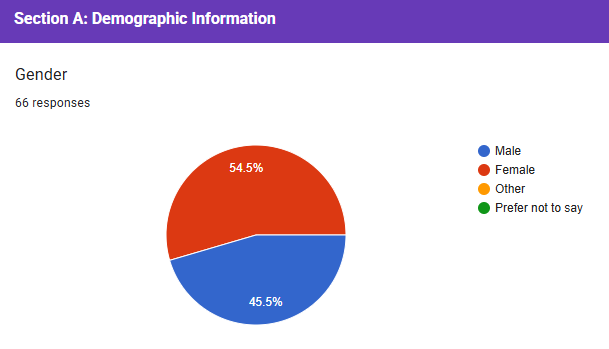
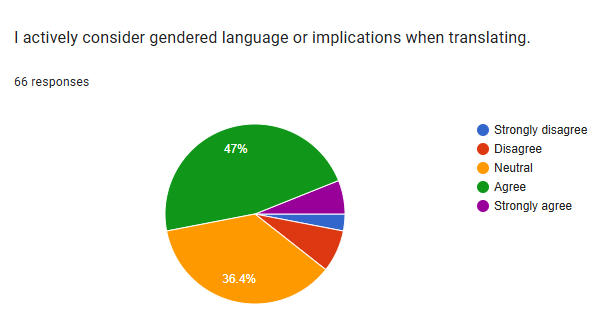
The questionnaire consists of statements related to gender differences in translation studies, and respondents will indicate their level of agreement using a 5-point Likert scale. The study has targeted translation’s male and female students, professional translators, and academics in the field of translation studies. A group of participants, aged 18 to 75 with 1 to 35 years of experience, aims to provide a comprehensive comparison of gender-based contributions. Participants responded to 20 questions divided into 4 sections as illustrated by the pie charts below:
For many years, studies on feminist translation have been marginalized, and by getting the responses of various actors on this topic, it would be easy to describe and portray the aim of the study. The researcher will adopt a model he defends to be the most adequate for the analysis.
1.3.1 Data analysis
The following electronic questionnaire was distributed to answer the questions raised:
The questionnaire aims to collect comprehensive data on the contribution of women in translation studies, the influence of gender on translation work, and the challenges faced by female translators.
1.3.2 Discussion and Results
Section (A) includes a total of 66 responses for the gender demographic questions:
- Female: 54.5% of respondents identified as female.
- Male: 45.5% of respondents identified as male.
Academics comprise the largest group, representing 71.2% of the total respondents, which corresponds to approximately 47 individuals. Professional Translator represent the second-largest group, accounting for 19.7% of the responses, which translates to about 13 individuals while students form the smallest group, making up 9.1% of the total, corresponding to approximately 6 individuals.
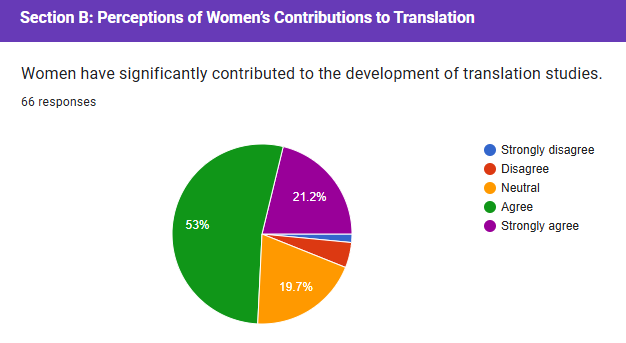
Based on the provided survey, the results on Section (2) indicate a strong perception that women have significantly contributed to the development of translation studies, with the majority of respondents expressing agreement or strong agreement. While a majority of respondents perceive that women’s contributions in the academic community are equally recognized and valued, a notable portion of the surveyed individuals hold differing views, indicating a diverse range of perspectives on gender equality within this context.
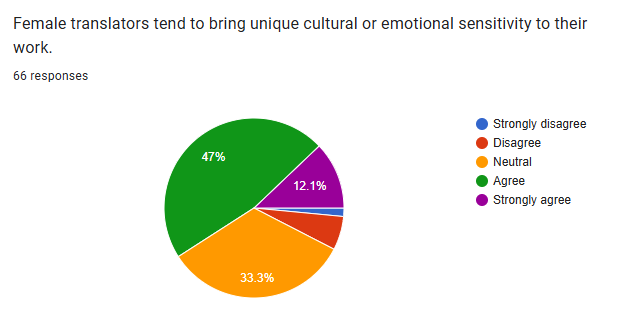
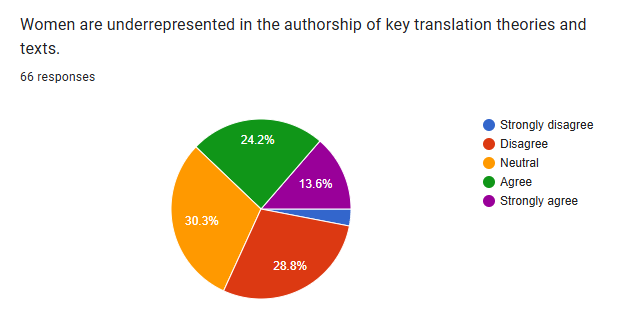
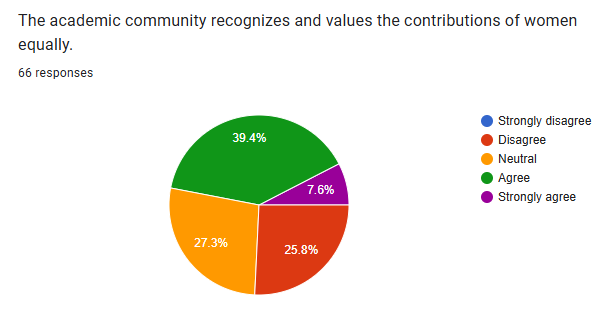
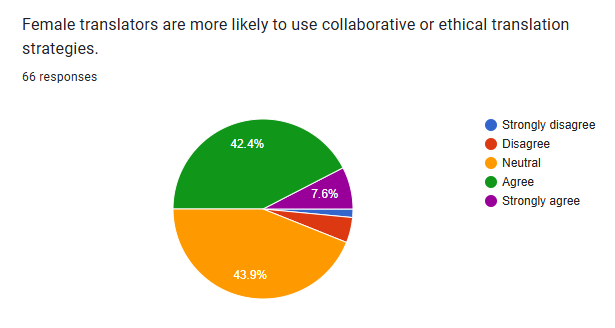
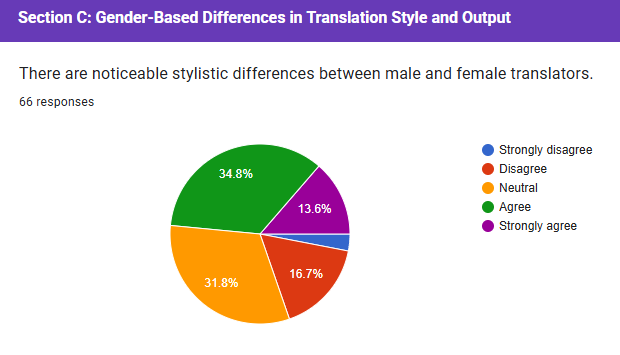
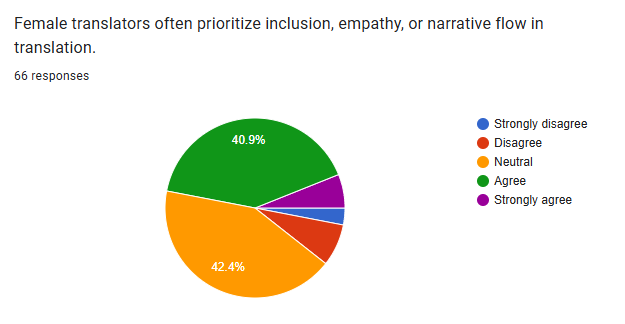
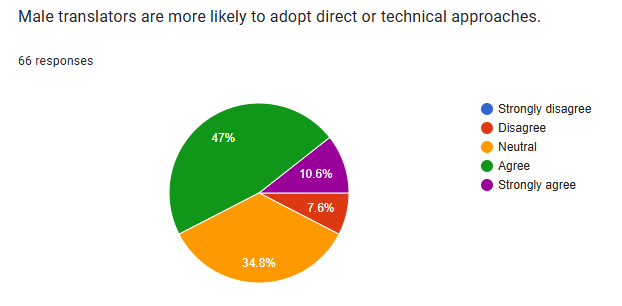
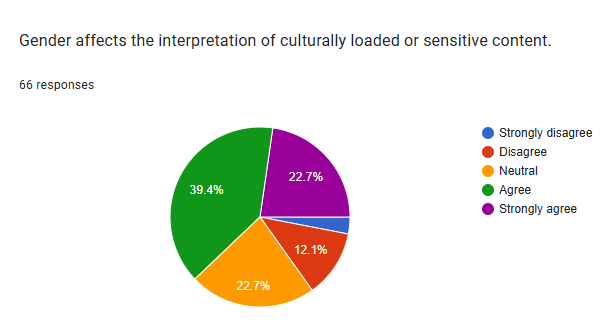
Section (C) tackles gender-based differences in translation style and output, specifically stylistic differences between male and female translators. A significant portion of respondents believe there are noticeable stylistic differences between male and female translators
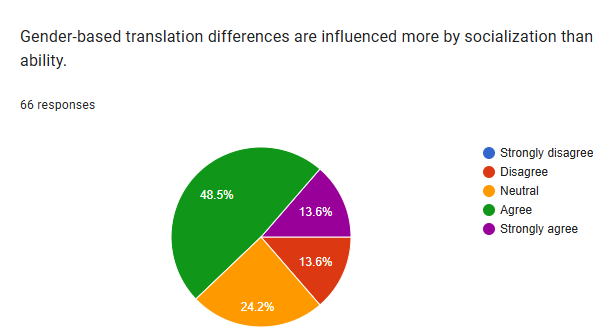
The majority of respondents agree that gender-based translation differences are more influenced by socialization than ability. This suggests a prevailing belief among the surveyed group that social factors play a more significant role than inherent capabilities in explaining any differences observed in translation based on gender.
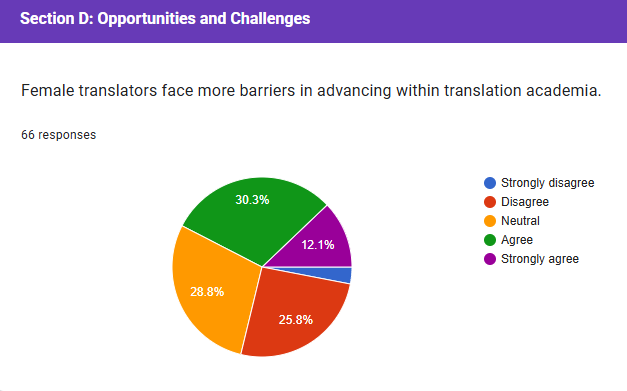
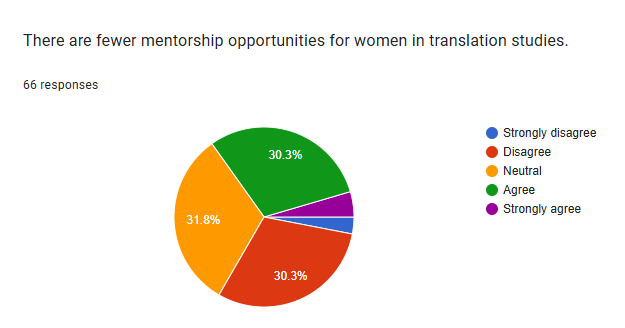
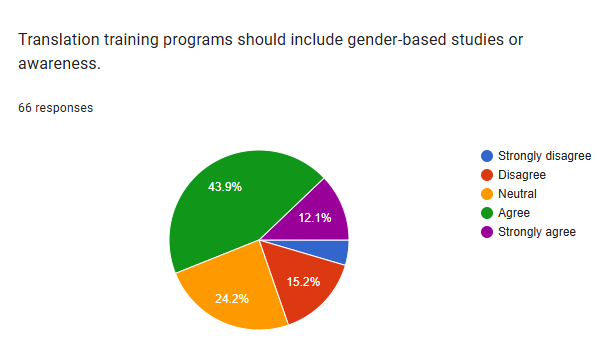
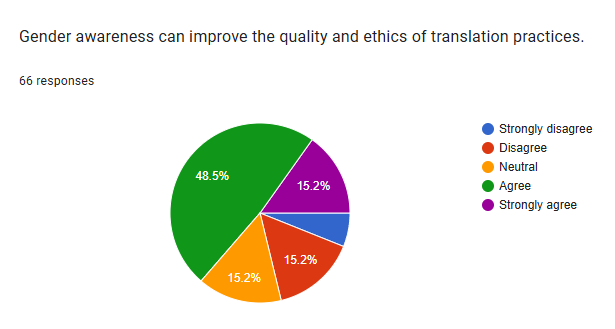
In Section (D), the survey results indicate a divided opinion among regarding the availability of mentorship opportunities for women in translation studies. Respondents express a positive view, suggesting a significant portion believes in the importance of gender awareness in translator education. A significant majority of respondents strongly agree that gender awareness can improve the quality and ethics of translation practices.
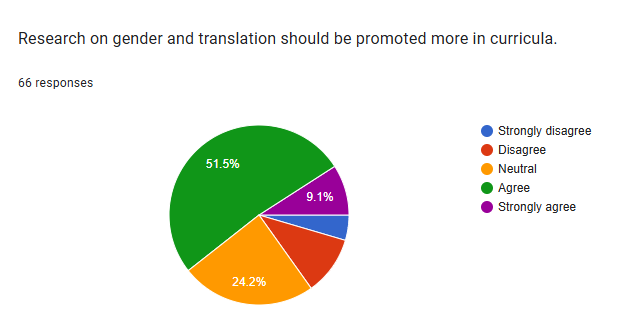
The largest portion of respondents agreed with the statement, indicating a significant desire for more focus on gender and translation in academic curricula.
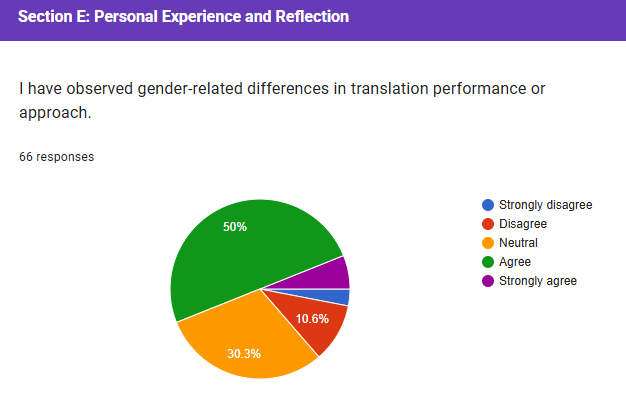
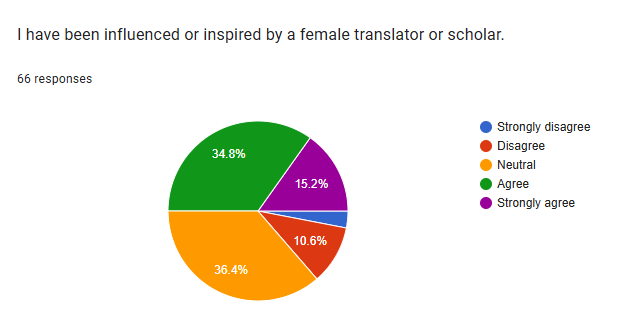
The last section (E) shows that a large majority of the respondents either perceived gender-related differences in translation or held no strong opinion against it. While a significant portion remained neutral, a combined majority of respondents either strongly disagreed or disagreed, suggesting that a substantial number have not been influenced or inspired by a female translator or scholar, according to this survey.
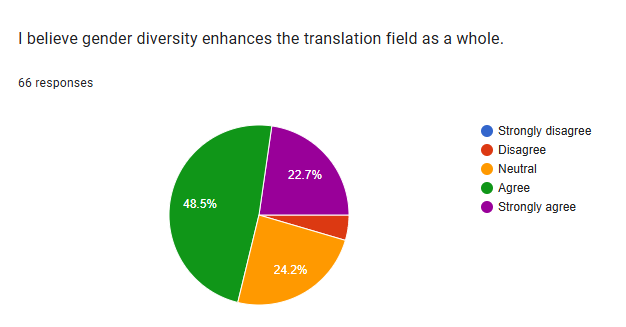
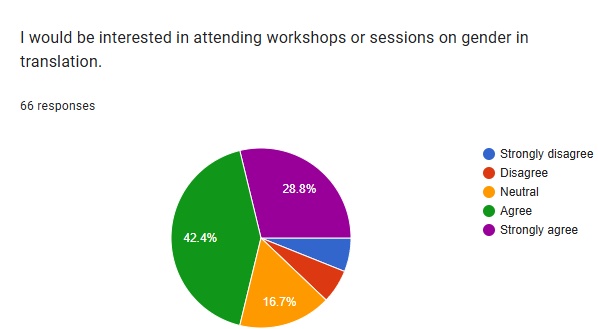
The majority of respondents agree or strongly agree that gender diversity enhances the translation field. The survey indicates a strong positive interest in workshops or sessions on gender in translation, with the majority of respondents either agreeing or strongly agreeing to attend.
2. Feminist Translation
Feminist translation has been and will likely remain a very creative paradigm. It has generated a knowledgeable theory, a series of translation strategies or techniques, an active and powerful practice, a body of critical reactions, a female ancestry of writers and translators, a movement for gender equality in translation, and so on. It is a clear example of commitment and responsibility, and establishes for many a new ethics of translating.
Massardier-Kenney (1997) did not back the idea that feminist translation studies presented any new strategies but used the old ones instead. She put these strategies into two categories: “author centric (collaboration, commentary, resistancy) and translator-centric (recovery, commentary, parallel-texts)”. Commentary rejects the notion of an opposition between the writer and translator and supports the collective and creative nature of translation. It utilises a preface, translator’s note or footnotes which go with the feminist translation (Massardier-Kenney, 1997).
The translator takes advantage of these translation discourses in the translation practice to make her presence felt, and to explain references or aspects of the source culture. Resistancy was presented by Venuti (1999) who describes the strategy of translating a text in a way that it preserves its foreignness by using lexical ambiguities, neologisms or fragmented syntax. Recovery describes the process of publishing women’s writings which have remained untouched so far. The strategy of working with equivalent texts is choosing those works in the target language which are created in a similar situation.
2.1. History of Feminist Translation
The development of gender-based translational issues that dealt with feminist translation has developed the most in Quebec. Between the 1970s and the early 1980s, women authors in the region decided to explore and theoretically discuss power relations and its effect on translation and female translators. This could have been in view of the language reforms, the bilingual nature of the region or the spread of women’s movement and acceptance of other sexualities in addition to gender identities.
Feminist translation is therefore a means by which women from all social groups could make their voices heard on issues related to gender and feminist approaches to translation. However, gender-based translations are not certainly reviewed as feminist since feminist translations give a wider supremacy for women; and thus, von Flotow (2011) describes translation as a form of social engagement.
Ma (2010: 217) has pointed out that as feminists seek to overthrow the submission of women to men, feminist translation theorists seek to subvert the power of the original texts over the translated ones by studying the function and value of translation in history. Then feminist translators embraced strategies in translation including a secondary text adding, hijacking and supplement. Feminist theory in translation studies came to light just at the same time of feminism in the 1970s to publicise their need for equal rights between men and women.
Women translators like other professionals in translation have a crucial responsibility, as they do not only concentrate on reproducing translation discourses with their own practice, but keenly contribute to shaping it. Agorni (2002) elaborated on this by tracing these negotiations in the past, adding that the discussions can be discovered through the analysis of contextualized translations, projecting “localized” or nonliteral images of translation (Tymoczko 1999, 2000) which produce a marginal(ised), yet crucial, perspective on translation history.
It is worth mentioning that this kind of study is particularly difficult, for a number of reasons not least because women (in common with many men) did not publish their translations under their names, and rarely intervened in men’s main territory of translation theory. Yet, it is just such a lack of “primary” historical sources that works as an incentive for critics to bear in mind secondary, marginal(ised) sources, such as private letters, reviews, and biographical material (autobiographies, memoirs, etc.).
2.2. Theorising feminist translation
Feminist translation is one of the interesting and widespread practices that helps researches incorporate and find answers to questions about language, culture, gender, identity and sexual equality. Feminist research methodologies have powerfully engaged in all social and cultural aspects, including Translation Studies.
Although Feminist Translation Studies first began in Quebec in the 1970s and 1980s, as a direct consequence of women writers’ experimental writing wishing to rewrite femininity in language and to review the male-dominated discourse through cognitive manipulation of language. Canada and Spain are considered the first two countries where translation issues and the notion of gender have been most fruitfully discussed. Luise von Flotow, Barbara Godard, Sherry Simon, and Jose Santaemilia, among others, were the leading scholars dealing with gender concept.
This paper reintroduces women as the benchmark of gender difference in translation studies by studying feminist historic achievements in translation, analyzing and proposing new theoretical directions. Bassnett (1991: 37) sees that any translation theory should decide on the processes undertaken in the process of translation and not to lay out a set of guidelines for implementing the ‘perfect’ translation.
2.3. Theoretical backgrounds of Arab and Iraqi feminist translation
According to Munday (2009:192), women’s taking part in the act of translation has addressed four main angles. The first one examines the role of female translators themselves and their historical restrictions. However, the scarcity of academic texts on the issue of feminist translation can be overtly seen in the works of Arab writers such as Fatima Mernissi’s attempts to challenge the historical oppression of women with publishing books such as “The Forgotten Queens of Islam” (Mernissi, 1994), and the many collections and volumes written on presenting the one-sided image of women. The second angle seeks to restructure the ideological and historical relationship of translation with the social construction of gender, so that the feminist translator is not only leading to social change but revealing the traditional reasons behind the status quo. The third angle is that of assessing the translation of feminist texts involving this category.
As one of Canada’s most renowned poets, and also a translator, Moure (2012) argues that, “Choosing what to translate is a political act, it’s a community act. It’s an act that’s culturally formed” but according Spivak (1999:406), translating in the Arab world and India is “often a political exercise of a different kind”. In both regions, translators have dealt with a diversity of ethnically different political and cultural ideologies that have clashed with global ones and embraced them at a point in time, such as the socialist rules in Iraq, Syria and Egypt. Both regions have a high formal language and different dialects that act as everyday languages coloured by geographical influences outside its borders.
Kamal (2016:60) has adopted Godard’s notion about feminist translation theory which says that translation as re/writing is a groundbreaking contribution to the emergence of theorizing about feminist translation praxis. Godard (1990) defines the concept of ‘womanhandling’ regarding self-confidence and visibility in the texts – concepts that strongly contradict the traditional conventions of translation practice based on the ideas of invisibility and equivalence.
In her study, Abou Rached (2018:4) analysed the different strategies used to discuss six Iraqi women writers’ novels and story-telling in English translation. She used and examined analytical frameworks of feminist translation which are supported by the theoretical assumptions that all writing, including translation are gender-specific modifications of socio-linguistic, gender-based and “intersectional dynamics of power. These assumptions create barriers between gender-oriented writing and translation as unreliable, confusing and variable in ways significant to Iraqi women writers. Therefore, devices of feminist translation alongside Iraqi and Arab women’s literature in English translation still need extensive analysis.
It is noteworthy to indicate here that translation studies and feminist translation studies as academic disciplines and fields of enquiry are also still in stages of emergence. Although an established discipline in its own right (Baker, 2009: 1), translation studies often reflects the movement of language and communication itself and so is cited by Mona Baker as “falling within or crossing” many other academic field of knowledge such as literary criticism, philosophy, sociology, anthropology, as well as that of linguistics.
From an interchangeable postcolonial standpoint, such a feminist translation connection with genres of Arab women’s writing is suitable as feminist translators often challenge linguistic (neo/ colonial) power relations by translating texts (by women or about women and other marginalised identity groups) from less translated languages or literary standards, stressing its importance in a preface or afterword (Shread 2011: 287). It is essential to remember here that a (feminist) translator’s assertion of her/his activist agenda does not mean all texts or writers s/he translates are claimed or identified as having a clear feminist ideology.
The conclusion argues how a praxis-based critical approach of engaging Iraqi women writers’ novels in Arabic and English translation alongside feminist translation approaches of re/writing offers new critical perspectives to existing scholarship, contributing new knowledge and potential directions for future research in Iraqi and Arab (women’s) literature and translation studies alongside other related academic fields, such as gender studies and feminist postcolonial literary critique.
3. Women’s translation strategies and practices
The paper sheds light on the strategies and practices adopted in feminist translation that was developed and formulated by the pioneer feminist translators/theoreticians such as Luise von Flotow and Barbara Godard. The combination of feminism and translation studies has resulted in the rise of feminist translation theory which highlights the translator’s visibility and subjectivity. Here, we adopt von Flotow’s three major approaches used in feminist translation which are: supplementing, prefacing and footnoting, and hijacking to demonstrate that men have governed linguistic expressions and translational norms.
3.1. Women’s translation strategies
The notion of translation strategies has considerably contributed in Translation Studies since the gap between theory and practice has been filled. Feminist translation strategies fulfill different purposes. Leonardi and Taronna (1997) describe the use of the so-called feminist translation strategies. According to von Flotow (1991), the major feminist translation strategies are “the use of textual compensation; the use of prefaces and footnotes; and the ‘hijacking’ of the original meaning”. CAO Shuo (2017:32) sees that feminist translators are engaged into translating the works under the concept of feminism.
3.1.1 Supplementing
Being a feminist translation strategy, supplementing, as is a direct involvement into the translation project in favour of creating awareness. Von Flotow’s main approaches adopted by feminist translation are mainly intended to unearth evidence that males have controlled linguistic expressions and translational norms. Wu, E-chou (2013:1-12) states that von Flotow’s strategies include: “a) reviewing source texts in the dual contexts by a) supplementing, b) making the ignored female characters heard by prefacing and footnoting, and c) challenging gender representations of the original text by hijacking”.
Supplementing is basically an interference of the translator so as to eliminate the differences between source language and target language, also invalidation of sexist language. Use of italics, capital letters, changing letters is very common, such as huMAN rights, bay – BAYan, author – autHER. Supplementing is, therefore, a courageous move to make the feminist experimental effect. Von Flotow (1991: 69-84) explains that despite the fact that a language doesn’t have precisely the same problems of gender or word origin, there are other places in the text where a similar shift of language can be achieved.
Kamal (2016:60) defines the feminisation of Arabic as the insertion of women, and the assertion of their presence in the translated text. Instead of implying that the neutral form of the noun, adjective and verb in English implies masculine forms, Kamal decided in her feminist translation to constantly assert linguistically the feminine presence as long as there are no references in English of the masculinity of the lexical items in question. Thus, she has steadily chosen, in her feminist translation (and her writing in general), to include women in the text. She would therefore translate the phrase “the translator selects” as “tantaqi al-mutarjima aw al-mutarjim” or “yantaqi al-mutarjim aw al-mutarjima”, which in back translation would become “the (feminine) translator or the (masculine) translator” or “the (masculine translator) or the (feminine) translator”, while the verb which precedes the first noun would take its form in terms of femininity or masculinity.
3.1.2. Prefacing/Footnoting
von Flotow (1991) sees prefacing and footnoting as a normal practice in feminist translation. Prefaces and footnotes address the translation process as they are used to show translators’ identity and their contribution to the source text. Meanwhile, it stirs up the portrait of the intended reader. However, prefacing and footnoting is a strategy to explain the author’s intention, deliberately presenting and calling the readers’ attention to the translation strategy. It shows the translator herself, rather than the author, who is talking to the reader. In this case, feminist translation makes the translator as well as the feminine apparent in language. The translator is given authority as well as the real author (Simon 1996:15).
Preface usually has a didactic aspect, where the work of the writer and the translator are discussed and put into context. Various problems faced while translating a text, such as a divergence of ideology or the presence of puns or neologisms are discussed here, and the strategies used for translation are explained. The translator thus draws the readers’ attention to the translation process.
von Flotow (1991:76) affirms the idea that feminist translators “reflect on their work in a preface, and to confirm their active presence in the text in footnotes;” in doing so they can womanhandle the text to deliberately produce their own meaning. In addition, through footnotes the translator becomes an interferer, the translation an intertext, and the feminist translation “an educational tool supported with scholarly research” (ibd: 77).
3.1.3 Hijacking
Von Flotow (1991) proposed a third feminist translation practice known as ‘hijacking’. In hijacking, target text is rephrased with elements of women’s movement and thus it is all unrelated to the source text. Thus, von Flotow (1991) uses the term, hijacking, in order to show the direct role of the translator. In case of hijacking, the source text is not absolutely a feminist one. An unbiased even a sexist text can be hijacked in order to appropriate a text whose purposes are not necessarily feminist by a feminist translator for the purpose of creating awareness and making the woman/translator visible.
The third strategy is a controversial practice of feminist translation as it is rejected and criticized by many scholars, who have termed it hypocritical and elitist. Hijacking is a tool to directly intervene in the text to change the original and to twist the text into speaking too forcefully in the feminine. Flotow described it as a practice, where the translator gives herself the freedom to produce a creative work that speaks for itself.
Thus, she achieves by collaborating with the author as well as challenging them. Flotow reformulated it in 2005 and called it a conscious intervention in the text to incorporate feminist politics where there are none or when they are not noticeable. Even though the writer is a feminist herself, the translator still intervenes in the text to “correct” it and to avoid the generic masculine. Through this open manipulation of the text; Lotbinière-Harwood undertook a political activity, which was directed at making the language speak for women. This strategy is particularly risky. In the above-mentioned example, it worked since the author was willing to give up her textual authority in favour of the translator’s radical one towards the language.
3.2. Translation practices
Feminists’ actual translating practices are now receiving more attention than in the past – what remains to be seen is whether there is a gap between theory and practice. If we take Un cuarto propio, the first Spanish feminist translation of Virginia Woolf’s A Room of One’s Own, we can observe a few tendencies which might be summing up the feminist translators’ job:
- there are two basic techniques that are systematically used by feminist translators – e.g. prefacing and footnoting (or commentary), and supplementing (or compensation). Both constitute textual (supplementing) and extra-textual (prefacing and footnoting) strategies that contribute to the effective feminisation of the text and context, and to the visibility of both author and translator. Common resources are prefaces, footnotes, front and back covers, reviews, titles of book and collection, names of author and translator, gender-specification, linguistic refeminisation, and so on.
- despite appearances, there is practically no ‘hijacking’ in the work of feminist translators. The term, it is true, needs redefinition and reassessment, along with other concepts such as manipulation, resistance, conflict, difference, etc.
- in its attempt to feminise the whole text, Un cuarto propio offers a biased – though not deformed – picture of literary tradition, with more emphasis on women writers and feminist activists.
- many feminist translation projects stem from a strong and militant identification between translator and the author being translated. In Un cuarto propio, the translator (Mª Milagros Rivera Garretas) claims a strong feminist link between herself and Virginia Woolf.
- With regard to the approaches used by women translators, it is not the strategies themselves that are feminist, assuming the concept of feminist itself is clear and non-controversial, but somewhat the use to which these strategies are put. (von Flotow, 1991.74)
Flotow mentions three levels on which the category of gender can be researched in translation studies: “by focusing on gender as a sociopolitical category in macro-analyses of translation phenomena, such as the production, criticism, exchange, and success of works, authors and translators; by examining gender issues as the site of political or literary/aesthetic engagement through micro-analyses of translated texts; and by shaping the theories applied to or derived from translation praxis.” (Flotow cited in Baker/Saldanha, 2011:123).
4. Gender and Translation
Gender is an aspect which influences almost every part of our lives and it is not uncommon that it is considered important while finding a job or fitting in a social group. According to Castro (2013:7), the issue of gender and translation has been receiving critical consistency and experiencing a remarkable growth in the past few years, a strong proof that it is a productive field of study. Gender in Translation (Simon, 1996) and Translation and Gender (von Flotow, 1997) are the first attempts to link feminist politics and translation visibly. In Translation and Gender, von Flotow (1997: 8-12) identifies two ways to approach the issue of women and language: the reformist approach and the radical approach.
By shedding light on the relationship of gender-specific language and translation, it should necessarily define the notion of gender and its importance in the context of translated texts. This trend has not only enabled writers to publish tentative feminist works with different linguistic codes but has also allowed feminist translators to implement a series of translational strategies to address the process of constructing meaning in the activity of transformation.
4.1. Visibility of women in translation
Lotbinière-Harwood (qtd. in Gauvin 1989:9) states that translation practice is a political activity aimed at making language speak up for women. Thus, seeing a woman’s name on a translation work means that this translation has used every possible feminist translation strategy to make the feminine visible in language. She supports the idea of feminine visibility in language which means making women seen and heard in the real world.
“My translation practice is a political
activity aimed at making language speak for women.
So my signature on a translation means:
this translation has used every translation strategy to
make the feminine visible in language” (Lotbinière-Harwood qtd. in Gauvin 1989: 9).
In addition to the issue of gender representation in translation, Rani and Fauzi (2017:274) see that visibility or invisibility of gender on the part of the translator is another argument that has been developing in Translation Studies with the evolution of post-colonial translation theories. It has also become a part of the overall discussions in women studies and feminist literary theory.
4.2. The role of translator’s gender in the outcome of translation
Although rather rarely studied, gender has played its role in translation studies and becomes a new filed to be studied more. Gender is related to some aspect such as language itself, the differences between male and female languages. Until feminism became recognized as a field in the 20th century, little attention had been given to the role gender plays in translation.
Rani and Fauzi (2017:275) support the notion that different sex leads to variations in the use of language. In practice, men and women tend to use language differently. Men and women have their own differences in how they say things. One of the most recent findings indicates that both of them have different brain. Furthermore, the way of translator whether male or female would have different way of translation.
Biologically male and female has the differences, not only biologically but the language used also different. According to Saragih (2017:18), language varies with reference to sex differences of the speaker. He elaborates on that by upholding the idea of women’s tendency to follow the rules and they are proud of their womanhood by abiding to them. On the contrary, men tend to challenge the rules by creating new ones and are proud of their manhood by breaking old rules.
Therefore, men do not care about making more grammatical errors than women. On the other hand, women use a language that is most probably involved in narrative text whereas men tend to construct expository text by which they try to change the world.
4.3. Iraqi women translators’ contribution to translation studies
Iraqi women translators have made significant contributions to the field of translation studies in various ways. Their work spans across academic, literary, and practical domains, impacting both the theory and practice of translation. Here are some key contributions:
- Cultural Mediation: Iraqi women translators often act as cultural mediators, bridging the gap between Arabic-speaking and non-Arabic-speaking worlds. They translate works that introduce Iraqi culture, literature, and socio-political issues to a global audience, fostering greater understanding and appreciation.
- Literary Translation: Many Iraqi women have translated important literary works from Arabic to other languages and vice versa. This includes poetry, novels, and other forms of literature that give voice to Iraqi experiences, especially those of women. Their translations help to preserve and disseminate Iraqi literary heritage.
- Academic Contributions: In academic circles, Iraqi women translators contribute to translation studies by researching and publishing papers on various aspects of translation theory and practice. They explore issues like the translation of gender, the politics of translation, post-colonial translation theories, and the representation of Iraqi identity in translated texts.
- Feminist Translation: Some Iraqi women translators focus specifically on feminist translation, ensuring that the nuances of women’s experiences and voices are accurately and sensitively conveyed in translation. This can involve translating works by Iraqi women writers or feminist texts from other languages into Arabic.
- Training and Mentorship: Iraqi women translators also contribute by training the next generation of translators. They teach in universities and conduct workshops, sharing their expertise and encouraging others to enter the field of translation.
- Participation in Translation Projects: Many Iraqi women are involved in large-scale translation projects, including those initiated by international organizations, cultural institutions, and publishing houses. Their participation ensures that a diverse range of voices and perspectives are included in these projects.
- Advocacy and Representation: By participating in conferences, symposiums, and translation associations, Iraqi women translators advocate for greater representation and recognition of translators from the Arab world. They highlight the specific challenges and opportunities that arise in the context of translating from and into Arabic.
These contributions are essential for the development of a more inclusive and representative field of translation studies, one that acknowledges and values the diverse voices and experiences of translators from different cultural backgrounds.
Some of the famous Iraqi women translators include:
- Salma Khadra Jayyusi: A prominent Palestinian-Iraqi poet, writer, translator, and literary critic. She is known for her translations of Arabic poetry into English.
- Dunya Mikhail: An Iraqi-American poet and translator known for her work translating contemporary Iraqi poetry into English. She has received numerous awards for her translations.
- Fawzia Assaad: An Iraqi translator known for her translations of Arabic literature into English. She has translated works by renowned Arab authors such as Naguib Mahfouz and Tayeb Salih.
These are just a few examples of notable Iraqi women translators who have made significant contributions to the field of translation.
Conclusion
Translation should not simply be dominated by a certain gender, as this reinforces male dominance and oppression of women through the lens of gender, a trend that has been built into a long history with the former being the superior gender and the latter the inferior gender.
Though the paper it is an attempt to show feminist influence on translation and translation studies and to analyse translation strategies and practices of female translators, more efforts should be made into this field. Research of this filed can be done in wider extent and from different directions, for example, whether female translators utilise different strategies to deal with texts related to women, such as the gap between female translators with apparent feminism thought and those without that.
Scholars in the translation field have emphasised the close relationship between translation and woman. They understand that the gendering and sexualisation of translation explicitly define the logical gender-based differences, the essence of which points to the struggle for power and domination of one sex over the other. However, the interdisciplinary study of intersection between translation and feminism can maximize the best strategy to give power to both women and translators are yet to be explored.
References
Abou Rached, R. (2018). Iraqi women’s stories: reading Iraqi women writers’ Arabic novels in English translation using analytical perspectives of feminist translation. PhD thesis, unpublished. The University of Manchester, U.K.
Agorni, M. (2002): Translating Italy for the Eighteenth Century: British Women, Translation and Travel Writing, Manchester, St Jerome.
Baker, M. (2009). ‘Resisting State Terror : Theorizing Communities of Activist Translators and Interpreters’, in Esperanza Bielsa and Christopher W. Hughes (eds) Globalisation, Political Violence and Translation, Basingstoke, Hampshire: Palgrave Macmillan, 222-242.
Baker, M. and Saldanha, G. (2011). Routledge Encyclopedia of Translation Studies (second edition. London/New York: Routledge.
Bassnett, S., and Lefevere, A. (1990). Translation, History and Culture. London: Printer Publishers.
CAO Shuo (2017). A Study of Translation Strategy in Eileen Chang’s The Golden Cangue from the Perspective of Feminist Translation Theory. Retrieved from Cross-Cultural Communication. Vol 13, No 8 (2017): Cross-Cultural Communication.
Castro, O. (2013). “Introduction: Gender, Language and Translation at the Crossroads of Disciplines.” Gender and Language, 7(1), 5-12. Vol. 7 No. 1 (2013): Special Issue: Gender, language and translation at the crossroads of disciplines.
Chamberlain, L. (1988). “Gender and the Metaphorics of Translation”. Signs: Journal of Women and Culture in Society. 13(3): 454-472.
Coates, J. (1997). Women, Men & language, a Sociolinguistic Account of Gender Differences in Language. (2nd edition), London & New York: Longman.
Godard, B. (1990), ‘Theorizing Feminist Discourse/Translation’, in eds. Susan Bassnett and André Lefevere, Translation, History and Culture, London: Pinter.
Gauvin, L. (1989). Letters from Another. (tr. Susanne de Lotbinière-Harwood). Toronto: Women’s Press.
Kamal, H., “Translating Feminist Literary Theory into Arabic”, Studia filologiczne: uniwersytet Jana Kochanowskiego, vol. 29, issue 2, pp. 57-73, 2016.
Leonardi, V., & Taronna, A. (2014). Translators vs translatresses’ strategies: ethical and ideological challenges. MonTI. Monographs in Translation and Interpreting, (3), 377–402. https://doi.org/10.6035/MonTI.2011.3.13
Ma, H. J. (2010). Selected Readings of Contemporary Western Translation Theories. Beijing: Foreign Language Teaching and Research Press.
Massardier-Kenney, F. (1997). “Towards a Redefinition of Feminist Translation Practice”. In: The Translator, vol. 3, no 1, pp. 55–69.
Mernissi F. (1994) The Forgotten Queens of Islam. Polity Press.
Minas, A. (2000). Gender Basics:Feminist Perspectives on Women and Men. (2nd edition), USA: Wadsworth.
Moure, E. (2012). Translation is a Political Act. Youtube Video. Retrieved from http://www.youtube.com/watch?v = Bhv9BnipBAg .
Munday, J. (2009). The Routledge Companion to Translation Studies. London: Routledge.
Rani, F and Fauzi, A. (2017).”The Role of Gender in the Process Translation”. In Journal of Applied Linguistics and Language Research 4 (4), pp.: 273-282.
Santaemilia, J. & Luise von Flotow (2011) (eds.) Woman and Translation: Geographies, Voices and Identities. MonTI 3 – http://dti.ua.es/es/monti-english/monti-contact.html
Saragih, A. (2017). Variations and Functional Varieties of Language. Banten: Mahara
Shread, C. (2011). “On Becoming in Translation: Articulating Feminisms in the Translation of Marie Vieux-Chauvet’s Les Rapaces”in Women and Translation: Returning to Feminist Theory in Translation, ed. Luise von Flotow, Ottawa: University of Ottawa Press, 283-303.
Simon, S. (1996). Gender in translation: Cultural identity and the politics of transmission. London & New York: Routledge.
Spivak, G. (1999) ‘The politics of translation‘. In L. Venuti (ed.), The Translation Studies Reader. London and New York: Routledge, 397–416.
Tymoczko, M. (1999): Translation in a Postcolonial Context, Manchester, St Jerome.
Tymoczko, M. (2000): “Translation and Political Engagement: Activism, Social Change and the
Vol. 13, No. 8, 2017, pp. 32-39
Von Flotow, L. (1991) ‘Feminist Translation: Contexts, Practices, Theories’, TTR 4(2): 69-84
Von Flotow, L. (1997). Translation and gender, translating in the ‘era offeminisim’. Manchester: St. Jerome Publication. Retrieved from Academia Arena 2017;9(8) http://www.sciencepub.net/academia
Von Flotow, L. (2011) Translating Women. Ottawa: Ottawa University Press.
Wu, E-chou. (2013). Feminist Translation / Feminist Adaptation: Ang Lee’s Sense and Sensibility. Paper presented at the conference On the Move: ACSIS conference, Norrköping, June 11-13.
 Arabic
  English