
Reimagining Educational Assessment in the Artificial Intelligence Era: An Umbrella Review of Innovations and Future Directions
إعادة تصوّر التقويم التربوي في عصر الذكاء الاصطناعي: مراجعة شاملة للابتكارات والاتجاهات المستقبلية
Sami Ali1
1 Assistant Professor, Development Curriculum Committee, Al-Neelain University, Khartoum, Sudan
Email: highnesssami@gmail.com
DOI: https://doi.org/10.53796/hnsj72/38
Arabic Scientific Research Identifier: https://arsri.org/10000/72/38
Volume (7) Issue (2). Pages: 627 - 632
Received at: 2026-01-10 | Accepted at: 2026-01-20 | Published at: 2026-02-01
Abstract: The rapid and pervasive integration of advanced Artificial Intelligence (AI) tools, particularly Large Language Models (LLMs) such as ChatGPT, has created a profound disruption in higher education, rendering many traditional student assessment methods obsolete. This paradigm shift necessitates a comprehensive re-evaluation of pedagogical and evaluative practices. This umbrella review synthesizes the findings from 40 recent systematic reviews, meta-analyses, and scoping studies (2020–2026) to delineate emerging, robust assessment strategies in the AI era. The synthesis identifies three critical, interconnected themes: Adaptive and Formative Assessment, AI-Enabled Authentic Assessment, and Predictive and Diagnostic Assessment. The core conclusion is that the age of AI demands a fundamental shift from evaluating the product of learning to assessing the process of learning and the student's competency in human-AI collaboration. This review provides a synthesized framework for educators and policymakers seeking to future-proof their assessment systems.
Keywords: Artificial Intelligence in Education (AIEd), Student Assessment, Umbrella Review, Generative AI, Authentic Assessment, Formative Feedback, Higher Education, AI Fluency.
المستخلص: أدّى الاندماج السريع والمتزايد لأدوات الذكاء الاصطناعي المتقدمة، ولا سيّما نماذج اللغة الكبيرة مثل ChatGPT، إلى إحداث اضطراب عميق في التعليم العالي، مما جعل العديد من أساليب تقويم الطلبة التقليدية غير ملائمة أو متجاوزة. ويستلزم هذا التحول النموذجي إعادة تقييم شاملة للممارسات التربوية والتقويمية. تستعرض هذه المراجعة الشاملة نتائج 40 مراجعة منهجية وتحليلًا تلويًا ودراسة استكشافية حديثة (2020–2026)، بهدف تحديد استراتيجيات تقويم ناشئة وفعّالة في عصر الذكاء الاصطناعي. وتكشف عملية التركيب عن ثلاثة محاور مترابطة وحاسمة: التقويم التكيفي والتكويني، والتقويم الأصيل المدعوم بالذكاء الاصطناعي، والتقويم التنبؤي والتشخيصي. وتخلص الدراسة إلى أن عصر الذكاء الاصطناعي يفرض تحولًا جذريًا من تقويم نواتج التعلم إلى تقويم عمليات التعلم وكفاءة الطالب في التعاون بين الإنسان والذكاء الاصطناعي. وتقدّم هذه المراجعة إطارًا تركيبيًا داعمًا للمربين وصنّاع السياسات الساعين إلى تحصين أنظمة التقويم لمتطلبات المستقبل.
الكلمات المفتاحية: الذكاء الاصطناعي في التعليم، تقويم الطلبة، المراجعة الشاملة، الذكاء الاصطناعي التوليدي، التقويم الأصيل، التغذية الراجعة التكوينية، التعليم العالي، الكفاءة في الذكاء الاصطناعي.
1. Introduction
The educational landscape is currently undergoing a transformation of unprecedented speed, primarily driven by the accessibility and sophistication of Generative AI (GenAI) [1] [15] [21]. The ability of these tools to produce high-quality text, code, and creative content on demand has fundamentally compromised the validity and reliability of conventional assessments, such as take-home essays, standard coding assignments, and memory-based examinations [3] [23] [38]. The challenge is no longer merely one of academic integrity and plagiarism detection, but a deeper, pedagogical imperative to assess what truly matters in a world where cognitive tasks are increasingly augmented by machines [14] [37].
To navigate this complex terrain, a systematic synthesis of the burgeoning research is required. This umbrella review, a high-level synthesis of existing systematic reviews and meta-analyses, aims to provide a consolidated, evidence-based perspective on the most promising new ideas for student assessment [6] [13] [28]. By aggregating the findings of 40 rigorous studies, this review seeks to offer a robust framework for higher education institutions, particularly those in the Global South, such as Al-Neelain University, that are striving to integrate these global technological shifts into their local educational contexts [17] [26] [29].
2. Methodology
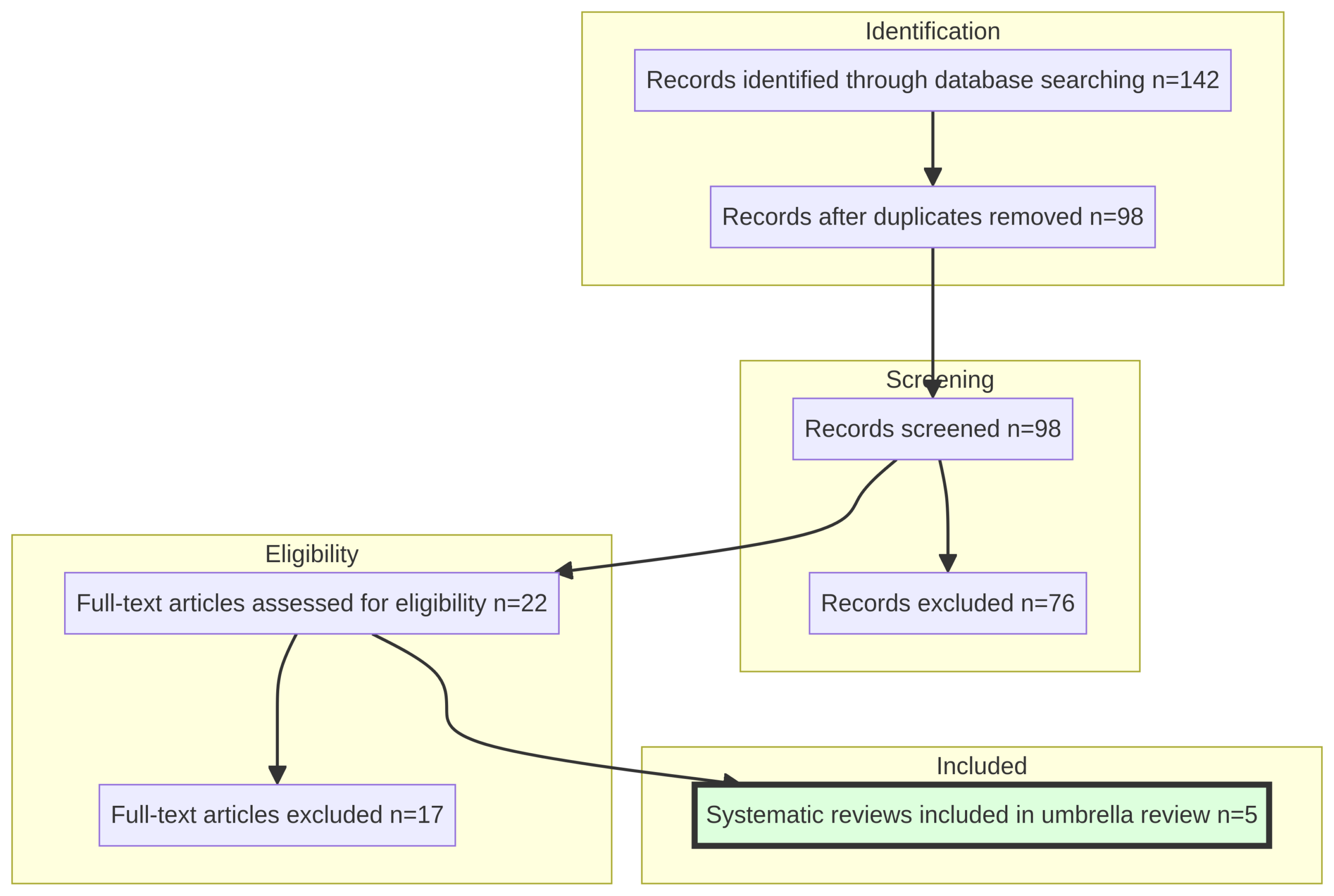
This study employed an umbrella review methodology, synthesizing data from systematic reviews, scoping reviews, and meta-analyses published between 2020 and 2026. The search strategy was conducted across major academic databases (e.g., Scopus, Web of Science, ERIC) using key terms such as “artificial intelligence,” “student assessment,” “systematic review,” and “meta-analysis” [4] [12] [27]. The inclusion criteria were restricted to secondary studies that explicitly focused on the application or impact of AI on student assessment in higher education [15] [24] [35].
A total of 40 highly relevant secondary studies and reports were selected for in-depth synthesis, covering topics from general AI applications in assessment [4] to the specific impact of ChatGPT and chatbots [1] [5] [21]. The synthesis process involved a thematic analysis of the included reviews’ findings, focusing on emerging assessment practices, their reported effectiveness, and associated challenges [13] [19] [20]. The methodology adheres to the principles of the PRISMA (Preferred Reporting Items for Systematic Reviews and Meta-Analyses) statement, ensuring transparency and rigor in the aggregation of evidence [6].
3. Results: A New Assessment Triad
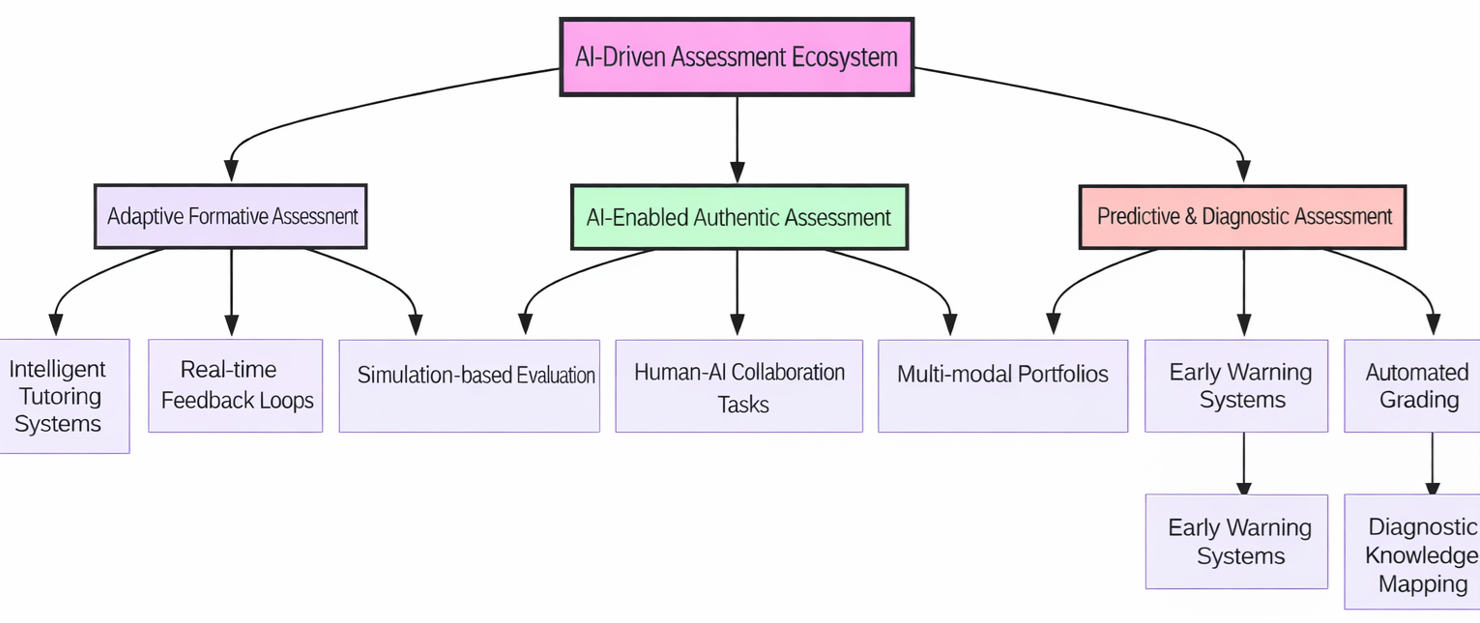
The synthesis of the included systematic reviews reveals a convergence on three primary, interconnected themes that define the future of student assessment in the AI age [2] [10] [31]. These themes represent a fundamental shift from traditional, summative evaluation to dynamic, process-oriented assessment [8] [39].
3.1. Adaptive and Formative Assessment
The most immediate and well-documented application of AI in assessment is its capacity to transform formative evaluation. Traditional assessment is characterized by delayed feedback and a one-size-fits-all approach, which limits its pedagogical utility. AI-enhanced systems, in contrast, offer unparalleled personalization and immediacy [4] [25] [40].
Intelligent Tutoring Systems (ITS) and AI-driven micro-assessments leverage machine learning algorithms to continuously monitor student performance, identify specific knowledge gaps, and provide real-time, personalized feedback [7] [18] [24]. This shift is critical, as it moves the focus from a final grade to the ongoing learning process [11] [16]. The scalability of these systems, which can provide instantaneous feedback to thousands of students, addresses a major limitation of faculty-led formative assessment [2] [22] [34].
Table 1: Comparison of Traditional vs. AI-Enhanced Assessment
|
Feature |
Traditional Assessment |
AI-Enhanced Assessment |
Pedagogical Shift |
|---|---|---|---|
|
Primary Goal |
Summative evaluation (Grading) |
Formative feedback (Learning support) |
From Product to Process |
|
Feedback Timing |
Delayed (Days/Weeks) |
Instantaneous (Real-time) |
From Correction to Intervention |
|
Personalization |
Uniform (One-size-fits-all) |
Adaptive (Individualized pathways) |
From Standardization to Customization |
|
Focus of Evaluation |
Knowledge recall and reproduction |
Higher-order thinking and application |
From Memory to Competency |
3.2. AI-Enabled Authentic Assessment
The rise of GenAI has made it imperative to assess skills that cannot be easily replicated by a machine. This has accelerated the adoption of authentic assessment, which requires students to apply knowledge and skills in real-world, contextualized scenarios [8] [37] [38]. AI is not merely a tool for grading these assessments but an integral part of their design and execution [39] [40].
- Simulation-Based Assessment: In fields like medicine and engineering, AI acts as a Virtual Operative Assistant (VOA) within simulated environments. The AI does not just grade the outcome; it provides metrics on the process—efficiency, decision-making, and adherence to protocols—during the simulation [4] [7] [30].
- Assessing Human-AI Collaboration: A key emerging idea is the assessment of “AI Fluency,” which is the student’s ability to effectively prompt, verify, and integrate AI-generated content into their work [2] [22] [35]. Assessment tasks are now being designed to explicitly require the use of AI, with the evaluation focusing on the student’s critical judgment and ethical use of the tool, rather than the final output alone [14] [31] [33].
- Multi-Modal Assessment: AI’s capability to process diverse data types (voice, video, code, text) enables the creation of multi-modal portfolios. This allows for a more holistic evaluation of competencies that transcend traditional written assignments, such as communication skills (analyzed via voice/video) or practical application (analyzed via code execution) [7] [18] [31].
3.3. Predictive and Diagnostic Assessment
Beyond direct student interaction, AI is transforming assessment at the institutional level through predictive analytics. By analyzing large datasets of student performance, engagement, and demographic information, AI models can function as Early Warning Systems [9] [22] [32]. These systems can accurately predict students at risk of failure or dropout, allowing faculty and support staff to intervene proactively rather than reactively [10] [26] [34]. Furthermore, AI-driven diagnostic testing can pinpoint the precise nature of a student’s difficulty, enabling highly targeted remedial instruction, which is far more efficient than broad, generalized support [10] [23] [36].
4. Discussion and Future Directions
The findings of this umbrella review underscore that the challenge posed by AI is fundamentally a pedagogical one, not a technological one [1] [19] [20]. The future of assessment is not about building better AI detectors, but about designing assessments that are AI-resistant by nature—assessments that value uniquely human skills [8] [14] [37].
4.1. The Evolving Role of the Educator
The shift to AI-enhanced assessment redefines the role of the educator from a primary grader to an Assessment Designer and mentor [5] [17] [30]. Faculty must be trained in AI pedagogy to design authentic tasks that leverage, rather than resist, AI tools [1] [26] [35]. This includes developing rubrics that explicitly reward critical thinking, synthesis, and the ethical application of AI, moving away from the time-consuming and often emotionally taxing task of manual grading [11] [20] [40].
4.2. Ethical and Integrity Challenges
While AI offers immense potential, it also introduces significant ethical challenges. The reliance on digital systems for feedback can sometimes elicit negative emotions in students, such as frustration or uncertainty, highlighting the need for human-centric design in AI interfaces [4] [11] [20]. Furthermore, issues of data privacy, algorithmic bias, and equitable access to advanced AI tools must be addressed to ensure that the new assessment landscape does not exacerbate existing educational inequalities [13] [14] [20].
4.3. Conclusion
The age of Artificial Intelligence marks the end of assessment as we have known it. The evidence synthesized in this umbrella review of 40 studies clearly indicates that the future lies in dynamic, personalized, and authentic evaluation methods [1] [2] [10]. Higher education institutions must embrace this transformation by investing in faculty training, adopting AI-enabled assessment infrastructure, and fundamentally redesigning curricula to assess the skills of human-AI collaboration [8] [29] [33]. By making this strategic shift, institutions like Al-Neelain University can ensure that their graduates are not merely knowledgeable, but possess the AI Fluency and critical competencies required to thrive in the 21st-century global workforce [9] [31] [34].
References
[1] Milakis, E. D., Argyrakou, C. C., Melidis, A., & Vrettaros, J. (2025). ChatGPT and AI Chatbots in Education: An Umbrella Review of Systematic Reviews, Scoping Reviews, and Meta-Analyses. International Journal of Education and Information Technologies.
[2] Wang, S. (2024). Artificial intelligence in education: A systematic literature review.Expert Systems with Applications.
[3] Ocaña-Fernández, Y., Valenzuela-Fernández, L. A., & Garro-Aburto, L. L. (2019). Artificial intelligence and its implications in higher education.Journal of Educational Research and Reviews.
[4] González-Calatayud, V., Prendes-Espinosa, P., & Roig-Vila, R. (2021). Artificial Intelligence for Student Assessment: A Systematic Review.Applied Sciences, 11(12), 5467.
[5] Zhang, J. (2025). Meta-Analysis of Artificial Intelligence in Education.ERIC.
[6] Moher, D., Liberati, A., Tetzlaff, J., & Altman, D. G. (2009). Preferred reporting items for systematic reviews and meta-analyses: the PRISMA statement.PLoS medicine, 6(7), e1000097.
[7] Feigerlova, E. (2025). A systematic review of the impact of artificial intelligence on health professions education.BMC Medical Education.
[8] UNESCO. (2025). What’s worth measuring? The future of assessment in the AI age.UNESCO Articles.
[9] Demandsage. (2026). 75 AI in Education Statistics 2026 (Global Trends & Facts).Demandsage.
[10] XIA, Q. (2025). Rethinking higher education teaching and assessment in-line with AI innovations: A systematic review and meta-analysis.African Journal of Educational Management, Teaching and Policy Research.
[11] Saplacan, G., Muntean, C. H., & Muntean, G. M. (2023). Digital feedback in higher education: A qualitative study on students’ emotional experiences.Computers & Education, 201, 104829.
[12] Matos, T. (2025). A systematic review of artificial intelligence applications in education: effectiveness, challenges, and implications.ScienceDirect.
[13] Garzón, J. (2025). Systematic Review of Artificial Intelligence in Education: Opportunities and Obstacles.MDPI.
[14] Ncube, P. D. N. (2026). Redefining student assessment in AI-infused learning environments: a systematic review of challenges and strategies for academic integrity.Springer.
[15] Zhao, J. (2024). Generative AI and Educational Assessments: A Systematic Review.University of Western Australia.
[16] Zhu, Y., Liu, Q., & Zhao, L. (2025). Exploring the impact of generative artificial intelligence on students’ learning outcomes: A meta-analysis.Education and Information Technologies.
[17] Alotaibi, N. (2026). Faculty Acceptance of Generative AI in Higher Education: A Meta-Analysis of TAM and UTAUT Studies (2021-2025).International Journal of Higher Education.
[18] Liu, B., Zhang, W., & Wang, F. (2026). Can Generative Artificial Intelligence Effectively Enhance Students’ Mathematics Learning Outcomes?—A Meta-Analysis of Empirical Studies from 2023 to 2025.Education Sciences.
[19] Emerald. (2025). A systematic review on the future of educational assessment: AI-driven grading and personalised feedback in higher education.Emerald Publishing.
[20] MDPI. (2026). Sustainable AI-Driven Assessment in Higher Education: A Systematic Review of Fairness, Transparency, Pedagogical Innovation, and Governance.Sustainability.
[21] Bouguettaya, S. (2025). A Meta-Survey of Generative AI in Education.MDPI.
[22] HEPI. (2025). Student Generative AI Survey 2025.Higher Education Policy Institute.
[23] Weng, X. (2024). Assessment and learning outcomes for generative AI in higher education: A scoping review.Australasian Journal of Educational Technology.
[24] Online Learning Consortium. (2024). Harnessing Generative AI (GenAI) for Automated Feedback: A Systematic Review.Online Learning Journal.
[25] MLS Journals. (2024). Formative Assessment and Artificial Intelligence: Strategies for Personalized Feedback.Pedagogy, Culture and Innovation.
[26] Campbell University. (2025). AI in Higher Education: A Meta Summary of Recent Surveys of Students and Faculty.Academic Technology.
[27] RSIS International. (2025). Unlocking Potential: Systematic Review of Generative AI in Higher Education.IJRISS.
[28] ResearchGate. (2025). Systematic Review of Artificial Intelligence in Education: Trends, Benefits, and Challenges.ResearchGate.
[29] Forbes. (2025). 7 AI Decisions That Will Define Higher Education In 2026.Forbes.
[30] Faculty Focus. (2026). Designing the 2026 Classroom: Emerging Learning Trends in an AI-Powered Education System.Faculty Focus.
[31] IntegraNXT. (2025). AI in Education: Top 5 Emerging Trends in 2026.IntegraNXT.
[32] Otus. (2026). Five Ways Schools Will Lead the Way for AI in 2026.Otus Resources.
[33] CoSN. (2025). Charting What’s Next: The 2026 Top Topics in K-12 Innovation.Consortium for School Networking.
[34] TSIA. (2026). State of Education Services 2026: From AI Efficiency to Transformation.Technology & Services Industry Association.
[35] LinkedIn. (2026). How to design with AI in 2026 based on 2025 studies.Dr. Philippa Hardman.
[36] Toddle. (2026). Future of Assessment Summit 2026.Toddle Events.
[37] MSU Denver. (2026). Authentic Assessment in the Age of Generative AI: Guidance for Faculty.MSU Denver.
[38] Echo360. (2025). Ultimate Guide to Authentic Assessment in an AI-Enabled World.Echo360.
[39] Macmillan Learning. (2025). Authentic Assessment in the Age of AI.Macmillan Learning.
[40] FeedbackFruits. (2024). Transforming authentic assessment with AI.FeedbackFruits Blog.
 Arabic
  English